
Trump Announces Israel, Hamas Agree to ‘First Phase’ of Gaza Ceasefire — A Diplomatic Turning Point?
What the newly agreed “first phase” entails, what it means for hostages and peace, and why skepticism still looms large

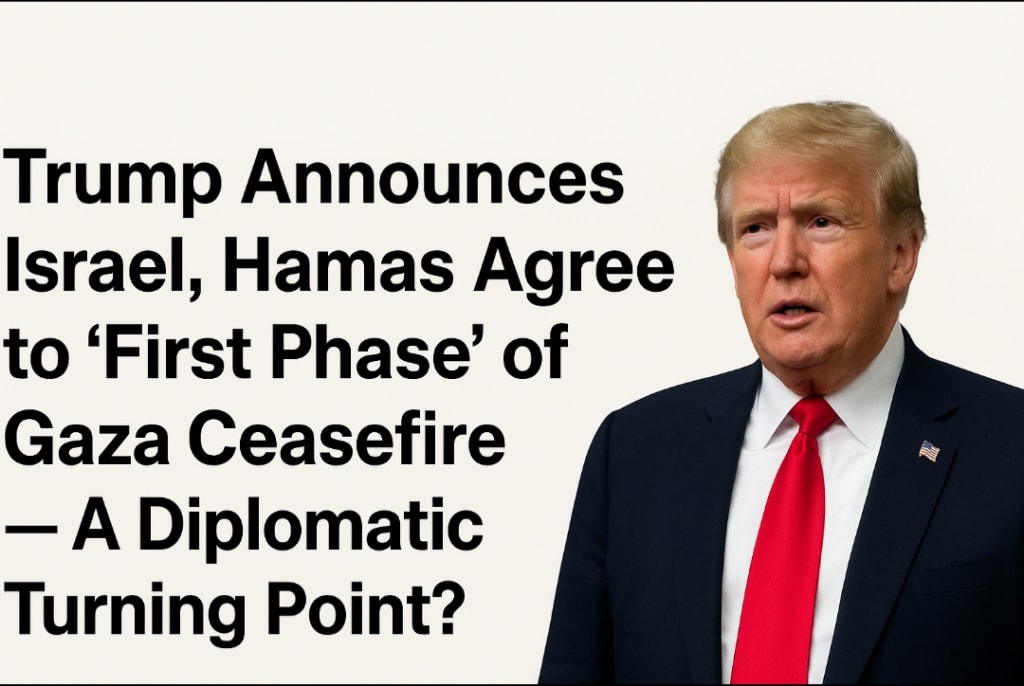
Trump’s Announcement and Global Reactions
On October 8, 2025, former U.S. President Donald Trump announced that Israel and Hamas had agreed to the “first phase” of a Gaza ceasefire. The declaration instantly drew international attention, being seen as both a diplomatic breakthrough and a risky political gamble. Global leaders, including UN Secretary-General António Guterres, cautiously welcomed the development, urging both sides to ensure the ceasefire holds. Israel’s Prime Minister Benjamin Netanyahu called it a “great day,” while Hamas leadership in Gaza confirmed their readiness to comply but insisted that international guarantors ensure Israel’s adherence.
Key Points of the “First Phase” Agreement
The first phase reportedly includes several major components designed to reduce immediate hostilities. These include the release of all hostages held by Hamas, a prisoner exchange involving Palestinians detained by Israel, and a partial withdrawal of Israeli forces from Gaza to an agreed-upon line. A 72-hour implementation window is expected to begin once the Israeli cabinet gives its formal approval. However, crucial details—such as how much territory Israel must withdraw from and who will administer Gaza afterward—remain unclear, making the deal both hopeful and uncertain.
Humanitarian and Political Significance
If implemented successfully, the ceasefire could mark a turning point for the people of Gaza, offering long-awaited relief from years of violence. The conflict has caused immense suffering, with thousands displaced and infrastructure devastated. The potential release of hostages has brought renewed hope to families on both sides. Politically, the deal could enhance Trump’s diplomatic profile and position the U.S. once again as a key peace broker in the Middle East. For Israel, it presents an opportunity to reduce international pressure and regroup strategically. For Hamas, it may strengthen political legitimacy among Palestinians, though not without internal opposition.
Challenges and Skepticism Surrounding the Agreement
Despite the optimism, skepticism remains high. The vague phrasing of “agreed-upon lines” for troop withdrawal has raised concerns about Israel’s real intentions. Similarly, questions about Hamas’s future role in Gaza governance remain unanswered. Will Hamas be allowed to maintain arms? Will the group relinquish control to a neutral or internationally supported authority? These uncertainties have fueled debates across diplomatic circles. Past ceasefires between Israel and Hamas have collapsed due to mistrust, delayed implementation, or external provocations—factors that could once again threaten this fragile truce.
Regional and International Reactions
Neighboring countries like Egypt, Qatar, and Turkey have been instrumental in facilitating the talks and are expected to play monitoring roles in the deal’s execution. European and Arab leaders have also expressed cautious optimism, noting that the agreement could serve as a foundation for longer-term peace. Meanwhile, humanitarian organizations are urging for immediate aid access and infrastructure rebuilding in Gaza. Global powers such as the United States and the United Kingdom have framed the ceasefire as an essential step toward de-escalation, though many stress that a permanent peace will require deeper political reforms and trust-building.
The Unanswered Questions Ahead
While the “first phase” creates a path toward temporary calm, several unanswered questions still loom large. How will the ceasefire be enforced? What guarantees exist to prevent renewed hostilities? Who will govern Gaza after troop withdrawals? These issues could determine the deal’s longevity. The political realities in both Israel and Gaza make the future unpredictable—hardliners on either side could resist the compromises needed to sustain peace. The true test will come once the hostages are released and the first Israeli troops withdraw—whether both sides continue to cooperate or revert to old patterns of conflict.
A Fragile Hope for a War-Weary Region
The announcement of a “first phase” ceasefire between Israel and Hamas offers a rare glimmer of hope in a conflict defined by decades of mistrust and bloodshed. For the people of Gaza and Israel alike, even a temporary halt in fighting means the chance to rebuild, reunite, and recover. Yet, as history shows, hope in the Middle East is often fragile. The coming days will decide whether this agreement becomes a genuine turning point toward peace or another brief pause before violence resumes. For now, the world watches closely, holding its breath as one of the most complex and painful conflicts in modern history takes another uncertain step toward resolution.
Sources:
AP News
Reuters
Al Jazeera
The Guardian
Time Magazine
About the Creator
Waqar Khan
Passionate storyteller sharing life, travel & culture. Building smiles, insights, and real connections—one story at a time. 🌍
Every read means the world—thanks for your support! 💬🖋️
Keep reading
More stories from Waqar Khan and writers in The Swamp and other communities.
Raise the Voice, Break the Siege: The Global Sumud Flotilla’s Call for Humanity
Origins and Leadership: Pakistan at the Helm The Global Sumud Flotilla found one of its most visible faces in Senator Mushtaq Ahmad Khan, a Pakistani politician and activist. Under his leadership, Pakistani activists joined hands with international allies to turn an idea into a mission — a mission rooted in the belief that humanity must respond when Gaza’s people are suffering. Pakistan’s civil society has long voiced solidarity with Palestinians, but the flotilla represents a tangible and historic step forward.
By Waqar Khan6 months ago in The Swamp
The Forsyth House Fire
Since 1851, Forsyth House has stood on the corner of Union Street and Gordon Street in the heart of Glasgow. Its iconic, or was... because on Sunday 8th of March, 2026, a fire broke out in a small, seemingly un-named shop in the building and tore all that history down. As I write, the rubble is still unsettled and the street is still blocked off. Central Station is quiet on the upper level, and around 30 small businesses have quite literally gone up in smoke.
By S. A. Crawford3 days ago in The Swamp
The First Rainbow Baby
Pitter-patter, pitter-patter. The rain fell in rhythmic splatters, slowly slowing, but still constant. Mira rolled onto her side pulling the blanket tight against her ears, but still she could hear chitter-chatter and scurrying feet of the creatures that refused to sleep in the lower decks.
By A. J. Schoenfeld3 days ago in Fiction


Comments
There are no comments for this story
Be the first to respond and start the conversation.