
Tragic America Still Speaks Today
Dreiser’s critique of capitalism echoes through today’s broken system

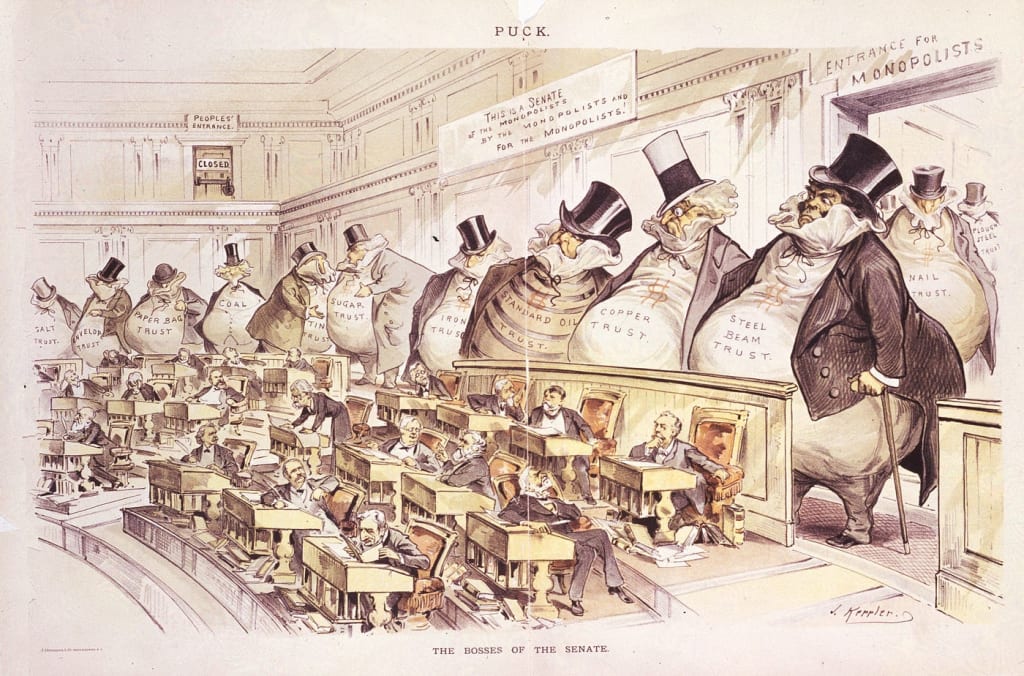
A few decades ago, Theodore Dreiser published Tragic America, a nonfiction work that dared to confront the ruthless powers of capitalism operating in the United States ~ and it was quickly suppressed. Written in 1931, as the Great Depression unfolded, the book offered a fearless examination of how banks, railroads, corporations, and government institutions allied to enrich a small elite while crushing ordinary people. Dreiser described a system where the rich controlled society so completely that the poor lost self‑respect and the right to decide their own lives.
Dreiser himself was a journalist turned novelist turned critic of capital power. By the time he wrote Tragic America, he had already authored major novels like An American Tragedy and Sister Carrie, novels that explore how ambition, poverty, and the social system distort lives. But in Tragic America, he abandoned story form to deliver direct, sharp essays on topics such as “Our Banks and Corporations as Government,” “Exploitation ~ Rule by Force,” “The Position of Labor,” and “Abuse to the Individual.”
The book was almost immediately banned. Libraries and bookstores refused to carry it. In some places, copies were burned. Boston’s censorship groups wielded enough power that Dreiser’s message was erased from public life. Its suppression echoed the earlier fates of his novels, which critics labeled obscene or immoral. Still, he stood firm, believing that literature must expose truth, no matter how uncomfortable.
Dreiser’s style in Tragic America is rooted in naturalism and journalism. He favored factual observation, blunt tone, and long logical argument over lyrical prose. He believed that society and economic forces largely shaped individual lives, leaving little room for free choice. In his view, the poor and working class were victims of circumstances rather than moral failure.
Nearly 95 years later, the big themes in Tragic America remain strikingly current. Wealth inequality has soared, with a tiny minority controlling most of the capital. Labor rights are under threat, wages stagnate, and corporate influence over politics is pervasive. Dreiser’s description of banks and corporations acting as government rings eerily true in today’s world of lobbying and financial dominance.
He also held a strong belief in solidarity and change. Dreiser joined the League of American Writers and even embraced socialist ideas later in life, arguing that working people needed collective power against elite control. Tragic America called for government ownership of essential services, fairer distribution of wealth, and protections for labor and democracy. It attacked how courts and Constitutions were twisted to serve business elites and ignore ordinary people’s rights.
Sub‑themes: first, Dreiser highlighted how industry and railroads profited from inertia and apathy, winning enormous profits at public expense. Second, he condemned how the Supreme Court often acted as a corporate service station, upholding business interests over public good. He also explored how mass surveillance, growing police power, and political suppression targeted workers and dissidents ~ all themes we recognize in modern debates about civil liberties, corporate personhood, and state power.
Readers today find it striking how Dreiser’s language ~ though harsh and unpolished ~ delivers emotional force. Critics of his fiction often complained about his clumsy sentences and heavy style. Yet scholars now acknowledge that this blunt style suited his social critique: his observations of factories, stock exchanges, hotels, and working‑class life were painstakingly detailed and sharply real.
What lessons does Tragic America offer in 2025? It warns that unchecked capitalism fosters inequality, commodifies human life, and undermines democratic freedom. It reminds us that economic crises disproportionately hurt the many while the few profit. And it challenges readers to question narratives that equate wealth with worth and silence dissent.
Though long banned, the book has recently reappeared in academic circles and digital archives. Scholars rediscover its importance as a rare work of political nonfiction by a significant American novelist. It stands as both a historical document of the Great Depression and a prophetic voice on the failures of modern capitalism.
About the Creator
majid ali
I am very hard working give me support
Parallel Protests
I haven't written for quite some time, but I have A LOT of thoughts about yesterday's protest rally against our government's involvement and complicity in America's war on Iran, on the harbourside of my home city Bristol, and I need to put them somewhere. My gorgeous girlfriend is always a loving and listening ear and sharing it all with her will always be a healthy and happy way of processing the mental and emotional weight, but getting it straight in my brain to share means writing it all down in straight lines, so, here we are and thanks for being here.
By Steph Cole7 days ago in The Swamp
Shots Fired at U.S. Consulate in Toronto, Police Say
Early Tuesday morning, authorities in Canada launched an investigation after gunfire was reported at the United States Consulate in downtown Toronto. The incident, which occurred before sunrise, has drawn international attention and prompted heightened security around diplomatic buildings across the country. Fortunately, no injuries were reported, but officials say the event is being treated as a serious national security matter.
By Jameel Jamaliabout 10 hours ago in The Swamp


Comments
There are no comments for this story
Be the first to respond and start the conversation.