
Top Democrat Defends State of the Union Protests as House Speaker Says He Nearly Ejected Omar and Tlaib
Debate over decorum and dissent highlights divisions in Congress during annual address

Introduction
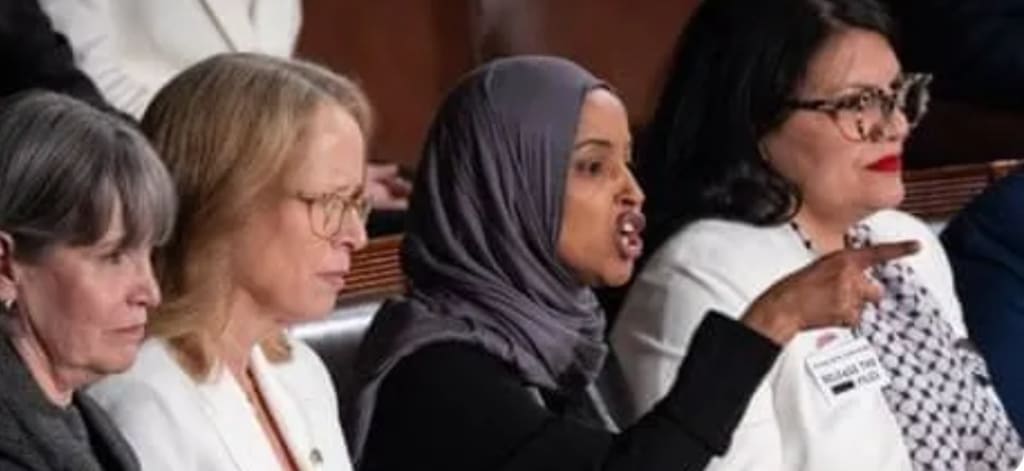
Tensions on the House floor during the recent State of the Union address have sparked a debate over protest, decorum, and the limits of dissent in Congress. A senior Democrat defended the actions of two progressive lawmakers who displayed signs and voiced objections during the speech, while the House speaker said he came close to ejecting them. The exchange has renewed discussion about how members of Congress should conduct themselves during one of the most visible events in American politics.
The controversy centers on Representatives Ilhan Omar and Rashida Tlaib, both Democrats known for their outspoken positions. During the address, they signaled their disagreement with parts of the president’s remarks. According to the speaker, their conduct pushed the boundaries of House rules.
A Night of Visible Dissent
The State of the Union address is a constitutionally required report from the president to Congress. Over time, it has evolved into a high-profile televised event attended by lawmakers, justices, military leaders, and invited guests. While applause and visible reactions are common, formal disruptions are rare.
This year’s address followed months of partisan conflict over budget negotiations, foreign policy, and domestic legislation. As the president delivered remarks on immigration, healthcare, and national security, several Democratic members remained seated or held up signs to signal disagreement. Omar and Tlaib were among those who made their positions clear.
Their gestures drew attention both inside the chamber and across social media platforms. Some viewers praised the protest as a form of peaceful expression. Others criticized it as disrespectful during a formal proceeding.
Speaker’s Warning
The House speaker, a Republican, later said he considered ordering the sergeant-at-arms to remove the lawmakers. He argued that House rules require members to maintain decorum during official addresses. According to his account, the conduct of Omar and Tlaib came close to violating those standards.
The speaker did not ultimately take action, but his comments underscored the tension in the chamber. He maintained that protests should not interrupt the constitutional duty of the president to report to Congress. In interviews following the event, he emphasized the importance of preserving what he described as institutional norms.
Critics of the speaker’s stance pointed out that visible dissent, including silent gestures or signs, has occurred during previous addresses without leading to removal. They argued that enforcement of decorum often reflects political context.
Democratic Defense
A senior Democrat quickly defended Omar and Tlaib. He said members of Congress have a right to express disagreement, particularly when policies discussed in the speech affect their constituents directly. He framed the protest as peaceful and consistent with democratic values.
The Democrat emphasized that dissent is part of the legislative process. He noted that the Constitution protects speech and that elected officials should not be penalized for nonviolent expression of opposition. According to him, the actions of the two representatives did not disrupt the speech in a way that prevented the president from delivering his remarks.
Supporters echoed that position, arguing that the protest reflected concerns over issues such as immigration enforcement and foreign policy decisions. They said the signs and gestures were a way to draw attention to policy disputes that might otherwise receive limited coverage during a nationally televised address.
Broader Debate on Decorum
The incident has prompted renewed examination of decorum in Congress. Formal rules govern behavior on the House floor, but enforcement often depends on the presiding officer’s judgment. Historically, moments of tension during presidential addresses have included shouted comments, walkouts, and silent displays of protest.
In past years, members from both parties have broken with tradition. During one address, a Republican lawmaker shouted “You lie” at a Democratic president, drawing widespread criticism. In other instances, lawmakers have boycotted the event entirely. These precedents complicate the current debate, as both parties have at times challenged the boundaries of acceptable conduct.
Observers note that the political climate has grown more polarized, making displays of disagreement more visible and more likely to spark controversy. What once might have been viewed as minor gestures can now dominate news cycles and social media discussions.
The Role of Omar and Tlaib
Omar and Tlaib have frequently been at the center of national debates. As members of a progressive wing of the Democratic Party, they have advocated for changes in immigration policy, expanded social programs, and a reassessment of US foreign policy in the Middle East.
Their critics argue that public protest during the State of the Union undermines unity at a moment meant to showcase national priorities. Supporters counter that unity should not require silence on issues they see as urgent.
Both lawmakers have defended their actions, stating that they were representing the concerns of their districts. They said their protest was measured and did not involve shouting or preventing others from participating.
Political Calculations
The exchange between the speaker and the top Democrat also reflects broader political strategy. For Republicans, emphasizing decorum can reinforce arguments about institutional respect and order. For Democrats, defending protest can align with calls for accountability and grassroots activism.
Analysts suggest that both sides understand the symbolic power of the State of the Union. Televised images from the chamber can shape public perception. Even brief moments of dissent can become focal points in the larger narrative of partisan division.
At the same time, lawmakers must balance messaging with the risk of backlash. Voters may respond differently depending on their views of the president and of congressional norms.
Public Reaction
Public opinion appears divided. Some voters view the protest as a legitimate form of speech in a democracy. Others believe the event should remain free from visible dissent out of respect for the office of the presidency.
Social media platforms amplified the debate. Clips and photographs circulated widely, with commentary reflecting partisan divides. Advocacy groups weighed in, praising or condemning the lawmakers’ actions.
Polls taken after similar incidents in previous years suggest that reactions often align closely with party affiliation. This pattern indicates that perceptions of decorum may be shaped as much by political identity as by consistent standards.
Constitutional and Historical Context
The Constitution requires the president to provide information to Congress on the state of the union, but it does not dictate the format. The modern televised address developed in the 20th century. Over time, it has become a stage for both policy announcements and political theater.
Legal scholars note that members of Congress retain broad protections for speech under the Speech or Debate Clause. While chamber rules can limit conduct during proceedings, removing a member is an uncommon step. Historically, enforcement has focused on preventing direct interruptions rather than silent gestures.
This context complicates calls for strict penalties. Any decision to eject a member could set a precedent affecting future sessions.
Looking Ahead
It remains unclear whether the House will revisit its rules in response to the incident. The speaker has not announced formal disciplinary action. The top Democrat indicated that he hopes the focus will return to policy debates rather than procedural disputes.
Future State of the Union addresses may continue to feature visible signs of disagreement. As polarization persists, lawmakers may feel pressure from their constituents to demonstrate opposition publicly.
The balance between decorum and dissent is likely to remain contested. While traditions emphasize respect for the office, democratic systems also rely on open expression of disagreement.
Conclusion
The dispute over the protests by Ilhan Omar and Rashida Tlaib during the State of the Union address reflects deeper divisions in American politics. A House speaker’s warning and a top Democrat’s defense highlight competing views on how lawmakers should conduct themselves in moments of national attention.
As Congress continues to navigate partisan conflict, episodes like this serve as reminders that the boundaries of acceptable protest are not fixed. They evolve alongside political culture and public expectations. Whether future addresses will see similar displays remains uncertain, but the debate over decorum and dissent is unlikely to fade soon.
About the Creator
Saad
I’m Saad. I’m a passionate writer who loves exploring trending news topics, sharing insights, and keeping readers updated on what’s happening around the world.
Why Black History Matters in America?
The United States of America is celebrating their 250th anniversary in 2026. I'm proud to be an American and as someone who was born here, I wouldn't imagine myself living anywhere else. This is a country where opportunities are possible. Where anyone can be successful in anything they desire to do. Equality, community, and togetherness are the backbones of what America is and should be about. However, we have an administration who wants to erase and disregard those who have made positive, meaningful impacts in our country, specifically Black figures, such as Martin Luther King, Jr., Rosa Parks, and Maya Angelou. President Trump and his administration have been constantly complaining and fighting against what they call the "Woke agenda". They use this excuse as a distraction from other issues they refuse to address, such as the high cost of living, climate change, and inflation. That equality is dividing America, when in reality, it's bringing us together. Being woke is not tied to a specific political party. No matter where you stand on the political spectrum, you can still care about other people and their plights. Compassion and empathy for others isn't tied to a political party, either. We were taught as children to treat others the way we want to be treated and not judge others because they're different from us. Caring about others isn't a personal attack on your beliefs. It doesn't make you any less of a person. People who are easily offended over African American figures, past or present, or anything related to it, are grasping at straws. Current and future generations need to know who people like Harriet Tubman and Shirley Chisholm were, especially in the classroom. Black History is part of American History. It should be recognized, not hidden or forgotten. Besides, you can't shield children from everything, just because your feelings are easily hurt.
By Mark Wesley Pritchard 26 days ago in The Swamp
Ukraine War Briefing: Kyiv to Accelerate Placement of Anti-Drone Nets Across Frontline
Ukrainian authorities have announced plans to rapidly expand the installation of anti-drone protective nets along key sections of the front line, as Russian aerial attacks intensify and low-cost drones continue to inflict casualties and disrupt military logistics. The move reflects Kyiv’s growing emphasis on defensive innovation as the war enters another grueling phase marked by attrition and technological adaptation. Officials in Kyiv said the nets — often made of reinforced steel mesh or industrial cables — will be deployed over trenches, vehicle routes, ammunition depots, and medical evacuation corridors. The aim is to intercept or detonate incoming drones before they strike troops or equipment. President Volodymyr Zelenskyy praised frontline units and civilian volunteers who have pioneered the use of such barriers, calling the initiative “a practical and life-saving response to a changing battlefield.” He added that expanding the program is now a national priority as Ukraine confronts daily drone assaults from Russia. Rising Drone Threat Over the past year, drones have become one of the most lethal tools of modern warfare in Ukraine. Cheap, commercially modified quadcopters and long-range explosive drones have been used to target infantry positions, armored vehicles, and even civilian infrastructure. Military analysts say that Russia has dramatically increased its production and deployment of so-called “kamikaze” drones, forcing Ukraine to adapt quickly. While air defense systems remain critical against missiles and aircraft, they are often too costly or scarce to counter every small drone. Anti-drone nets offer a low-tech but effective alternative. By physically blocking drones from reaching their targets, the nets reduce the impact of explosive payloads and prevent surveillance drones from identifying troop positions. A Ukrainian engineer involved in the project said the design was inspired by fishing nets and industrial safety barriers. “We needed something simple, fast to install, and cheap enough to cover kilometers of front line,” he explained. Frontline Implementation The initial rollout has focused on eastern and southern sectors where fighting is most intense. Soldiers have already begun installing net corridors over supply routes and trench systems, sometimes using cranes and trucks to suspend them several meters above ground. Commanders report early success. In several cases, drones became entangled in the mesh and exploded harmlessly above defensive positions. “It doesn’t solve everything, but it gives our troops an extra layer of protection,” said one field officer. Ukraine’s defense ministry confirmed that funding has been allocated to accelerate production and deployment. Civilian factories and metal workshops are being contracted to manufacture standardized net systems, while volunteers continue to help transport and install them near the front. Psychological and Tactical Impact Beyond physical protection, the nets are said to have a psychological benefit. Soldiers operating under constant drone threat often experience stress and fatigue. Knowing that some form of barrier exists overhead has reportedly improved morale in certain units. Military experts caution, however, that the measure is not foolproof. Drones can be programmed to fly higher or attack from different angles, and heavy artillery can destroy net structures. Still, analysts describe the strategy as part of a broader trend toward improvised battlefield defenses. “This war has shown that innovation doesn’t always mean high technology,” said a European defense analyst. “Sometimes simple engineering solutions can shift the balance, at least locally.” Broader Strategic Context The decision to expand anti-drone nets comes as Ukraine continues to face shortages of ammunition and air defense interceptors. Western military aid has resumed but remains uneven, prompting Kyiv to emphasize cost-effective defensive tools. Meanwhile, Russia has continued its drone and missile campaign against Ukrainian cities and infrastructure. Energy facilities, rail networks, and residential areas have all been targeted in recent weeks, underscoring the urgency of defensive adaptations. Zelenskyy’s office said discussions are underway with international partners to share lessons learned from the net deployment program. Some NATO officials have reportedly expressed interest in studying the system for potential use in future conflicts. Looking Ahead As the war grinds on, Ukraine’s approach highlights a shift toward layered defense: combining traditional air defense systems with physical barriers, electronic warfare, and rapid battlefield engineering. The expansion of anti-drone nets may not change the overall strategic picture, but it reflects Kyiv’s determination to protect its forces with whatever tools are available. For Ukrainian soldiers on the front line, the nets represent more than metal and cables. They are a symbol of adaptation in a conflict where survival increasingly depends on creativity as much as firepower.
By Fiaz Ahmed 2 days ago in The Swamp


Comments
There are no comments for this story
Be the first to respond and start the conversation.