
To Belong or Not to Belong
Where is a refugee's home under Covid19?

A couple of weeks into this pandemic and I have found myself contemplating the conditions of temporary existence. Not because social distancing is giving me an existential crisis (which I might be), but because as a "stateless" young woman I know better than to assume everyone is safe. While refugees, worldwide, are already vulnerable individuals, what happens when the conditions of citizenship are put to the test? Generally, in a fight against an international pandemic, countries assume the motto every man for themselves (excuse the sexist phrase). This covers everyone under the security of citizenship or even a temporary status like a study via- not to say that they are fully secure either; but what happens to those stuck in between?
Let me start with this: I am one of the lucky ones. My name is Waad Hassan and I am a third-generation Palestinian refugee. I am a refugee in Lebanon which deprives me of various human rights such as the right to own property or pursue around 70+ jobs. But let's not linger on the sad part. In a way, I am an international citizen, I was born in Dubai, grew up in Lebanon, received my undergraduate degree in the USA, and I am currently pursuing my Master's in Canada. Right now, I am living in the safety of my apartment in a university residence. I spend my days studying online, reading, cooking, and pondering how long does it take for boredom to cause someone to spontaneously-combust. But, again, I am one of the lucky ones.
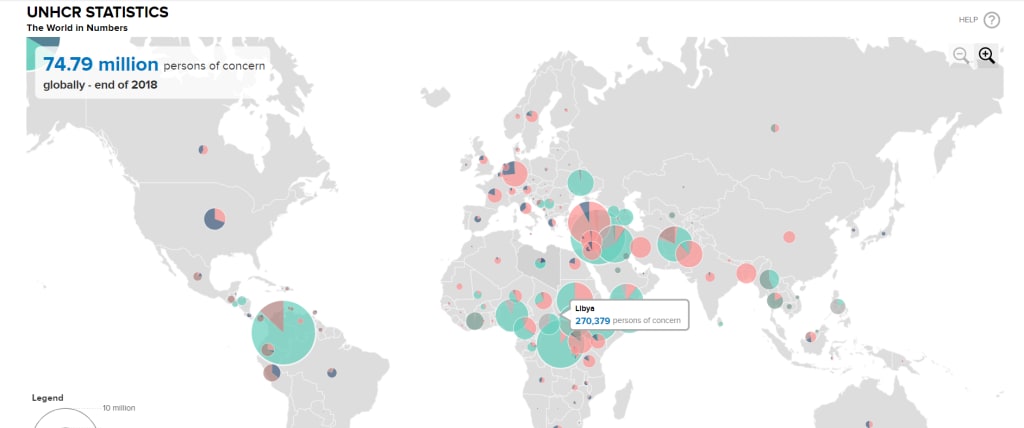
According to the UNHCR, there are around 70.8 million displaced people in the world of which 25.9 million are refugees and 3.5 million are asylum-seekers. First, let me explain, while all refugees are struggling, some of them have managed to be refugees of countries that grant them rights like Canada. I only say this to avoid a bleak image in the middle of this bleak pandemic. Other refugees, if not the majority, are continuously struggling to attain human rights: where do they live? which country is responsible for them? how will they seek medical attention? I am not sure how to answer that. Second, there are asylum seekers. One of the first reactions to a pandemic is closing the borders. And yes! I know that is a necessary move, but all consequences must be measurable. What happens to those stuck between a country they are escaping and one that will not have them? What happens to those stranded at the borders with no protection what-so-ever?
I do not have answers, but I believe asking questions is an important step. I want to make sure you know that I acknowledge my privilege: I get to sit behind a laptop screen in a comfortable apartment and write this piece. Though I have had my fair struggles as a refugee with no citizenship, I have the current security of my student visa in Canada.
Now ask yourself this, have you asked any questions from whatever place of privilege you are in?
About the Creator
Keep reading
More stories from writers in The Swamp and other communities.
There’s an Internet Blackout in Iran. How Are Videos and Images Getting Out
When mass protests erupted across Iran, the government responded with a familiar tactic: cut the internet. Mobile data slowed to a crawl, international connections dropped, and social media platforms went dark. For millions inside the country, the blackout meant isolation — no messaging apps, no news, no way to tell the outside world what was happening. And yet, despite these sweeping restrictions, videos and images of protests, arrests, and street violence continue to surface online. Clips circulate on X, Instagram, and international news broadcasts, raising a pressing question: How is information escaping one of the most tightly controlled internet shutdowns in the world? Why Iran Turns Off the Internet Iran has repeatedly used internet shutdowns as a tool of control during periods of unrest. By restricting access, authorities aim to: Disrupt protest coordination Prevent footage from reaching global media Limit international scrutiny Control domestic narratives During previous protests in 2019 and 2022, near-total shutdowns coincided with some of the deadliest crackdowns. Human rights organizations argue that internet blackouts create conditions where abuses can happen unseen. In the current wave of protests, the blackout has been broader and more sustained than before — affecting not just social media but core mobile and broadband infrastructure. If the Internet Is Down, How Is Content Escaping? Despite the blackout, Iran is not completely sealed off. Information leaks through a combination of technology, ingenuity, and risk-taking. The most important factor? Satellite internet. Starlink: A Signal From Space Starlink, the satellite internet service operated by SpaceX, has become the most powerful tool for bypassing Iran’s blackout. Unlike traditional internet, which relies on cables and telecom towers controlled by the state, Starlink connects directly to satellites orbiting Earth. As long as a user has a receiver terminal and a clear view of the sky, they can access the global internet — even when national networks are shut down. Over the past few years, thousands of Starlink terminals have reportedly been smuggled into Iran, often at great personal risk. These devices are illegal under Iranian law, but activists say they are now essential for keeping the country digitally connected. Once connected, users can upload videos, send images, and communicate with journalists and human rights groups abroad — often in near real time. The Risks of Staying Connected Using satellite internet in Iran is extremely dangerous. Authorities have declared Starlink equipment illegal and have reportedly conducted raids to seize terminals. Possession can lead to arrest, interrogation, or worse. In some areas, users hide terminals on rooftops, power them briefly, upload content, then disconnect to avoid detection. The government has also attempted to jam satellite signals, disrupting connections in certain regions. While jamming can weaken service, it hasn’t fully eliminated access — turning the situation into a technological cat-and-mouse game. Every video that makes it out is a calculated risk. Old-School Methods Still Matter Satellite internet isn’t the only way information escapes Iran. Some protesters rely on slower, more traditional methods: Saving videos on memory cards or USB drives Physically transporting data across borders Sending footage through trusted intermediaries Uploading content during brief moments of restored connectivity These methods are far less efficient than satellite internet, but they still play a role — especially in areas where Starlink access is limited or heavily jammed. Why These Images Matter The footage coming out of Iran isn’t just viral content — it’s evidence. With foreign journalists largely barred from operating freely inside the country, citizen-recorded videos are often the only window into events on the ground. Human rights organizations rely on this material to document abuses, verify deaths, and pressure governments to respond. Without these images, the international community would be forced to rely almost entirely on official statements — a scenario that overwhelmingly benefits those in power. Experts warn that internet shutdowns often correlate with spikes in violence, precisely because visibility disappears. The continued flow of images disrupts that strategy. The Digital Battlefield What’s unfolding in Iran is part of a global trend. Governments around the world increasingly view the internet as a battlefield — a space to be controlled during unrest. Protesters, in turn, adapt with new tools, from encrypted messaging to satellite connectivity. Iran’s blackout shows both sides of this struggle: A state attempting to enforce digital silence Citizens using technology to break it This dynamic raises difficult questions about sovereignty, technology companies, and the future of information control. Can Iran Fully Seal the Blackout? So far, the answer appears to be no. While the government can dramatically reduce connectivity, total isolation is increasingly difficult in a world of satellites, portable tech, and global networks. Every advancement in censorship is met with an adaptation in resistance. Still, access remains uneven. Many Iranians are completely offline, unable to communicate with loved ones or access basic information. The videos reaching the world represent only a fraction of what’s happening inside the country. What Comes Next As protests continue and international pressure grows, the digital struggle will remain central to Iran’s crisis. The government will likely intensify efforts to block satellite access, while activists look for new ways to stay connected. What’s clear is this: the blackout has not achieved total silence. Each image uploaded, each video shared, and each message sent is a reminder that even the most aggressive internet shutdown cannot fully suppress human voices. Final Thoughts Iran’s internet blackout is not just a technical issue — it’s a human one. It reveals how deeply communication is tied to freedom, accountability, and power in the modern world. In an era where truth travels through pixels and signals, the battle over connectivity may be just as important as the protests themselves. And for now, despite the darkness, the signal is still getting through.
By Muhammad Hassanabout 17 hours ago in The Swamp




Comments
There are no comments for this story
Be the first to respond and start the conversation.