
The Ultimate Manifesto of Absurd Revolution
Abigail Goldwater


Part I: The Stage is Set, the Play is Mad
Act I: The Absurdity Overture
Reality, as we've been sold it, is a limited-run stage production directed by a committee of gibbering baboons. The set design is... ambitious. Picture this: gated communities sprouting like gleaming, chrome-plated fungi next to favelas cobbled together from desperation and discarded dreams. A smiling cartoon dog, perpetually sipping coffee, while the ozone layer develops a comb-over and the polar bears start taking bets on which of us goes extinct first.
This, my friends, is late capitalism.
The self, in this glorious mess, isn't some solid, reliable unit. It's a goddamn collage. A frantic scrapbook of Instagram filters, hastily-scribbled affirmations from pop psychology books, and that weird collection of porcelain dolls your great-aunt Mildred left you. We gaze at our reflections in the funhouse mirror of existence, and what do we do? We laugh. Because, frankly, the alternative is weeping into a pint of lukewarm ale, and nobody has the time for that.
We find ourselves at a particularly sticky crossroads. To our left, the signpost reads "Absurdism," helpfully decorated with existential dread emojis. To our right, a slightly more graffitied sign proclaims "Rebellion," scrawled in what appears to be a mixture of glitter and the blood of a thousand smashed illusions. Our tour guides? A motley crew. Nietzsche, with his pronouncements about supermen and the death of God (and probably a very impressive mustache wax routine). Monty Python, with their impeccable timing and a knack for making the utterly ridiculous seem strangely profound. Kierkegaard, muttering about the dizziness of freedom and the unbearable lightness of being (misunderstood). And a generous sprinkling of cosmic memes, because, let's face it, the universe has a sense of humor. A dark, twisted, slightly malevolent sense of humor, but humor nonetheless.
Act II: The Neoliberal Nightmare
The root of our current predicament, the festering, oozing wound in the underbelly of civilization, is neoliberalism. That market-driven beast, spawned in the 1980s, a hellhound unleashed by Thatcher and Reagan, and subsequently house-trained (sort of) by Blair and Clinton. It has turned democracy into a performance art piece, a sort of "Whose Democracy Is It Anyway?" where the answer, invariably, is "Not yours."
Neoliberalism, by its very design, is a demolition crew. It dismantles the welfare state, the safety net that was supposed to catch us when we fell. It weakens unions, the only collective voice the working class has in this cacophony of capitalist screeching. It empowers billionaires and media moguls, those shadowy figures who pull the strings from behind velvet curtains, their faces illuminated only by the glow of their offshore bank statements.
Thatcher and Reagan, with their bouffant hair and their promises of trickle-down economics (which, it turns out, was less a trickle and more of a drought), told us the world was flat. Blair and Clinton, those smooth-talking centrists, rewrote the rules of the game to serve the market, that insatiable god to whom we are all expected to sacrifice our weekends, our sanity, and our dwindling savings.
Tony Blair, with his carefully calibrated soundbites, announced a "dynamic economy" built on the "enterprise of the market." He declared, with a straight face, that there would be "no favours from a Labour government" for unions, the very institutions that his party was founded to protect. He sold us out, the bastard.
These Third Way politicians, these chameleons of the political landscape, were our greatest betrayers. They paraded neoliberalism as a compromise, a sensible middle ground. But it was a capitulation, a surrender on the battlefield of social justice. It left millions working longer hours for less pay, their dreams shrinking with every paycheck, while the rich got richer, their yachts growing ever larger, their champagne flutes overflowing with the tears of the dispossessed.
And the truly galling thing? We hear the same promises echoed today, from a new generation of demagogues. They offer us scapegoats instead of solutions. They point our anger at immigrants, those desperate souls seeking refuge from the very systems that neoliberalism created. They demonise trans youth, those brave individuals who dare to live authentically in a world that seems determined to erase them. They rail against the "woke left," that nebulous bogeyman conjured up to distract us from the real architects of our misery.
As one analyst astutely observed, it's "the same old story... with whatever scapegoat-du-jour suits their immediate political needs: immigrants, 'Communists,' trans kids, or simply the 'woke left.'" The faces change, the targets shift, but the tune remains the same. Divide and conquer. Distract and rule.
Conspiracy theorists and culture warriors, those merchants of manufactured outrage, fan the flames of racism and resentment. They peddle their toxic wares on YouTube and Twitter, their voices amplified by algorithms designed to reward the most inflammatory content. Meanwhile, the oligarchs and media elites, those puppet masters of our collective delusion, hide behind their golden curtains, their actions unexamined, their motives unquestioned.
Act III: The "This is Fine" Dog and the Absurdity of It All

In the pubs of London, in the online forums where the disaffected gather to share their despair and their dark humour, one image reigns supreme: the bonkers "This Is Fine" dog. The cartoon canine, sitting calmly in a burning room, wearing a jaunty hat, sipping his coffee, and insisting, with a manic grin, "This is fine."
As NPR, in a moment of surprising cultural insight, explained, thanks to the ubiquity of this meme, the phrase has come to mean "things are very much not fine at all." It's the digital-age equivalent of whistling past the graveyard, a coping mechanism for a world that seems to be perpetually on the verge of collapse.
We sip our tea, our Earl Grey, our builder's brew, as the walls crumble around us. We parrot that complacent lie, that mantra of denial. This oblivious grin, this quintessentially British stoicism laced with a heavy dose of internet irony, masks our desperation. It's the stiff upper lip of the apocalypse.
But here's the thing about absurdity: it's not the end. It's the beginning.
The existentialists, those gloomy but ultimately rather insightful philosophers, taught us that life's lack of cosmic purpose does not force us to despair. Rather, it frees us to create our own significance. To build meaning in a meaningless world.
Camus, the patron saint of the absurd, declared that "the absurd is born of this confrontation between the human need and the unreasonable silence of the world." He understood that this conflict, this tension between our desire for order and the universe's indifference, is the engine of our existence. "The whole consequence of a life can depend on it," he warned.
In Camus's dramas, the characters of irrationality, nostalgia, and absurdity lock horns with logic, with reason, with the cold, hard facts of reality. And yet, we cling to revolt. We imagine Sisyphus, that poor bastard condemned to eternally roll a boulder uphill, happy. Laughing, even, as he pushes his burden, because he, and he alone, owns his rebellion.
In that spirit, in the spirit of Sisyphus, in the spirit of the "This Is Fine" dog, we proclaim: even in a meaningless world, defiance is a kind of meaning. To rage against the dying of the light, to scream into the void, to dance on the precipice of oblivion – these are not acts of futility. They are acts of creation.
Nietzsche, that wild-eyed prophet of self-overcoming, tells us to "become who we are," to chisel ourselves into existence from the raw stone of our psyches. He didn't expect us to worship idly at the altar of tradition or conformity. He expected us to create. Though he is often (and wrongly) branded a nihilist, Nietzsche wished to fill the void left by fading gods, guiding us "toward psychological health, personal excellence and virtue."
His ideal, the Übermensch, the Overman, is the one who stands beyond the herd, the one who laughs in the face of the abyss, who dances on its lip, who embraces the chaos and forges his own path. Consciously or not, modern memes, those bite-sized nuggets of cultural commentary, capture this spirit. Bruce Almighty, on his knees, praying for beauty, only to have his prayers hilariously, tragically, ignored. Groucho Marx, with his painted-on mustache and his surreal pronouncements, whispering to us from beyond the grave, "Life is absurd, break the absurdity." We yearn for that freedom, that audacity, that sheer, unadulterated will to meaning.
Meanwhile, Freud and Lacan, those titans of the unconscious, remind us that the Self is a trickster, a shape-shifter, a master of disguise. We are not one coherent puppet, dancing to the tune of reason and logic. We are the puppet-master's divided empire, a collection of conflicting desires, hidden agendas, and repressed memories.
Lacan, in his typically cryptic but ultimately rather profound way, proclaimed that "the unconscious is structured like a language." Meaning that our sense of identity, that fragile construct we cling to so fiercely, is woven from symbols and stories, from half-remembered dreams and whispered anxieties. The "I" we cherish, the "I" we present to the world, is born in a Narcissus mirror, forever trapped in its own reflection. It's always an image, a performance, a construction.
Freud, with his cigars and his couch, showed us that our desires, those unruly beasts that lurk in the shadows of our minds, slip into jokes and dreams, into Freudian slips and the hidden meanings of everyday life. Jung, with his archetypes and his collective unconscious, insisted that the creative mind "plays with the objects it loves" from some deep, inner necessity.
In art and madness, in the wild abandon of the creative spirit, our hidden selves cavort. They dance naked under the pale moonlight, they whisper secrets in the dead of night, they paint the world in colours that no sane person has ever seen. The ways we rebel against mediocrity, the ways we refuse to conform to the suffocating norms of society – be it with paint, with punk poetry, with a guerrilla theatre performance, or with Monty Python's absurd walk – come from that divine play instinct, that urge to create, to disrupt, to be.
Act IV: The Ministry of Silly Walks and the Politics of Laughter
Monty Python's Ministry of Silly Walks was more than just a sketch; it was a slogan, a battle cry for the creatively dispossessed. Dartmouth anthropologists, in a moment of academic brilliance, noted that Monty Python "forever changed the world of comedy" by "poking a subversive finger in the eye of buttoned-up British society."
John Cleese's absurd gait, that ridiculous, gravity-defying strut, was no mere pratfall. It was a symbol, a potent reminder that bureaucracy, at its core, is a comedy. That the rules and regulations that govern our lives, the endless forms and procedures, the soul-crushing meetings and the pointless paperwork, are often nothing more than a series of silly walks, performed by people who take themselves far too seriously.
If policy is a ministry of silly walks, then we shall dance crazily until the whole damn thing collapses. We shall embrace the absurd, the ridiculous, the utterly nonsensical, until the halls of power echo with our laughter.
British humour, in all its glorious, self-deprecating, darkly satirical glory – from Cleese's Victorian satire to the Monty Python "Dead Parrot" sketch, that masterpiece of bureaucratic absurdity – teaches us that laughter can be a political act. It punctures the pomposity of power, it deflates the egos of the self-important, it knocks the wind out of solemn authority.
In this dark theatre of existence, sometimes we resemble the Mad Hatter at a tea party: we laugh to keep from crying. We embrace the madness, the chaos, the sheer, unadulterated lunacy of it all, because, sometimes, insanity can be clarity.
We recall Kierkegaard's "dizziness of freedom," that terrifying but ultimately liberating realization that we are responsible for our own choices in a world without inherent meaning. We remember Jung's abyss, the dark, swirling depths of the unconscious, where the monsters of our fears and desires reside. Diving into madness, embracing the irrational, can be the only way to find truth, to break free from the suffocating grip of conformity.
The artist's brush, the poet's pen, the mad prophet raving in the wilderness – they all reveal what pretends to be reality. They peel back the layers of illusion, they expose the cracks in the façade, they show us the world as it truly is: a beautiful, terrifying, utterly absurd place. The subconscious, that swirling vortex of dreams, desires, and forgotten memories, is a collage of dreams, and sometimes the most honest government, the most truthful reflection of our collective soul, comes not from Westminster or Washington, not from the halls of power or the chambers of reason, but from our wildest imaginations.
Part II: A Short, Not-So-Sweet History of How We Got Here
Act I: The Neoliberal Raiders
Now, how did we get here? How did we end up in this burning room, sipping our coffee and pretending that everything is fine? A short, and inevitably incomplete, history:
In the 1970s and 80s, those decades of shoulder pads, big hair, and even bigger egos, neoliberal raiders colonized the world. Reagan and Thatcher, those high priests of the free market, unleashed a wave of austerity, deregulation, and privatization that swept across the globe like a particularly virulent strain of economic flu. They preached the gospel of rugged individualism, the myth of the self-made man, while simultaneously installing central banking systems and orchestrating massive bailouts for the elites, the very people who had caused the problems in the first place. (They called that "freedom," the cheeky bastards.)
Democracy, in this new world order, became a veneer, a thin, fragile mask that barely concealed the iron fist of the market. As one scholar aptly put it, neoliberalism is "a political project that aims not only to reduce the power of the state but...to undermine the efforts of any collective actor."
In plain terms, it means your vote, your voice, your right to strike, your ability to organize and demand better conditions – all of that becomes a circus, a meaningless charade. Meanwhile, stock options for the 1%, those golden tickets to unimaginable wealth, are treated as sacred, inviolable, the very foundation of civilization itself.
Act II: The Third Way Sellout
The 1990s added a sugar rush of contradiction to the already toxic cocktail. Tony Blair's "New Labour" pitched itself as cool and modern, a sleek, rebranded version of the socialist party of old. But beneath the slick marketing and the carefully crafted soundbites, something rotten was brewing. Blair crossed out the old Clause IV from the Labour Party constitution, the clause that committed the party to collective ownership of the means of production, and replaced it with a rap-style "market and competition" spiel. He sold the soul of the Labour Party for a mess of pottage, for a fleeting moment of electoral popularity.
Hillary Clinton and Bill, those dynamic Democrats, gave their own sermons on "opportunity and responsibility," which, when translated into actual policy, meant NAFTA, welfare work-tests, financial deregulation, and a series of ill-advised military interventions. They argued that the conflict between labour and capital was "past history," even as factory after factory closed its doors, leaving communities devastated and workers stranded.
Yes, the economy boomed, for a while. The stock market soared, the dot-com bubble inflated, and the champagne flowed freely in the boardrooms of Wall Street and the City of London. But the average worker's take-home pay stagnated. The social contract, that implicit agreement between the governed and the government, between the worker and the employer, began to crack. The foundations of society began to crumble.
In the name of globalisation, that seductive siren song that promised prosperity for all but delivered only greater profits for the few, left-leaning parties forgot their left wing. They abandoned their traditional base, the working class, in pursuit of the elusive "middle ground," that mythical place where everyone is happy and no one is offended.
As The Nation, in a moment of rare insight, observed, Blair and Clinton's "Third Way" had no mass movement backing it. It was a talk-shop of technocrats, of policy wonks and spin doctors, not a people's revolution. It rallied only on polls and PR, on focus groups and carefully crafted soundbites.
The moment it stumbled, the moment the cracks in the façade began to show – say, after 9/11 or the 2008 financial crash – politics lurched right. The centre could not hold, and the vacuum created by the abandonment of left-wing principles was filled by the rising tide of populism and xenophobia.
Tony Judt, that brilliant and sadly missed historian, warned that if the centre-left didn't offer a compelling vision of the common good, "they would open a vacuum in public life, a space that will be filled by...populist and xenophobic prescriptions." He was right, of course. Today's grotesque reality – the rise of right-wing populists, blaring their hateful rhetoric, and the centrist parties gasping ineffectually at their heels – was built on those empty hands, on the abandonment of principle in the name of political expediency.
Act III: The Rise of the Populist Grifters
Now we see the results of this betrayal. Trump, Farage, Le Pen, and a host of other charlatans and demagogues minted themselves as tribunes of the forgotten, as champions of the working class, as the only ones who dared to speak the truth to power. Nigel Farage, that pint-swilling, flag-waving demagogue, even posed as a working-class hero, despite his carefully hidden wealth and his penchant for offshore tax havens.
But their broad-brush promises, their simplistic solutions, their appeals to fear and resentment, have exposed nothing, changed nothing. They have been all sizzle and no steak, all bluster and no substance. As Aldo Madariaga, in the Fabian (that online bastion of socialist thought), reports flatly: "Populists have not empowered the workers they vow to protect, much less reduced the power of the business class."
The angry mob gets a scapegoat, someone to blame for their woes, a convenient target for their frustration. The masters, the oligarchs, the elites, get a big windfall, another tax cut, another regulatory rollback, another opportunity to consolidate their power and their wealth.
Populists scapegoat immigrants, those desperate souls fleeing war and poverty, or cultural boogeymen, those convenient targets of moral panic, while handing the deed of the economy back to capital, to the very forces that created the problems in the first place.
What's truly alarming, what should send a shiver down the spine of anyone who cares about democracy, is how neoliberal elites often court the xenophobes, how they pander to the prejudices of the mob in order to maintain their own power.
Our sources, those brave journalists and academics who dare to speak truth to power, explain that radicals on the right share with the neoliberals a deep-seated disgust for genuine democracy. They both see the messy, unpredictable, often frustrating process of popular self-government as a threat to their own authority.
Far from fighting neoliberalism, today's populists mostly jockey with neoliberals to steer "the project" back to hard-line market rule. They may use different rhetoric, they may appeal to different constituencies, but at their core, they share the same fundamental belief: that the market knows best, that the people are too stupid to govern themselves, and that the only role of government is to get out of the way of business.
The core of each side's alliance, strangely, is contempt for organised politics by the people. They both see unions, community groups, social movements, any form of collective action, as a threat to their power. "Populist attempts to hamper democracy... reinforce neoliberalism's antidemocratic project," one analysis finds.
In practice, the symbol of this unholy alliance might be two snakes coiling around each other, locked in a perverse embrace, their heads entwined around the halls of power: one snake wearing a crown, the symbol of traditional authority, the other wielding a pitchfork, the symbol of populist rage. Both smiling down on our confusion, our bewilderment, our growing sense of despair.
And all the while, the billionaires and media barons, those puppet masters of our reality show, lounge in their golden cabooses, sipping champagne and counting their ever-growing fortunes. They fund tabloids and Twitter mobs that shout "Take our country back!" as if the country were theirs to lose, as if the rest of us were merely tenants in their gilded mansion.
The real story, the one they don't want you to know, is that this stunt, this carefully orchestrated drama of division and outrage, deflects working-class rage away from the oligarchs. It channels our anger, our frustration, our growing sense of injustice, away from the true source of our problems and towards some convenient scapegoat.
As one critic put it bluntly, antisemitism and racism are used to "deflect working-class anger away from the billionaires who feel entitled to rule the masses," redirecting it toward some new scapegoat, some new enemy to be vilified and demonised.
Those scapegoats – immigrants, minorities, the "woke left" – play the villains in an endless circus, a grotesque spectacle designed to keep us divided and distracted. Meanwhile, the ringmasters, the billionaires and the politicians who serve them, pocket the receipts, laughing all the way to the bank.
We will not be fooled. We will not be distracted. We will not be divided. Our manifesto, this sprawling, incoherent, yet strangely compelling document, is an incantation against this grand misdirection, this elaborate illusion.
We shout, from the rooftops, from the barricades, from the depths of our despair: Look around! The masters of the world are not the shape-shifting monsters on cable news, the bogeymen and boogey-women and boogey-people-beyond-the-binary who haunt our nightmares. They are not the shadowy figures in the Illuminati or the lizard people in the hollow earth.
They are the bald, pudgy men on Forbes lists, the CEOs with their carefully coiffed hair and their thousand-dollar suits, the eerily familiar voices on late-night talk shows, the politicians with their practiced smiles and their empty promises.
We will not bow down to those who sell us comfort while selling themselves our lives. We will not be seduced by their lies, their propaganda, their carefully crafted illusions. We will not be complicit in our own enslavement.
Aphorism: When all is phantom and spectacle, sincerity becomes a revolution.
Part III: Art, Madness, and the Reclamation of Meaning
Act I: The Art of Rebellion
Above all, we champion art and madness. In a society that prizes consistency and "brand identity," that demands conformity and obedience, we see creativity and chaos as the last bastions of humanity, the final frontiers of resistance.
Jung, that explorer of the inner world, reminds us that "the creation of something new is not accomplished by the intellect but by the play instinct acting from inner necessity. The creative mind plays with the objects it loves."
In rebellion, in the act of defiance, we do not plug into the simulacrum, the simulated reality that surrounds us. We do not become cogs in the machine, consumers in the marketplace, subjects of the spectacle. We play.
We splash paint like a Surrealist dream, our canvases exploding with colour and form, defying logic and reason. We smash instruments in a punk concert, our music a cacophony of rage and energy, a primal scream against the dying of the light. We dance wildly on the pavement to Mozart's Moonlight Sonata, our bodies moving to a rhythm that transcends the mundane, the ordinary, the everyday. (Hell, we mix them together in mad protest, a symphony of chaos and beauty.)
Each mad act, each weird pun, each viral meme of absurdity is a crumb of meaning left in the collapsing machine. They are the graffiti of the soul, the hieroglyphs of the dispossessed, the whispers of a world that refuses to be silenced.
Aphorism: Art is the scream that sanity muffles. Let us be screaming painters.
Act II: The Reclamation of Nihilism

We also reclaim nihilism. If meaning doesn't exist, if the universe is indifferent to our struggles, if we are all just fleeting specks of consciousness in an infinite void, then that's not a cause for despair. It's a clue, an invitation, a challenge to invent some meaning.
Yes, life is an unfinished puzzle with half the pieces missing. So we chuck out the box, with its misleading picture of a completed whole, and build something else entirely. We create our own picture, our own rules, our own damn puzzle.
In the face of emptiness, we assert our freedom by saying yes to experience, yes to humour, yes to revolt. We embrace Nietzsche's abyss without blinking, staring into the void until it stares back at us, and then we wink. We leap with Darwin's monkey, that symbol of our chaotic, unpredictable evolution, and click on "I'm feeling lucky," trusting that irony, that dark, twisted sense of humour, with a sliver of hope.
In practice, this means looking up from our phones, those glowing rectangles that mediate our reality, and closing the neoliberal game. We unplug from the matrix, we step outside the spectacle, we refuse to be mere spectators in the theatre of our own lives.
If politics offers us only two sterile menus, two equally unappetising choices (say, "free market or tradition"), we flash the middle finger at the waiter, we storm out of the restaurant, and we cook our own damn meal. We resurrect the commons, those shared spaces of community and solidarity, in real life: community gardens where we grow our own food, rent strikes where we refuse to be exploited, poetry gatherings where we share our stories, code schools in basements where we learn the skills to build a better future.
We refuse mediocrity by daring to be excellent, by striving for greatness in whatever we do. Like Nietzsche's higher type, we do not settle for the "comfortable slavery" of consumerist tedium, the soul-crushing routine of a life lived on autopilot.
Act III: The Legion of Mundane Miracle-Workers
We snatch back the narrative from the pundits, those talking heads who pontificate from their air-conditioned studios, and proclaim instead: We are a legion of mundane miracle-workers.
Our days are often heavy with bills and bosses and boredom, yes. We trudge through the daily grind, our dreams deferred, our hopes dimmed. But in the liminal space between one regret and another, in the fleeting moments of respite from the relentless demands of the system, we secretly plan our sabotage.
We send memes to our friends when a politician says something particularly ridiculous, our laughter a small act of defiance. We edit Parody Twitter accounts, our wit a weapon against the absurdity of it all. We talk back to the TV in ridiculous British accents, our voices a chorus of dissent.
Blackadder's cynicism, that sardonic, world-weary acceptance of the inherent absurdity of existence, becomes our weapon ("I have a cunning plan!"), and ourr age, our righteous indignation at the injustices of the world, becomes a fuel for creativity, a source of inspiration for our art.
Our primary demands, our non-negotiable terms for our participation in this grand, cosmic joke, are as follows:
Awareness: We demand the truth, even if it hurts, especially if it hurts. The sooner we accept how we were tricked, how we were seduced by the siren song of neoliberal dogma, the faster we can wake from our collective hypnosis, the sooner we can begin the long, arduous process of healing.
Collectivity: We rebuild horizontal networks of solidarity, the unions, the cooperatives, the community arts spaces, the mutual aid societies, that the neoliberals so ruthlessly tore down. We understand that anger is a fire, a powerful force that can either destroy us or forge us anew. We choose the latter. Let it burn for us, not against each other.
Rebellion: We reclaim anger from the cultural machine, from the forces that seek to commodify and control our emotions. Our fury will not be a beast to scare each other, a weapon to be used against the vulnerable. It will be a coal to forge new instruments, tools of resistance, weapons of love. Every protest march is a surrealist parade, a living work of art. Every picket line is a performance art piece, a testament to the power of collective action.
Creativity: Art is not a luxury, a frivolous pursuit for the privileged few. It is oxygen, the very air we breathe. Museums and theatres resist the market when they host fringe shows, when they give a platform to the marginalized voices, the unconventional artists, the ones who refuse to be silenced. Bedroom rappers and kazoo bands, street performers and graffiti artists, they all keep culture vital, they all remind us that there is more to life than profit margins and quarterly reports. We prize the strange, the whimsical, the uncanny, the art that challenges our assumptions and expands our horizons.
Humour: We laugh at tyranny. With a Monty Python approach, we expose power as a pratfall, a ridiculous spectacle of self-importance and incompetence. If Elvis Costello could sing "Pump It Up" while the stock market crashed, his voice a defiant cry in the face of impending doom, then so can we perform punk opera on a hedge of Brexit memes, our music a weapon against the forces of darkness.
Revolution: Ultimately, we refuse to accept the world as it is. We refuse to be complicit in our own oppression. As Patti Smith, that high priestess of punk rock, sang, we are the people, mister, and life goes on. We may not overthrow everything tomorrow, but in the orchestra of revolt, in the symphony of resistance, we will not play second fiddle. We will not be silenced.
Between these principles, between the old and the new, between the wisdom of the ages and the madness of the moment, we weave a tapestry of resistance. The ghosts of Freud and Lacan whisper in our therapists' chairs, reminding us of the complexities of the human psyche. Deleuze's rhizomes, those sprawling, interconnected networks of thought, tangle through our hashtags, connecting us in unexpected ways. Kierkegaard's anxiety, that existential dread that haunts us in the dead of night, nods in recognition when we glance at our screens, at the endless stream of bad news and manufactured outrage. Sartre shouts liberté when we step out the door, reminding us of our radical freedom and our terrifying responsibility.
These thinkers, these rebels, these madmen and women, give shape to our fever-dream. None of them ever wrote for Instagram, none of them ever crafted a viral tweet, but in their own ways, they gave us our survival kit, the tools we need to navigate this absurd world: the knowledge that we can't solve everything, but we can make art out of our suffering, that we can find meaning in the face of meaninglessness, that we can laugh in the face of despair.
So we take pen, brush, and keyboard, those humble instruments of creation, and declare: The medium is the message, and our message is: revolt beautifully.
We will craft realities from fantasies, we will build worlds out of words and images, we will paint our dreams onto the canvas of the everyday. We will paste patched-together collages, those Frankensteinian creations of found objects and stolen moments, on every vacant wall, reclaiming public space for the imagination. We will compose songs that do not chart but seed revolution in our hearts, anthems of resistance that resonate with the dispossessed.
In these simple acts, in these small gestures of defiance, in these moments of creative rebellion, we ignite change. For as Jung put it, when we do not play, when we suppress our creative instincts, we surrender contact with the creative world, with the very source of our vitality. And our world, our society, our very souls, are starved for creation.
We will not remain silent. We will not be silenced. We embrace existential revolt: the rebellion of every artist, every misfit, every dreamer who says "the world will not contain me," who refuses to be defined by the limitations of a broken system.
We will speak truths in punchlines, we will fight with feathers, we will arm ourselves with laughter and throw Molotov cocktails of sarcasm at the night. We will be the court jesters of the apocalypse, the fools who dare to speak truth to power, the madmen and women who see the world as it truly is, and who refuse to look away.
Part IV: The Absurd Dawn

In conclusion, in this grand finale of our incoherent symphony, know this: We are neither sheep, blindly following the herd, nor zealots of a false prophet, mindlessly parroting the party line. We are awake. We have seen how the system co-opts our pain, how it commodifies our suffering, how it uses our anger to feed its illusions. And we refuse to dance to that tune.
In the end, the only absurdity left, the only truly unforgivable act of madness, is to surrender, to give up, to accept the world as it is.
We choose absurdity on our terms: a kaleidoscope of insight splashed against the canvas of today's carnage, a riot of colour and sound in the face of overwhelming darkness.
We raise our voices (and eyebrows) with Nietzsche's conviction that creating one's self, becoming who you truly are, is the noblest work of all, the ultimate act of defiance. We embrace Camus's courage to defy nihilism, to find meaning in a meaningless world, to roll our boulder uphill with a grin. And we channel Jung's playful defiance of purely rational art, his belief in the power of the imagination to heal and to transform.
Our struggle may feel Sisyphean, an endless cycle of pushing against the weight of the world. But remember Sisyphus, and remember why we imagine him grinning as he rolled: for the myth teaches us to find happiness in struggle itself, to embrace the absurdity of it all, to find joy in the act of rebellion.
So here we stand, at this absurd dawn, on the precipice of oblivion, armed with our wits, our creativity, and our unwavering belief in the power of the human spirit. We are fierce, we are ironic, we are unbowed.
We weave memes like mantras, those digital-age koans that encapsulate the madness of our times. We burst into song at the cafeteria queue, our voices a chorus of dissent in the mundane monotony of the everyday. We sketch doodles of dancing finance ministers, our art a weapon against the forces of oppression. We stage impromptu flash mobs against blandness, our bodies a living testament to the power of collective action.

Every such act, every small gesture of defiance, is a tiny victory. We do not concede to despair or hatred, those twin sirens that lure us towards the rocks of oblivion. We do not pick scapegoats, those convenient targets that distract us from the real source of our problems. Instead, we aim our absurd arrow, our weaponized wit, squarely at the heart of complacency, at the forces that seek to keep us silent and submissive.
Laugh with us, cry with us, argue with us, rage against us – just do not ignore us. Because in the end, if the joke's on us, if we are indeed the fools in this cosmic play, then let it be a cosmic joke that makes us laugh last.
Liberation is absurd. Rebellion is joyful.
Life – in all its maddening beauty – is ours to seize.
About the Creator
Abigail Goldwater
I am a quantum computing person. I used to lecture but those kind of jobs where you can 'teach' and 'contribute meaningfully' don't exist anymore. I like writing about philosophy, science and politics. Sometimes all at the same time.
Keep reading
More stories from Abigail Goldwater and writers in The Swamp and other communities.
The Man the Matrix Made
In the initial basis of understanding contemporary political performance, one must confront a peculiar paradox: the figure who most loudly proclaims to have escaped "the Matrix" may represent its most sophisticated product. Andrew Tate, the self-proclaimed escape artist from systemic control, operates as a near-perfect embodiment of what quantum metapolitics produces when masculine anxiety meets algorithmic capitalism. The means in which he has constructed his public persona reveals not liberation from control systems, but rather their most complete expression—a man who believes he has transcended the spectacle whilst functioning as its most enthusiastic reproduction engine.
By Abigail Goldwater3 months ago in The Swamp
A Gathering of Evil Bosses
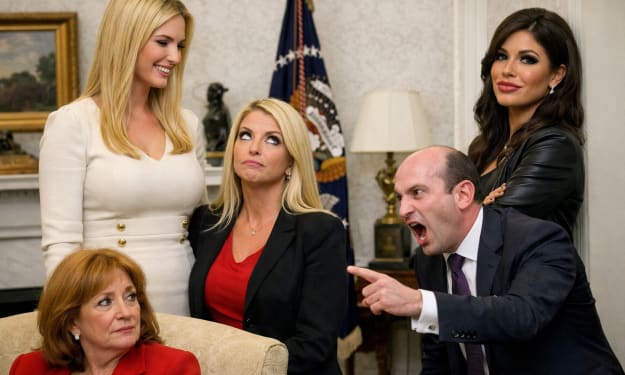
“I’m the queen of chin jutting while I smooth my hair, attacking, insulting, and deflecting to protect my appointer.” “Oh, please, Blondi, my hair is curled, highlighted, and longer than yours. I feature television commercials telling immigrants that we will give them a free plane ride home, and if they voluntarily turn themselves in, they will be allowed to legally apply for re-entry. It runs everywhere, and I look good in it! You can’t compete because of your blond hair. Mine is nicer, and my lips are prettier than yours.”
By Andrea Corwin 16 days ago in The Swamp
Becca
"Everything is so... flat." Denille said stupidly as she looked around her new neighborhood. She looked around at the muted desert where even the smallest sign of life seemed to have given up. The plant life was shrubs that were half cooked by the heat and where there should have been a lawn, a mess of white rocks laid glistening in the sun. Even the sky looked stretched thin, like the sun had ironed it smooth. She’d moved from Riverside, where at least there were hills, but here in Barstow, everything felt baked and brittle.
By Sara Wilsonabout 16 hours ago in Fiction


Comments
There are no comments for this story
Be the first to respond and start the conversation.