
"The Streets of Defiance: Los Angeles vs. Federal Force"
As anti‑ICE protests erupt in LA, clashes with federal troops ignite a new battleground over civil rights, immigration, and executive power.

1. Catalyst: Federal Immigration Raids (June 6–7)
On June 6, 2025, a series of coordinated federal raids by U.S. Immigration and Customs Enforcement (ICE) swept through the Los Angeles Fashion District, a clothing warehouse, a Home Depot parking lot, and a doughnut shop
At least 44 arrests occurred that day, adding to the 118 already made over the prior week . These enforcement actions triggered swift backlash.
Protesters—including union leaders like SEIU California president David Huerta—converged on the locations. Federal agents, some marked with patches from FBI, DHS, and ATF, clashed with activists after protestors reportedly “hurled chunks of broken concrete”
By the evening, LAPD declared an unlawful assembly as tear gas, pepper balls, flash‑bangs, and other “less‑lethal” munitions dispersed crowds into surrounding streets
On June 7, in Paramount, protesters obstructed streets with shopping carts and bins. Federal agents responded with flash‑bangs and pepper spray, injuring several individuals
By nightfall, President Trump invoked Title 10, deploying 2,000 National Guard troops to Los Angeles—marking the first time since 1965 that a president has federalized a state’s Guard without the governor’s consent
2. Explosion of Protests and National Guard Presence (June 8–9)
On June 8, protest organizers called for continued demonstrations, gathering near Los Angeles City Hall. Around 300 National Guard troops were stationed in three city locations, particularly around federal buildings and the Metropolitan Detention Center, Roughly 500 US Marines from Twentynine Palms were placed on alert, Tensions rose as federal forces used smoke and pepper spray to create entry paths for DHS and Border Patrol vehicles
In turn, border czar Tom Homan warned, “someone’s going to lose their life” if the protests continued—and even suggested that Governor Gavin Newsom and Mayor Karen Bass might face federal charges
On June 9, with protests persisting and estimated attendance around 2,000, at least 56 arrests were reported over the weekend
That same day, President Trump ordered another 2,000 National Guard troops, expanding the federal force in Los Angeles to over 4,000, alongside 700 active‑duty Marines
3. Scenes from the Streets: Clashes and Chaos
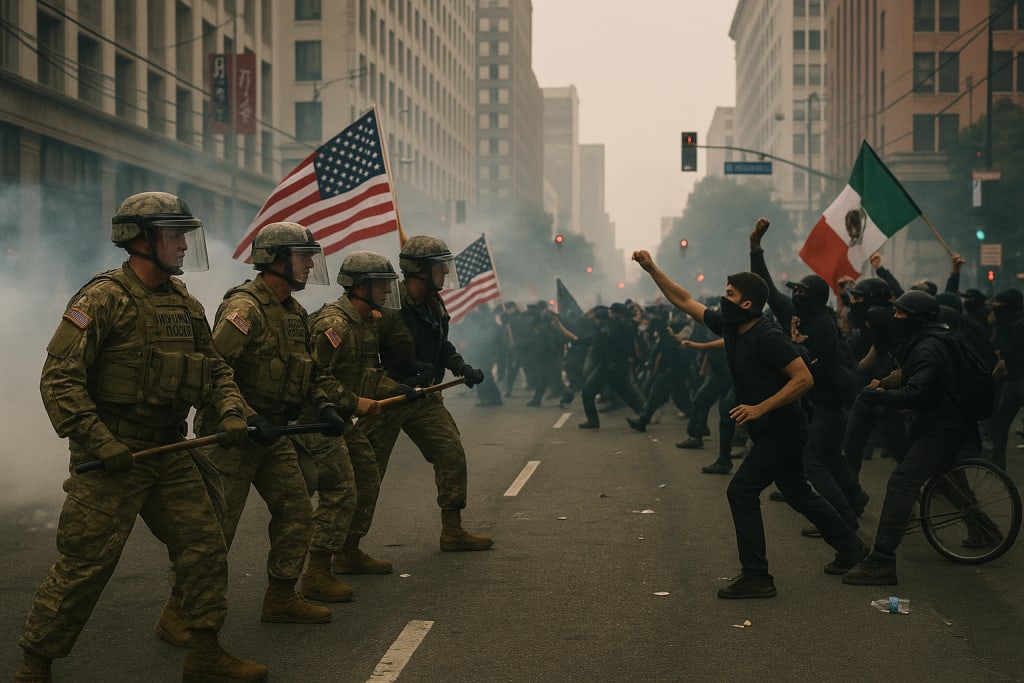
Downtown L.A. morphed into a tense battleground. Protesters chanted slogans and carried Mexican and Central American flags, setting fire to barricades and igniting at least one vehicle near Home Depot
Federal forces responded with an array of crowd-control tools: tear gas, flash-bangs, rubber bullets, pepper spray, and smoke devices . Protesters retaliated by hurling rocks, bits of broken concrete, and bottles at law enforcement
In one notable moment, journalists—clearly marked as press—were struck. A New York Post photographer was hit by a rubber bullet to the forehead, while an Australian reporter was also injured .
Meanwhile, Waymo suspended its robo-taxi service downtown after five of its autonomous vehicles were torched during the unrest
4. Political Quagmire: Federal vs. State Power
Governor Gavin Newsom responded vehemently. He filed a lawsuit challenging the federal deployment, calling it unconstitutional and "deranged," and alleging troops were left idle, "with no food or water"
Los Angeles Mayor Karen Bass expressed alarm, saying L.A. was being treated as a “political test case,” and accusing the Trump administration of fueling chaos
Both officials demanded troop withdrawal and encouraged peaceful protest, while condemning both violence and federal heavy-handedness .
In sharp contrast, President Trump defended his actions, labeling the protesters as “radical,” promising stricter controls, and even threatening to “arrest” Governor Newsom
Homeland Security Secretary Kristi Noem accused local leaders of lax enforcement, and FBI Director Kash Patel described the situation as cities “under siege by marauding criminals,” hinting at federal law enforcement intervention.
5. Ripples Beyond L.A.: Nationwide & Global Reactions
What began in L.A. quickly spread. Smaller solidarity demonstrations occurred in San Francisco, Santa Ana, Houston, San Antonio, New York, and Boston . In San Francisco, transportation disruptions, vandalism, and over 150 arrests were reported .
Internationally, Mexico’s consul general in L.A. highlighted that at least 35 Mexican nationals had been detained, urging for the humane treatment of due-process rights
Australian Prime Minister Anthony Albanese and global observers condemned the escalation as authoritarian and dangerous
6. Deeper Significance: Constitutional Fault Lines
The Title 10 deployment has drawn fierce legal scrutiny. Critics warn it risks undermining the principle of civilian domestic protest, setting a precedent for federal militarization of protests
Others trace echoes to the 1965 use of federal troops in Selma, noting the unprecedented nature of a president overriding a governor's refusal .
Supporters argue the federal intervention was necessary to protect federal property, maintain order, and fill gaps in local responses
7. Human Stories Amid Turmoil
- David Huerta, arrested during the Home Depot raid, became a potent symbol of the labor-immigration nexus—his detention galvanized many protesters
- Journalists hit in the crossfire—especially the New York Post photographer—raised red flags about press safety when military force is deployed domestically .
- Community members, especially students, flocked to protest. Fueled by wartime-like visuals, networks of mutual aid and legal coaching emerged on the streets .
8. Where It Stands Now & What Comes Next
As of June 10, 2025, L.A. remains tense. Federal forces—now exceeding 4,000 personnel—continue their show of force . California’s lawsuit proceeds, asserting an overreach of federal power
Protests are expected to resurge—whether in L.A. or in solidarity across the U.S.—as civil-rights and immigrant-justice groups coalesce. The danger of renewed violence or increased militarization looms, especially as political rhetoric escalates.
9. Final Reflection
This confrontation in Los Angeles is more than unrest triggered by immigration policy—it lays bare deep constitutional tensions over authority, the line between order and repression, and the very nature of democratic dissent. The peaceful and the militant coexist on downtown streets. Community leaders and allies confront tear gas and troop presence. At its heart is a community resisting displacement and crackdowns—and voicing unwavering defiance at the residing power it says no longer shields its people.
This moment could define the limits of federal authority or, conversely, normalize the presence of militarized responses to domestic protests. The outcome will reverberate far beyond L.A.’s boulevards—shaping how America strikes the balance between national security and civil liberties.
About the Creator
Saboor Brohi
I am a Web Contant writter, and Guest Posting providing in different sites like techbullion.com, londondaily.news, and Aijourn.com. I have Personal Author Sites did you need any site feel free to contact me on whatsapp:
+923463986212
Keep reading
More stories from Saboor Brohi and writers in The Swamp and other communities.
"Silent Wings Over Sirsa: Pakistan’s Phantom Strike"
The sky over northern India was moonless, quiet, and cloaked in deep velvet. At Sirsa Airbase, the heart of India’s western aerial defense, all was still. Hangars glowed faintly under perimeter lights, Sukhois and Mirages slept on runways, watched by sleepy ground crews.
By Saboor Brohi 7 months ago in The Swamp
If You Love Me, You'll Do It
I met Jason when I was five years old. I could say that I loved him from the moment I saw him. He was so handsome to me and I felt in awe by his presence. When they introduced him as the new kid in school, I wanted to be his friend right away. I remember it like it was yesterday. I remember his smile and how he didn't seem shy. He appeared confident and ready to learn. I waved at him and said "hello," before anyone else could even say a word. He sat next to me, and I asked him if he wanted to be friends. He looked so happy as he said, "Yes!"
By Sidney Smith (Sid Smith)6 days ago in Fiction


Comments
There are no comments for this story
Be the first to respond and start the conversation.