
The Reason Feminism Repels Women.
What is the difference between an infant and a “new wave” feminist?


This article was originally published in November 2017.
What is the difference between an infant and a new wave feminist? At some point, an infant will eventually grow up, groom itself properly, and stop complaining at every given chance.
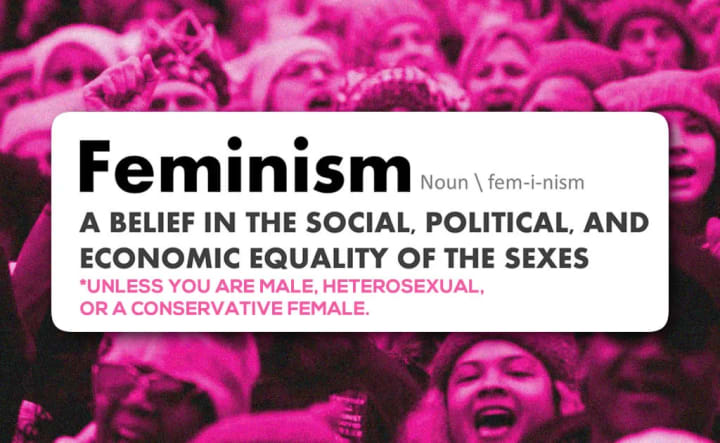
Feminism. It’s an idea that evokes thoughts of equal justice, equal rights and equal pay for women. A noble notion that few civilized humans would or could disagree with ― but just try telling that to our friends in the middle east.
Feminism. A morally righteous movement rooted in the principled native ways of iconic respectable feminist leaders like Susan B. Anthony, Mary Tyler Moore, and even Hillary Clinton, for a brief moment or two in history. A movement founded on benefiting and advancing the female gender in all its wisdom, strength, caring nature, unique talents, beauty, poise, and power.
Well, actually, that would be the immediate thoughts one would gather from an initial cursory inspection of the new modern take on a once morally ethical and respectively formidable movement. However, those positive attributes described are best reserved for the historical sense of feminism at its origins. New wave feminism, on the other hand, is an entirely different beast. Be careful as to not conflate what is, with what once was. As Jamie Lee Curtis once said, “Don’t judge a book by its cover… ’til you’ve read the book.”

New wave feminism, with its megaphone of outrage and penchant for performative theatrics, has morphed into something unrecognizable to its foremothers. Where once the movement stood for tangible victories — voting rights, property ownership, workplace protections — today’s iteration often seems mired in petty grievances and divisive rhetoric. It’s less about building bridges and more about burning them, alienating the very women it claims to champion. The question is: why? Why does a movement that once inspired millions now leave so many women rolling their eyes or quietly backing away?The answer lies in the shift from empowerment to victimhood. Historical feminism, embodied by the likes of Susan B. Anthony, was about claiming agency — demanding a seat at the table through grit, reason, and moral clarity. It was a call to action, not a call to complain. Contrast that with the current landscape, where social media amplifies the loudest, most extreme voices. These voices don’t just ask for equality; they demand retribution, often cloaked in jargon like “toxic masculinity” or “systemic oppression.” The result? A movement that feels less like a sisterhood and more like a lecture hall, where dissent is heresy and nuance is a dirty word.
Consider the optics. New wave feminists often project an image of perpetual outrage — shrieking at perceived slights, policing language, and vilifying anyone who dares question the orthodoxy. It’s not hard to see why this repels women who value independence and reason. Many women don’t want to be cast as eternal victims, nor do they relish the idea of waging war against half the population. They want partnership, not polarization. They want to be seen as equals, not as fragile creatures needing constant validation or protection from words, ideas, or even air conditioning.
And then there’s the contradiction at the heart of it all. New wave feminism claims to celebrate women’s strength but often infantilizes them, portraying women as too delicate to handle disagreement or challenge. It’s a strange paradox: a movement that preaches empowerment while simultaneously suggesting women need safe spaces from hurt feelings or differing opinions. This doesn’t resonate with women who navigate the real world — balancing careers, families, and personal ambitions — without the luxury of clutching pearls over microaggressions.The alienation runs deeper when you look at the movement’s priorities. While women in some parts of the world fight for basic rights — like the freedom to drive, work, or avoid forced marriage — new wave feminism in the West often fixates on trivialities. From policing Halloween costumes to demanding trigger warnings on classic literature, the focus feels disconnected from the struggles of everyday women. It’s no wonder many women, from working-class mothers to corporate executives, look at this and think, “This doesn’t represent me.”
But here’s the kicker: the problem isn’t feminism itself. The core idea — equality of opportunity, respect, and dignity — remains as vital as ever. The issue is the hijacking of that idea by a vocal minority who’ve turned a noble cause into a caricature. To reclaim its soul, feminism needs a course correction. It needs to rediscover its roots in reason, resilience, and universal principles. It needs to listen to the women who feel sidelined — those who don’t see their lives reflected in viral hashtags or campus protests. It needs to focus on real issues: economic opportunity, maternal health, education access, and yes, supporting women in regions where “feminism” isn’t just a buzzword but a matter of survival.
Imagine a feminism that celebrates women’s achievements without demonizing men. One that encourages dialogue over dogma, and strength over sensitivity. A feminism that inspires rather than repels. That’s not a pipe dream — it’s the legacy of the movement’s pioneers, waiting to be reclaimed. Until then, new wave feminism will continue to alienate the very women it claims to represent, leaving them to wonder: when did the fight for equality become a fight against common sense?
Ricky Diaz — conservative grit on faith, family, freedom, and unfiltered truth . @iamrickydiaz . Biz: [email protected]
About the Creator
Ricky Diaz
https://linktr.ee/iamrickydiaz Political influencer Journalist, Interviewer, Actor. Biz: [email protected]
Keep reading
More stories from Ricky Diaz and writers in The Swamp and other communities.
EXPOSED: Red States' Baby Boom vs. Blue States Against the Womb
AI Disclosure: This piece was drafted with the help of certain AI tools for targeted research and statistical data, while every word, angle, and fire was crafted by Ricky Diaz @iamrickydiaz. No shortcuts—just amplified fact-checking for the truth.
By Ricky Diaz5 months ago in The Swamp
Parallel Protests
I haven't written for quite some time, but I have A LOT of thoughts about yesterday's protest rally against our government's involvement and complicity in America's war on Iran, on the harbourside of my home city Bristol, and I need to put them somewhere. My gorgeous girlfriend is always a loving and listening ear and sharing it all with her will always be a healthy and happy way of processing the mental and emotional weight, but getting it straight in my brain to share means writing it all down in straight lines, so, here we are and thanks for being here.
By Steph Cole7 days ago in The Swamp
The First Casualty Of War Is The Truth
It is often said that in times of war, the first casualty is the truth. When Donald Trump launched Operation Epic Fury, he said that the goal was to stop Iran from developing nuclear weapons. At the same time, when the head of the International Atomic Energy Agency (IAEA), Rafael Grossi, was asked about it, he said that they do not even have access to the sites. Therefore, they have no clear idea about what is happening there, and he appeared somewhat confused.
By Ibrahim Shah 3 days ago in The Swamp


Comments
There are no comments for this story
Be the first to respond and start the conversation.