
The Plague is Here. Now Let's Bring Back the Cooler Historical Trends.
Part 1 of a series discussing the aspects of history that deserve a resurgence during modern times


History is fascinating! I don’t mean the textbook Western Civ classes that we were forced to take in college (or sleep through in my case). I mean history as a whole, the continuous evolution of everything that humans have ever created or had contact with. It’s amazing to think of how far we have come in the few years (as far as the Earth’s chronology is concerned) that humans have been here. As much as we have progressed however, I can’t help but feel that we have left a lot of things behind that should have followed us. There has been so much greatness through different cultures, different eras, and different genres that have been mostly forgotten.
As technologically “advanced” as we deem ourselves to be at this point in history, we have still been no match for one of the most natural things on the planet, as old as Earth itself, disease. There’s no doubt that Covid-19 will forever mark the year 2020 in our history. It will be a story for the ages, just as we were taught about the Spanish Flu and The Black Death (the bubonic plague) growing up.
So, I had a thought. Since we are experiencing such a similar and devastating moment in history as those of some of our ancestors, why not re-introduce those things that were wonderful about their time? Instead of focusing so much on continuously moving forward, how about we take a step back and immerse ourselves on the things that those before us got right?
Part 1: Language

Oh, the language! I am completely obsessed with European history (especially involving royal lines) and I believe that it’s mostly due their almost theatrical way of speaking.
Medieval Times
The 5th through the 15th centuries were known as as the Medieval Period and was the time in which The Black Death spread across Europe. Middle English, French, and Latin were the most common languages throughout Europe and naturally, over centuries it evolved and different regions began using different variations. These languages are actually the derivatives for the majority of what we speak as “American English” in the present time.
I’m not really trying to give you a history lesson, so I’m just going to give examples and relate it back to modern media. I know most of us have seen the movie “A Knight’s Tale”, starring Heath Ledger. While it is was obviously very edited for modern times, it was based on Geoffrey Chaucer’s first tale in “Canterbury Tales” and sounds a bit like:
“When April, with its sweet showers,
Has pierced the dryness of March to its roots,
And bathed every stem in the liquid
Which will show its qualities in the flower;
When Zephyrus as well with his sweet breath
Stirs up in every meadow and field
The new crops; when the young sun
Has run halfway through the sign of Taurus;
When small birds begin to make songs,
Who sleep all the night with open eyes,
As Nature moves them in their hearts —
It’s then that folks long to go on pilgrimages,
And for the faithful to seek unknown lands;
And so in particular, from every town’s end
Of England to Canterbury they go,
To find the holy blissful martyr
Who helped them when they were sick.
I’m not going to even pretend to understand every line in this passage, but that’s really the beauty of it. The flow of each word and the descriptiveness of the passage as a whole paints such a vivid moment during this story. Could you image running errands and having a discussion about the weather with someone standing in line with you, but it resonated a tone similar to the above passage?

The Renaissance
The Renaissance period of history (the 14th through 17th centuries)brought with it, a new vernacular as far as linguistics are concerned. During this societal “re-birth”, there was a lot of what we are actually discussing here taking place. They were expounding upon already established classical studies of Greek and Roman art, literature, and philosophy. They made advancements on these subjects, as well as with the already existing languages.
One of the greatest works of literature ever created also set the stage for Renaissance style writings. The Divine Comedy by Dante Alighieri was considered the inspiration for many of the greatest authors of this time. With lines such as these, how could fellow writers not want to create such beautiful works:
I saw these words spelled out in somber colors inscribed along the ledge above a gate;“Master,” I said, “these words I see are cruel.”
He answered me, speaking with experience:“Now here you must leave all distrust behind;let all your cowardice die on this spot.
We are at the place where earlier I said you could expect to see the suffering race of souls who lost the good of intellect.”
Placing his hand on mine, smiling at me in such a way that I was reassured,he led me in, into those mysteries.
Here sighs and cries and shrieks of lamentation echoed throughout the starless air of Hell;at first these sounds resounding made me weep:
tongues confused, a language strained in anguish with cadences of anger, shrill outcries and raucous groans that joined with sounds of hands,
raising a whirling storm that turns itself forever through that air of endless black,like grains of sand swirling when a whirlwind blows.
And I, in the midst of all this circling horror,began, “Teacher, what are these sounds I hear? What souls are these so overwhelmed by grief?

Even though the examples given were written by authors, who excelled in the study of words and language, it still gives a look into the structure that language used to be as a whole and how much it has evolved. Of course different languages and dialects have experienced their own transformations over time, but there was a pride in the way that people spoke. It told a story about their culture, their upbringing, their interests, and even their social standing.
Any movie or translation of the life of Elizabeth I and Romeo & Juliet for the most part captures the linguistic beauty of this time.
The Present
I may get reamed for it, but I stand behind it: as a human race, we have completely slaughtered our languages. There are so many slang terms, mispronunciations, grammar carnage, and just an overall laziness with how we communicate, that having a conversation has honestly become frustrating. It’s almost as though some TRY to sound uneducated by how they communicate, whether through written or verbal means.
I think that is what makes historical language so appealing. People that were given the opportunities to learn to read and write did not squander their good fortune. It wasn’t taken for granted as it is today. Today it is considered commonplace for one to know how to read and write, especially in the United States. When something is given so freely, it is less likely to be care for, so if it’s butchered, it’s not a huge loss.
In a world full of LOLs, “aight nih”, “ill c u tomrrw”, bae, fleek,and yeet (whatever in the hell that means), it would be nice to be able to have a conversation and actually be able to picture what the speaker is describing. I would love to be able to scroll through my Facebook feed and not cringe at the misuse of “there”, their”, and they’re, or “accept” and “except”. Overall, I would just love for people to have a respect for language and communication, as our ancestors did.

I’m afraid that 40 years from now, when our grandchildren are asking us to describe the Covid-19 Plague of 2020, most of them will get “Well, it sucked. We were stuck at home and bored. We hated it and we all hated each other. It sucked. The end”.
When instead, they could be able to form an idea in their minds of what it was really like through our descriptions. Such as when Petrarch, a great poet of the Renaissance was sure that no one would believe the terror that they faced throughout the Bubonic Plague, he wrote:
‘O happy posterity, who will not experience such abysmal woe and will look upon our testimony as a fable.’

Everyday citizens even commented on the catastrophic conditions with vividness:
“Such fear and fanciful notions took possession of the living that almost all of them adopted the same cruel policy, which was entirely to avoid the sick and everything belonging to them. By so doing, each one thought he would secure his own safety.”
They brought the direness of the situation to light through their words:
“The plight of the lower and most of the middle classes was even more pitiful to behold. Most of them remained in their houses, either through poverty or in hopes of safety, and fell sick by thousands. Since they received no care and attention, almost all of them died. Many ended their lives in the streets both at night and during the day; and many others who died in their houses were only known to be dead because the neighbours smelled their decaying bodies. Dead bodies filled every corner. Most of them were treated in the same manner by the survivors, who were more concerned to get rid of their rotting bodies that moved by charity towards the dead. With the aid of porters, if they could get them, they carried the bodies out of the houses and laid them at the door; where every morning quantities of the dead might be seen. They then were laid on biers or, as these were often lacking, on tables.”
That’s all for my dreams of a well-spoken world. In Part 2, I will highlight the fashions and trends that never should have went out of style!
About the Creator
Kassondra O'Hara
Working mom who uses her curiosity to fuel the curiosities of others ~ Writes mostly history and true crime
Keep reading
More stories from Kassondra O'Hara and writers in The Swamp and other communities.
How Does Turkmenistan have ZERO Reported Covid-19 Cases?
In order to understand the incomprehensible reality of how Turkmenistan citizens are not being allowed their basic rights as humans during this pandemic is to recognize the oppression that they have faced even since their departure from the Soviet Union in the 90s. The tyranny that these people have endured over the years is intensified in the fact that most of them don’t even know what life aside from it is like. Right now, the despotism is hiding a silent killer from the masses.
By Kassondra O'Hara5 years ago in The Swamp
The Forsyth House Fire
Since 1851, Forsyth House has stood on the corner of Union Street and Gordon Street in the heart of Glasgow. Its iconic, or was... because on Sunday 8th of March, 2026, a fire broke out in a small, seemingly un-named shop in the building and tore all that history down. As I write, the rubble is still unsettled and the street is still blocked off. Central Station is quiet on the upper level, and around 30 small businesses have quite literally gone up in smoke.
By S. A. Crawford3 days ago in The Swamp
The US Navy Decommissioned Middle East Minesweepers Last Year. Here’s What They Did
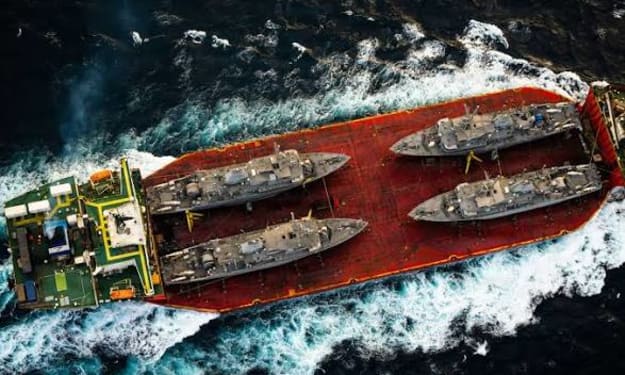
Last year, the United States Navy officially decommissioned a fleet of minesweepers that had been stationed in the Middle East, concluding decades of service aimed at safeguarding critical maritime routes in one of the world’s most strategically important regions. These vessels, which included Avenger-class minesweepers, played a crucial role in ensuring the safety of naval and commercial traffic, countering the threat of naval mines, and supporting coalition operations. Minesweepers are specialized ships designed to detect and neutralize naval mines, which are explosive devices placed in waterways to disrupt shipping and military operations. In the Middle East, particularly in the Persian Gulf and surrounding waters, these ships were tasked with protecting vital oil shipping lanes, military supply routes, and key ports from potential threats posed by adversaries. According to Navy officials, the decommissioned minesweepers were deployed for a range of missions, including mine countermeasure exercises, port security operations, and joint drills with regional partners. “These vessels have served as a critical first line of defense, ensuring safe navigation for both military and civilian vessels,” said Rear Admiral James Goldrick, who oversees maritime security operations in the region. “Their contributions have been invaluable in maintaining stability and operational readiness.” During their service, the minesweepers used a combination of sonar systems, remotely operated vehicles (ROVs), and mechanical sweeping gear to detect and clear mines. This capability was particularly important in the Persian Gulf, a narrow waterway where even a small naval mine could severely disrupt maritime traffic and the global oil supply. Their operations required close coordination with coalition partners, including the navies of the United Kingdom, Saudi Arabia, and other regional allies. The decommissioning process involved carefully retiring the ships from active service, removing sensitive equipment, and transferring or scrapping vessels according to military regulations. Many of the minesweepers had served for decades, and technological advancements had rendered some systems outdated compared to newer mine countermeasure platforms, including unmanned surface vessels (USVs) and advanced sonar systems. While these ships are no longer in operation, their legacy continues through training programs and lessons learned that have informed the Navy’s modern mine countermeasure strategies. Crews trained on these vessels developed expertise in navigation, mine detection, and coordination under potentially hostile conditions, skills that are now being transferred to personnel operating next-generation platforms. The role of minesweepers in the Middle East was particularly critical during periods of heightened tension, when adversaries threatened the Gulf’s shipping lanes with the potential deployment of mines. Their presence acted as both a deterrent and a practical measure to ensure uninterrupted flow of oil and commerce. Naval analysts point out that the retirement of these vessels reflects a broader shift in naval strategy, moving toward unmanned systems and multi-mission ships that can handle mine countermeasures while performing other operational tasks. Despite their decommissioning, the US Navy remains committed to maintaining security in the region. Newer platforms, such as the Independence-class littoral combat ships, equipped with modular mine countermeasure packages, are gradually replacing the traditional minesweepers. These vessels use advanced technologies, including unmanned underwater vehicles (UUVs) and autonomous systems, to detect and neutralize threats more efficiently and with reduced risk to personnel. Experts highlight that the minesweepers’ retirement does not signal a reduction in the Navy’s commitment to the region. Instead, it reflects an adaptation to modern naval warfare, where unmanned and highly networked systems can perform tasks that previously required manned vessels. “The mission remains the same: to ensure maritime freedom of navigation and protect commercial shipping,” said one naval strategist. “We are simply using new tools to achieve it more effectively.” Over their decades of service, the Middle East-deployed minesweepers completed thousands of operational hours, conducted joint exercises with allied navies, and played a critical role in securing one of the world’s most vital maritime regions. Their crews often worked in challenging conditions, including extreme heat, tight operational areas, and periods of geopolitical tension, demonstrating professionalism and dedication. Looking ahead, the Navy plans to expand its use of unmanned systems and integrate new mine countermeasure capabilities into the fleet. Lessons learned from the retired minesweepers will continue to inform doctrine, training, and operational planning, ensuring that future personnel can respond effectively to mine threats in both the Middle East and other strategic theaters. The decommissioning of these minesweepers marks the end of an era for the US Navy in the Gulf, but their contributions remain a cornerstone of maritime security in the region. As technology evolves, the legacy of these vessels and their crews lives on in the Navy’s ongoing mission to safeguard critical waterways, protect global commerce, and support coalition partners in maintaining regional stability. By retiring the old ships and integrating modern platforms, the US Navy aims to continue projecting strength, ensuring safe navigation, and adapting to the evolving maritime threats of the 21st century.
By Fiaz Ahmed 3 days ago in The Swamp



Comments
There are no comments for this story
Be the first to respond and start the conversation.