
The Night the Sky Lit Up Again
US–Iran Tensions and the Quiet Fear Underneath

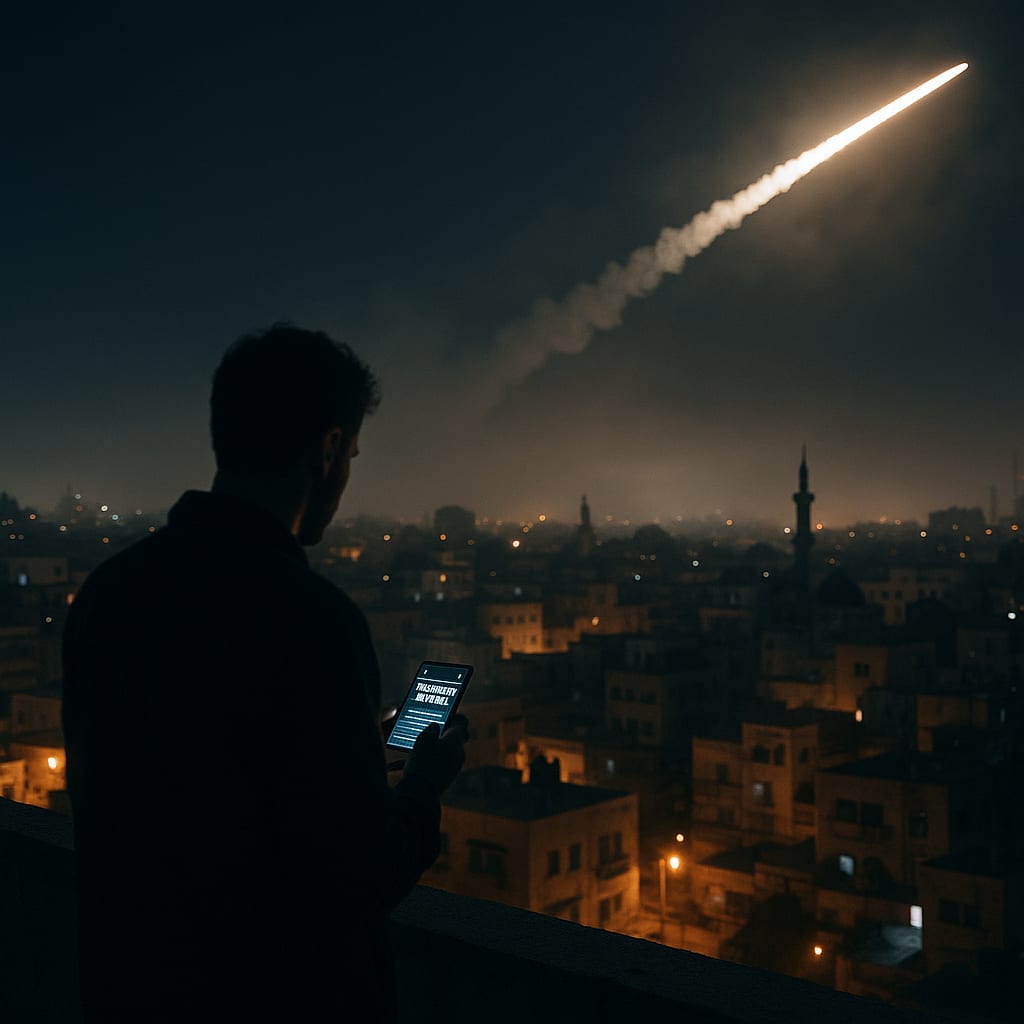
Missiles, Maps, and a Group Chat That Wouldn’t Stop Buzzing
The night the latest US–Iran headlines broke, my phone turned into a fire alarm.
Missile alerts. Breaking news banners. A shaky video of a streak of light over a dark city.
And in between all of that, a group chat with friends scattered across three time zones.
One message stuck with me:
“Is this it? Are we watching the start of a real war this time?”
No one answered right away.
Not because we didn’t have opinions.
Because everyone was doing the same thing: scrolling, refreshing, trying to decode a flood of half-facts and hot takes.
Somewhere between the memes and the panic, there was a quieter question humming beneath all of it:
What actually just happened between the US and Iran… and what does it mean for what comes next?
This isn’t just “foreign policy.”
It’s gas prices, the kid you know stationed in the Gulf, the Iranian family down the street trying to get their parents a visa, the growing feeling that the world is one bad decision away from spiraling.
So let’s talk about what just happened, without the shouting match.
Not to predict the future like pundits on TV—just to understand the ground we’re standing on right now.
What Just Happened: The Latest Flashpoint in US–Iran Tensions
If you only caught fragments, here’s the basic outline of the most recent flare-up.
An attack happened first—either on US forces in the region or on a target linked to Iran.
The details change depending on which incident we’re talking about, but the pattern is painfully familiar: rockets or drones, casualties, confusion.
The US blamed Iran or Iran-backed militias.
Washington then responded with airstrikes—“precision,” “proportional,” always described in words that sound antiseptic compared to the reality of explosions and people running for their lives.
Iran, meanwhile, denied responsibility or framed its actions as “resistance” or “self-defense.”
State media showed images of funerals and flags, rallied its base with talk of sovereignty and dignity.
And somewhere between those talking points and the satellite images, one phrase started trending again:
“Is this the moment it all blows up?”
That’s the surface-level version.
But these “new” tensions sit on top of a mountain of old ones.
To understand why everything feels so fragile, you have to zoom out without losing sight of the people standing directly under the blast radius.
How We Got Here: A Long Shadow of Sanctions, Strikes, and Broken Promises
US–Iran tensions didn’t start with the latest missile strike.
They didn’t even start with the nuclear deal or the killing of a general at Baghdad airport.
They run back through decades of bruises that never fully closed.
If you talk to Americans, many will reference the 1979 hostage crisis:
US diplomats held for 444 days after the revolution in Iran.
For a lot of people in the US, that’s still the mental image of Iran: angry crowds, blindfolded hostages.
If you talk to Iranians, many of them start earlier.
They’ll mention 1953, when the CIA helped overthrow Iran’s prime minister, or the years the US backed the Shah, or the brutal Iran–Iraq War where chemical weapons hit Iranian soldiers and civilians while the world largely looked away.
Both sides have their stories of betrayal.
Both sides have receipts.
Fast-forward and you get:
Sanctions that strangled Iran’s economy and regular people’s lives.
The 2015 nuclear deal (the JCPOA), which briefly felt like a bridge.
The US withdrawal from that deal, which felt to many Iranians like the bridge was pulled away mid-crossing.
The killing of Iranian General Qassem Soleimani by a US drone strike in 2020, an escalation that many thought would tip into all-out war.
A cycle of proxy attacks—militias, drones, rockets—stretching from Iraq to Syria to the Red Sea, like a shadow war always burning just below full flame.
By the time we get to “what just happened” this week or this month, both countries are walking onto the stage already angry, already wounded, already expecting the worst of each other.
So when a drone hits a US base or a missile hits an Iranian-linked target, it’s never just about that single event.
It’s about everything hanging behind it.
Watching a “Distant” Crisis From Way Too Close
Here’s something that keeps getting lost in the headlines:
This doesn’t feel “distant” to a lot of people.
I have a friend whose younger brother is deployed near the Persian Gulf.
When fresh footage of US–Iran tensions pops up on the news, she doesn’t see maps or talking heads.
She sees a nameless desert and thinks, “He’s somewhere out there.”
Another friend is Iranian-American.
Her parents’ WhatsApp groups explode every time tension spikes: voice notes from Tehran, rumors about upcoming airstrikes, videos of lines forming at currency exchanges.
She told me, “Every time the US and Iran clash, we hold our breath. We know it’s not just about governments. It’s visas, families, money, safety… everything slips a little more.”
Even if you don’t know anyone directly involved, you still feel the ripples.
You feel it when gas prices jump and suddenly your commute or your grocery bill costs more.
You feel it when your social feed fills with words like “World War III” used half as a joke, half as a nervous tic.
We talk about geopolitics like it’s chess.
But it feels less like a board game and more like living in a crowded apartment building where two neighbors keep slamming doors and screaming through thin walls.
You’re not in the fight.
But you can’t pretend you don’t hear it.
Why This Keeps Happening: The Unsaid Rules of the US–Iran Game
If you zoom in on any single episode—this strike, that retaliation—it can feel random and chaotic.
But if you watch the pattern long enough, something emerges:
both the US and Iran are playing a dangerous game with very specific, mostly unspoken rules.
You can see those rules in how each side moves:
Push, but not too far.
Iran might strike through proxies, not directly under its own flag. The US might hit militia sites instead of Iran’s mainland. Each side wants to show strength without crossing the invisible line into all-out war.
Use language like a shield.
The US calls its actions “defensive” or “limited.” Iran calls its responses “retaliation” or “deterrence.” Both sides want to sound justified, not reckless, even while dropping bombs.
Keep options open.
Nobody wants to look weak, but nobody really wants a full-scale war either. So they live in this grim in-between: calibrated violence, red lines, “messages” delivered by missiles.
The terrifying part?
The entire strategy assumes that everyone reads the signals correctly every single time.
No miscalculation.
No rogue commander.
No misunderstanding of how the other side will react.
We’re all relying on two governments that deeply distrust each other to keep escalating just enough to save face, and not enough to cause collapse.
That’s not exactly a comforting foundation for global stability.
How It Looks Inside Iran vs Inside the US
One of the reasons we keep talking past each other about US–Iran tensions is that each side is watching a different movie.
From the US side, the narrative often sounds like this:
Iran is a destabilizing force in the Middle East.
It supports militias and armed groups across the region.
Its nuclear program may someday threaten US allies like Israel or the broader world.
US troops and diplomats keep getting targeted, and Washington has to respond.
The story is framed as America trying to contain a dangerous regime.
From inside Iran, the narrative flips:
The US is seen as the bully: the coup back in the 1950s, the sanctions, the military bases surrounding Iran.
The nuclear program is framed as national pride and a bargaining chip, not a doomsday plan.
Proxy forces and regional influence are portrayed as a shield against being invaded or overthrown.
Every time there’s a new clash, both sides reach for these stories.
Each new strike is more proof that they were right about the other all along.
And caught between these competing versions of reality are millions of ordinary people—trying to buy groceries in Tehran as the currency collapses, or Skyping a partner stationed overseas, or just bracing for the next headline.
When both governments define “strength” as never backing down, the people living under their decisions end up carrying the cost.
What This Round of Tension Really Means for the Near Future
The question everyone whispers after the latest escalation is some version of:
“So… what now?”
If you strip away the noise, here’s what this moment really signals:
The risk of miscalculation is rising.
Every new strike adds pressure. Militias feel emboldened or cornered. Commanders get bolder. Political leaders get boxed in by their own “red line” rhetoric.
It doesn’t take a genius to see how this could go wrong fast.
The nuclear file is quietly getting worse.
While everyone focuses on airstrikes or drone footage, Iran’s nuclear program keeps moving. Monitoring has weakened. Trust is in tatters.
The space for a diplomatic solution shrinks every time a missile flies.
Regional dominoes are wobbling.
US–Iran tensions don’t stay bilateral.
They run through Iraq, Syria, Lebanon, Israel, the Gulf states, the Red Sea shipping lanes.
The region is already fragile. Every new confrontation adds strain on systems that are already stressed.
Pressure at home matters more than anyone admits.
Leaders in Washington and Tehran both have domestic problems.
Economic pain. Political polarization. Public frustration.
Sometimes that makes them more cautious. Sometimes it makes them more desperate to look strong.
None of this guarantees a major war.
But it does mean the room for error is shrinking, and the cost of each misstep is growing.
We’re not just watching “another round of posturing.”
We’re watching a world where the safety margins are wearing thin.
What Regular People Can Actually Do With This Knowledge
There’s a moment, after one too many “breaking news” alerts, when you feel completely powerless.
You’re not in the Situation Room.
You’re not at the negotiating table.
You’re just trying to get through your week without feeling like the whole world is cracking.
But “powerless” isn’t the only option.
You may not be able to stop a drone strike, but you can choose how you engage with the story around it.
A few things that have actually helped me:
Refusing to accept the lazy version.
Any sentence that starts with “Those people are just…” about Iranians, Americans, Arabs, Jews, soldiers, protesters—whoever—should set off alarms.
The more we flatten other people into caricatures, the easier it becomes to rationalize violence against them.
Watching what I amplify.
Not every shaky video is real. Not every tweet is from someone on the ground. I’ve started pausing before sharing anything that stokes panic.
That pause is a tiny act of resistance against misinformation, but it counts.
Listening to the people living under the headlines.
Iranian creators, veterans, aid workers, journalists—people who can talk about both the fear and the fatigue.
Their voices cut through the noise more than any official statement.
Talking about this in normal spaces.
Not to argue policy point by point, but to ask better questions.
“How do you feel about all this?”
“What worries you the most?”
“What do you wish people understood about this situation?”
Those conversations don’t rewrite treaties.
But they do something underrated: they keep the people most affected from disappearing into the abstraction of “US–Iran tensions.”
And that matters more than it sounds.
Because once people become invisible, it gets too easy for their suffering to be treated as collateral.
The Takeaway: Living Under a Sky That Could Change in a Single Night
The night my group chat blew up about the latest US–Iran escalation, nobody slept much.
By morning, the panic headlines had already softened.
Analysts were calling the strikes “limited,” “contained,” “unlikely to lead to full-scale war.”
Life went on.
Kids went to school. People went to work. Netflix released another show. The algorithm moved on to the next outrage.
But the feeling didn’t fully leave.
Not the fear of some world-ending war, exactly, but something quieter:
The awareness that our lives are more fragile than we think, and that somewhere, decisions are being made that could redraw the shape of our days without asking us first.
US–Iran tensions today aren’t just about missiles, sanctions, or nuclear centrifuges.
They’re about trust, memory, pride, fear, and the stories nations tell about themselves and each other.
They’re about how easy it is to build a system that runs on suspicion and retaliation…
and how hard it is to imagine anything else.
You don’t have to become a foreign policy expert.
You don’t have to pick a side in every argument.
But you can do one thing:
Refuse to be numb.
Pay enough attention to know when the sky is changing.
Care enough to remember that under every headline are people who didn’t choose this game, but have to live with the consequences.
And maybe, in a world where so much feels out of our hands, that refusal—to look away, to flatten, to dehumanize—is its own kind of power.
Not the kind that launches missiles.
The kind that, if it ever spreads far enough, might make them a little harder to fire.
About the Creator
abualyaanart
I write thoughtful, experience-driven stories about technology, digital life, and how modern tools quietly shape the way we think, work, and live.
I believe good technology should support life
Abualyaanart
Keep reading
More stories from abualyaanart and writers in The Swamp and other communities.
Why Black History Matters in America?
The United States of America is celebrating their 250th anniversary in 2026. I'm proud to be an American and as someone who was born here, I wouldn't imagine myself living anywhere else. This is a country where opportunities are possible. Where anyone can be successful in anything they desire to do. Equality, community, and togetherness are the backbones of what America is and should be about. However, we have an administration who wants to erase and disregard those who have made positive, meaningful impacts in our country, specifically Black figures, such as Martin Luther King, Jr., Rosa Parks, and Maya Angelou. President Trump and his administration have been constantly complaining and fighting against what they call the "Woke agenda". They use this excuse as a distraction from other issues they refuse to address, such as the high cost of living, climate change, and inflation. That equality is dividing America, when in reality, it's bringing us together. Being woke is not tied to a specific political party. No matter where you stand on the political spectrum, you can still care about other people and their plights. Compassion and empathy for others isn't tied to a political party, either. We were taught as children to treat others the way we want to be treated and not judge others because they're different from us. Caring about others isn't a personal attack on your beliefs. It doesn't make you any less of a person. People who are easily offended over African American figures, past or present, or anything related to it, are grasping at straws. Current and future generations need to know who people like Harriet Tubman and Shirley Chisholm were, especially in the classroom. Black History is part of American History. It should be recognized, not hidden or forgotten. Besides, you can't shield children from everything, just because your feelings are easily hurt.
By Mark Wesley Pritchard 27 days ago in The Swamp


Comments
There are no comments for this story
Be the first to respond and start the conversation.