
The Line, a Saudi Megaproject, Is Dead
Why Saudi Arabia’s Futuristic City Vision Collided With Reality, Costs, and Controversy

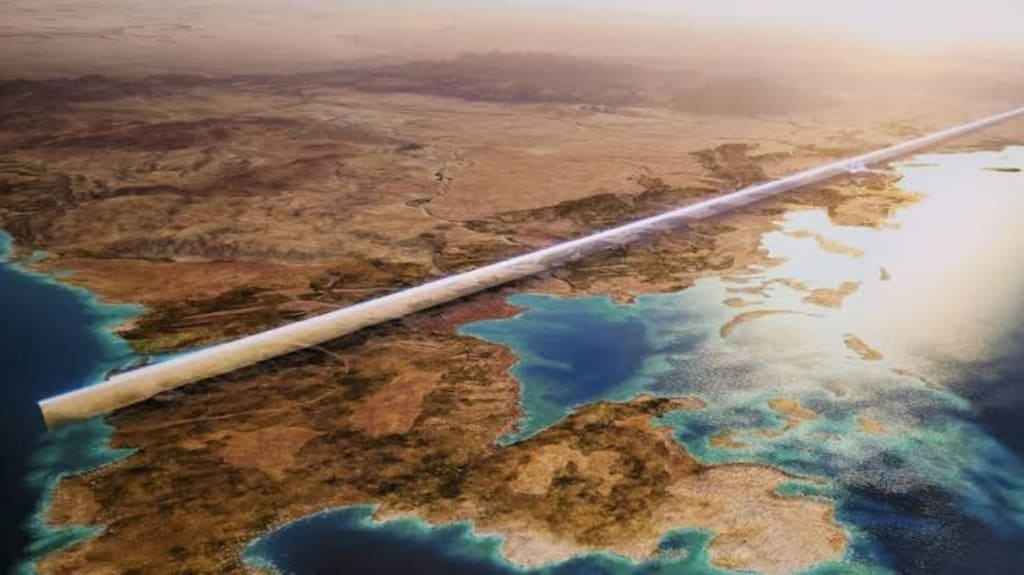
When Saudi Arabia unveiled The Line, it was presented as a vision of the future. A 170-kilometer-long city with no cars, no streets, and no carbon emissions, The Line promised to reshape how humans live. It was the centerpiece of NEOM, the kingdom’s ambitious plan to diversify its economy beyond oil.
But years after the announcement, a growing number of experts, investors, and observers are asking the same question: Is The Line effectively dead?
While Saudi officials have not officially canceled the project, mounting evidence suggests that The Line, as originally imagined, is no longer realistic.
What Was The Line Supposed to Be?
The Line was announced in 2021 as a linear smart city built in the Saudi desert near the Red Sea. According to its designers:
The city would house up to nine million people
It would run entirely on renewable energy
Residents could reach daily needs within five minutes
A high-speed rail system would allow end-to-end travel in 20 minutes
No cars, no roads, and no traditional infrastructure
The city’s mirrored walls, rising hundreds of meters high, were meant to reflect nature and minimize land use. It was bold, futuristic, and controversial from the start.
The Reality Sets In
As construction began, problems quickly surfaced.
1. Unrealistic Engineering Challenges
Building two parallel skyscrapers stretching across 170 kilometers is something the world has never attempted. Engineers raised concerns about:
Structural stability
Wind pressure
Heat management
Emergency evacuation
Long-term maintenance
The technology required either did not exist or had never been tested at this scale.
2. Soaring Costs
Initial estimates put the cost of NEOM at over $500 billion, with The Line as the most expensive part. Rising global inflation, supply chain issues, and construction costs pushed that number even higher.
Reports began to surface that Saudi planners were quietly cutting back the project’s scope to manage expenses.
Scaling Back the Dream
Instead of canceling The Line outright, Saudi Arabia appears to be shrinking it dramatically.
Sources familiar with the project suggest:
Only a small section of The Line may be built in the near future
Population targets have been reduced significantly
Focus has shifted to more practical developments within NEOM
This shift has fueled the belief that The Line, as originally sold to the world, will never exist.
Economic Pressures Behind the Scenes
Saudi Arabia’s economy is still heavily dependent on oil revenue. While oil prices have helped fund Vision 2030, the kingdom is also juggling:
Massive infrastructure spending
Global economic uncertainty
Rising domestic costs
Investor skepticism
International investors have reportedly expressed concerns about returns, making funding harder to secure. Mega-ambitions are impressive, but they must still make financial sense.
Human and Environmental Criticism
The Line also faced serious backlash from human rights groups and environmental experts.
Displacement Issues
Local tribes were reportedly forced to relocate to make way for construction. This led to international criticism and damaged the project’s global image.
Environmental Concerns
Ironically, a project marketed as “green” raised alarms about:
Wildlife disruption
Bird collisions with mirrored walls
Desert ecosystem damage
Enormous carbon emissions during construction
These concerns weakened public and investor confidence even further.
Why Saudi Arabia Won’t Admit It’s Over
Saudi leadership rarely announces failure, especially on projects tied to national pride. Instead of canceling The Line, officials appear to be:
Rebranding goals
Adjusting timelines
Redirecting attention to other NEOM projects
This allows the government to save face while quietly moving on.
In many ways, The Line has become more of a conceptual symbol than an actual city plan.
What NEOM Becomes Without The Line
NEOM itself is not dead. Other projects within the region, such as:
Oxagon (industrial hub)
Trojena (mountain tourism)
Luxury coastal developments
These are far more achievable and already showing progress. By focusing on these, Saudi Arabia can still claim success under Vision 2030.
The Line, however, was the most extreme and risky part of the plan.
A Lesson in Megaproject Reality
The rise and fall of The Line offers a powerful lesson:
Vision matters, but execution matters more
Technology cannot be willed into existence
Cities grow organically, not by decree
Human, environmental, and economic factors cannot be ignored
History is filled with grand projects that looked perfect on paper but failed in reality.
Is The Line Truly Dead?
Officially? No.
Practically? Almost certainly.
What remains is a scaled-down fragment, far removed from the bold vision that once captured headlines. The dream of a 170-kilometer mirrored city housing millions appears to have collided with real-world limits.
The Line may survive as a marketing idea, a case study, or a futuristic prototype. But as a full city? That future now seems extremely unlikely.
Conclusion
“The Line, a Saudi Megaproject, Is Dead” may sound dramatic, but it reflects a growing consensus. The world watched as Saudi Arabia attempted to leap decades into the future in one move.
Ambition alone, however, cannot overcome physics, economics, and human reality.
The Line will be remembered not as the city that changed the world—but as a reminder that even the richest nations must respect the limits of possibility.
Sometimes, the future arrives more slowly than we expect.
About the Creator
Fiaz Ahmed
I am Fiaz Ahmed. I am a passionate writer. I love covering trending topics and breaking news. With a sharp eye for what’s happening around the world, and crafts timely and engaging stories that keep readers informed and updated.
Keep reading
More stories from Fiaz Ahmed and writers in The Swamp and other communities.
‘We Have Lost a Piece of the City’s Soul’: What the Gul Plaza Inferno Means for Karachi
The fire that tore through Gul Plaza was not just another tragic incident in Karachi’s long history of urban disasters. For many residents, shopkeepers, and visitors, it felt deeply personal. As flames consumed the iconic building, a painful realization spread across the city: Karachi had lost a piece of its soul. Gul Plaza was more than concrete and shops. It was memory, livelihood, and identity. The inferno has now raised urgent questions about safety, governance, and the future of Karachi’s aging commercial heart. A Landmark Reduced to Ashes For decades, Gul Plaza stood as a familiar presence in Karachi’s bustling Saddar area. It was a place where people shopped, worked, and met friends. From small traders to long-time customers, the building held countless stories. When the fire broke out, thick smoke filled the sky, and flames spread rapidly through the structure. Firefighters battled the blaze for hours, struggling to control it amid narrow streets and limited access. By the time the fire was contained, the damage was devastating. Shops were destroyed, livelihoods were wiped out, and a piece of Karachi’s urban history was gone. The Human Cost Behind the Headlines While buildings can be rebuilt, the human cost is far harder to repair. Many shopkeepers had invested their life savings into small businesses inside Gul Plaza. For some, it was the only source of income supporting entire families. Overnight, years of hard work were reduced to ashes. Workers who depended on daily wages now face uncertainty. Vendors, clerks, and helpers are left wondering how they will pay rent or feed their families. The emotional toll is visible in the tearful faces of those who stood outside the burned structure, watching firefighters spray water over what remained. A Familiar Tragedy in Karachi Sadly, the Gul Plaza inferno is not an isolated incident. Karachi has seen repeated fires in commercial buildings, factories, and markets over the years. Each time, the same questions emerge: Why were safety measures missing? Why were fire exits blocked or nonexistent? Why did emergency response face delays? Despite past tragedies, meaningful reform has been slow. The Gul Plaza fire has once again exposed systemic failures that put lives and livelihoods at risk. Aging Infrastructure and Poor Enforcement One major issue is Karachi’s aging infrastructure. Many commercial buildings were constructed decades ago, long before modern fire safety standards were introduced. Over time, unauthorized modifications, illegal extensions, and overloaded electrical systems increased risks. Equally troubling is weak enforcement. Fire safety inspections are often irregular, poorly enforced, or ignored altogether. Emergency exits are blocked, alarms don’t work, and fire extinguishers are missing or expired. The Gul Plaza fire has become a stark reminder that rules without enforcement offer no protection. The Loss of Cultural and Commercial Identity Gul Plaza was not just a shopping center; it was part of Karachi’s commercial culture. Saddar has long been known for its historic markets and lively streets, representing the city’s diversity and resilience. With each destroyed landmark, Karachi loses more than buildings. It loses: Shared memories Community spaces Economic diversity Historical continuity For older residents, Gul Plaza represented a Karachi that felt more connected, more human. Its destruction deepens the feeling that the city is slowly losing its character. Public Anger and Calls for Accountability In the aftermath of the fire, public anger has grown. Many citizens are demanding: Transparent investigations Accountability for negligence Compensation for affected families Immediate safety audits of similar buildings Social media has been filled with grief, frustration, and questions about how many more tragedies it will take before real change occurs. Authorities have promised inquiries, but past experience has made the public skeptical. Words, many believe, must finally turn into action. What Needs to Change Now The Gul Plaza tragedy should be a turning point, not just another headline. Experts and activists argue that urgent steps are needed: Mandatory fire safety inspections for all commercial buildings Strict penalties for violations Upgrading firefighting infrastructure Training building staff in emergency response Clear evacuation plans and drills Most importantly, safety must stop being treated as an afterthought. A Moment for Reflection Beyond policy and enforcement, the fire invites deeper reflection about how Karachi treats its people and spaces. A city that grows rapidly but neglects safety creates conditions for repeated disaster. Karachi’s resilience is often praised, but resilience should not mean accepting preventable tragedies. The people deserve a city that protects them, not one that repeatedly fails them. Conclusion The Gul Plaza inferno is a wound that Karachi will carry for a long time. It symbolizes loss—of livelihoods, memories, and trust. When people say, “We have lost a piece of the city’s soul,” they are not exaggerating. This tragedy should not fade into the background once the smoke clears. It must become a moment of reckoning, forcing leaders and institutions to confront long-standing failures. Karachi has lost a landmark, but it still has a choice. It can continue down a familiar path of neglect, or it can honor what was lost by ensuring such a tragedy never happens again. The soul of a city is not just in its buildings—it is in how it protects its people.
By Fiaz Ahmed 2 months ago in The Swamp
Parallel Protests
I haven't written for quite some time, but I have A LOT of thoughts about yesterday's protest rally against our government's involvement and complicity in America's war on Iran, on the harbourside of my home city Bristol, and I need to put them somewhere. My gorgeous girlfriend is always a loving and listening ear and sharing it all with her will always be a healthy and happy way of processing the mental and emotional weight, but getting it straight in my brain to share means writing it all down in straight lines, so, here we are and thanks for being here.
By Steph Cole7 days ago in The Swamp
📢 Raise Your Voice Thread: 03/05/2026
Our “Raise Your Voice Threads” are hosted most alternating Thursdays at 12PM ET to offer creators more avenues to uncover exceptional stories on Vocal. As we are continuously searching for fresh creators and inspiring stories, this thread provides an opportunity to exchange and discuss the stories that have moved and motivated us on Vocal.
By Raise Your Voice by Vocal5 days ago in Resources


Comments
There are no comments for this story
Be the first to respond and start the conversation.