

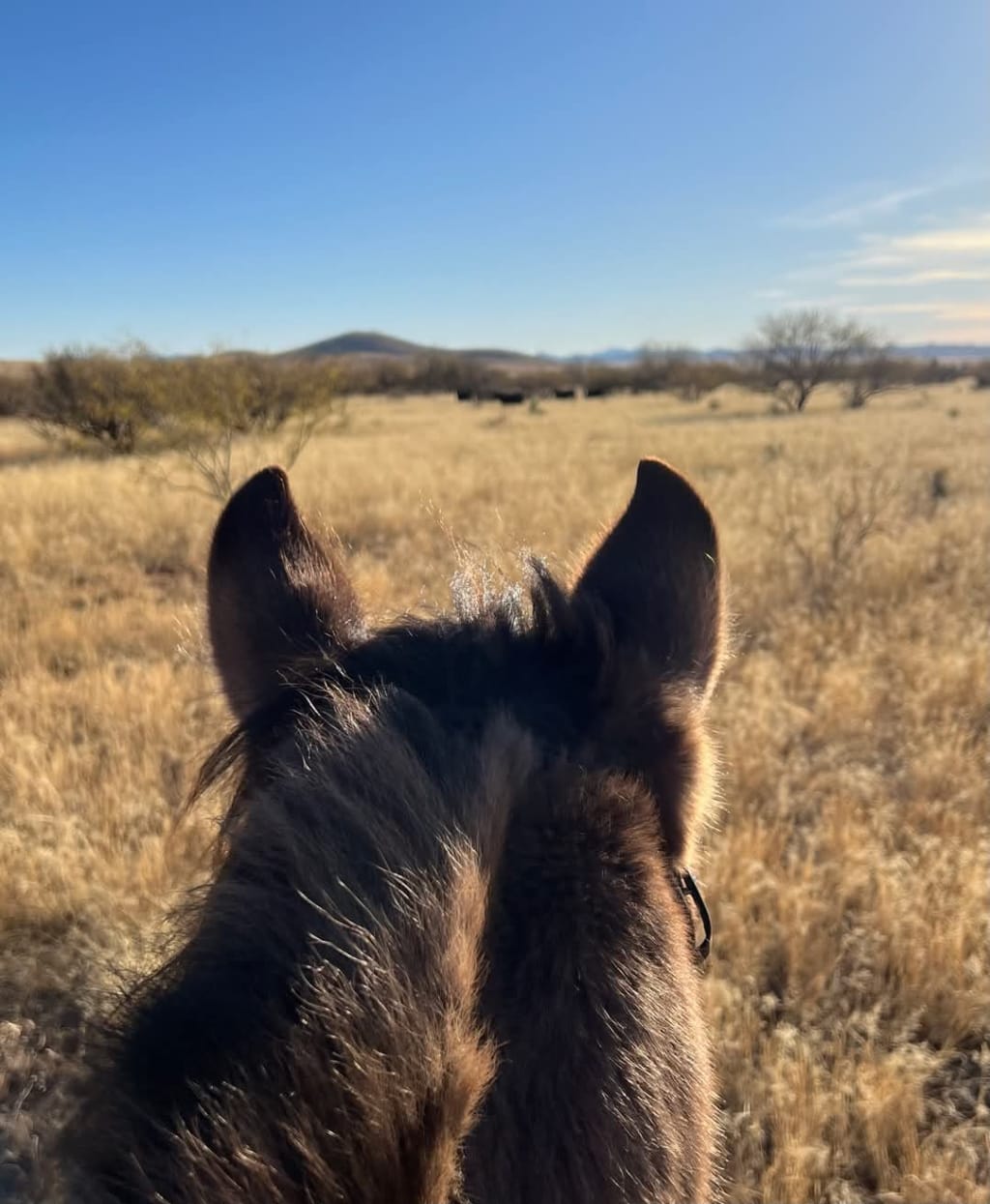
The air was heavy with the scent of earth, rich and fertile, as the sun hung low in the sky, casting long shadows across the fields. Violet stood at the edge of the homestead, watching the land stretch endlessly before her, green and gold beneath the wide, endless sky. The wind whispered through the trees, a gentle reminder of the quiet rhythm of the world she had come to know so well. The hum of crickets, the chirp of birds, the soft clink of the barn door opening in the breeze—these sounds had woven themselves into the fabric of her every day. They were the pulse of life, steady and constant.
She could hear Theodore’s footsteps behind her, his boots crunching over the gravel path, his breath steady and warm as he approached. His presence was a comfort, familiar and grounded. And yet, in this moment, Violet felt a strange stirring, a discomfort that she couldn’t name. It gnawed at her, hidden just beneath the surface, like the shadow of a storm gathering on the horizon.
Theodore stepped up beside her, his broad frame blocking the sun’s final rays. His brow was furrowed, eyes distant as he gazed over their fields. He placed a hand on her shoulder, a silent question in the gesture. Violet turned to him, her heart heavy with words unsaid.
“Do you ever wonder if we’re holding on too tightly to something that’s slipping away?” she asked, her voice barely above a whisper, as if speaking louder might summon the very change she feared.
Theodore’s lips twitched into a smile, but it was soft, knowing. He had always been the pragmatist, the one who saw the world for what it was—unchanging, dependable. But Violet had always been the dreamer, the one who felt the pull of something more. She was rooted in the soil beneath her feet, but her heart was always searching for something beyond the horizon.
“What do you mean?” Theodore asked, turning to face her fully now, his hands settling in the pockets of his worn trousers.
Violet hesitated, as if unsure whether to voice the discomfort that had taken root in her soul. But it had been growing for months, a seed that had taken hold and was now threatening to bloom into something undeniable.
“The man who came by this morning,” she began, her words hesitant, “the salesman with the fancy tins and pre-packaged foods... I cannot shake the feeling that what he offers is not just convenience. It is something far darker. A kind of forgetting.”
Theodore’s face softened, and he followed her gaze toward the fields where their children, Gabriel and Hannah, were running through the tall grass, laughing and chasing each other. The sight was a balm to Violet’s troubled heart. But even that peace was not enough to quell the rising tide of unease.
“I know what you mean,” Theodore said quietly. “I’ve been thinking about it, too. The world’s changing, Violet. People are more interested in the quick, the easy...”
Violet’s chest tightened, and she felt the weight of his words settle upon her like a stone in her stomach. But it wasn’t just that people wanted convenience. It was that they were forgetting the value of what it meant to grow something with your own hands, to nurture it, to understand the labor it took to bring something to life. The earth had always given them more than food—it had given them meaning, connection, purpose. What would happen if they lost that?
The salesman’s offer had felt like a wound in her heart—a reminder of how little the world valued the soil, the sweat, the simple joy of a meal made from the fruits of one’s own labor. Violet had seen it before, in the growing number of stores selling pre-packaged goods, in the small farms overtaken by the factory systems that churned out food like a machine. She had felt it deep in her bones that they were standing on the precipice of something terrible, something that could unravel the very fabric of their existence.
She looked at Theodore now, her eyes urgent, her soul aching with the need to be understood. “We cannot let them forget. We cannot let our children grow up thinking that food comes from nothing but a tin can, from a factory miles away, instead of from the earth beneath their feet.”
Theodore’s gaze softened, and for a moment, Violet saw the flicker of something in his eyes—a flicker of understanding. He had always been a man of reason, a man who believed in practicality. But even the most grounded of men could feel the tremors beneath the surface when something vital was at stake.
“We won’t let it happen,” he said, his voice steady but filled with a quiet resolve. “But we cannot do it alone, Violet. We need more than just us. We need the whole town to see, to feel what we’re feeling.”
Violet’s heart swelled with the weight of his words. She knew he was right. They had spent their lives cultivating not just crops, but a way of life that was rooted in authenticity and connection. But that way of life was being overshadowed by something faster, slicker, more efficient. The world was changing, yes, but it was changing in a way that made her want to hold on to the past, to cling to the simple, the real, the nourishing.
“I’ll speak to the women at the market,” she said, determination filling her voice. “And you, Theodore... you’ll talk to the men. We need to remind them what it feels like to break bread made from their own hands, to savor the taste of something that hasn’t been touched by machines.”
Theodore nodded, his brow set with quiet resolve. “We’ll plant the seeds, Violet. The rest will follow.”
The next days were filled with hurried conversations—whispers and urgent meetings beneath the cover of night. Violet and Theodore spread their message like a seed caught in the wind, letting it fall where it might. Slowly but surely, their neighbors began to listen. First it was just a handful of women, then a handful of men. There were murmurs at the market, where fresh vegetables and eggs began to reappear alongside the imported goods. Violet’s voice, soft but persistent, echoed in the hearts of those who still remembered what it was to grow something real.
The townspeople began to gather, slowly at first, around tables laden with food grown from the very soil beneath their feet. The air was thick with the smell of fresh bread, roasted root vegetables, and the sweetness of honey, still warm from the hive. Violet and Theodore watched as the people of their town—those whose hands had once been stained with the dirt of the earth—began to remember what they had forgotten.
It was not just food they were bringing back to the table. They were bringing back a way of life—a connection to the land, to one another, to the very essence of what it meant to be human. They were standing together in defiance of the world that sought to erase the simple, the honest, the real.
And in the years that followed, what began as a whisper turned into a cry—a rallying call for a movement that spread like wildfire. It was a movement born not from political upheaval or the clamor of industry, but from the quiet hearts of people who still knew the value of the earth beneath their feet. It was a movement that honored the sacred act of eating not just for sustenance, but for joy, for connection, for the simple pleasure of knowing where your food came from—and who had touched it with their hands before it reached your table.
And as Violet and Theodore stood together, hand in hand, watching their children run through the fields once more, they knew that they had made their choice. They had planted a seed, and it had grown into something far more powerful than they could have imagined—a movement that would not just feed the body, but the soul.
About the Creator
Taylor Ward
From a small town, I find joy and grace in my trauma and difficulties. My life, shaped by loss and adversity, fuels my creativity. Each piece written over period in my life, one unlike the last. These words sometimes my only emotion.
Keep reading
More stories from Taylor Ward and writers in The Swamp and other communities.
Binding Hearts, Building a Home
The beginning of a new year, like the slow breath of a tired soul finally at rest, always brings with it the quiet murmurings of hopes and goals, old and new. It’s in the cold air of January that one’s thoughts tend to scatter like leaves in the wind, but there’s something about the stillness of winter that invites the heart to settle, to reflect. So here I sit, on this first Sunday of the new year, looking over my household, and I reckon it’s time to set a course, one that binds this family of mine not to each other, but to the Lord—secure and undividable, like a knot too strong to ever be undone.
By Taylor Wardabout a year ago in Motivation
Parallel Protests
I haven't written for quite some time, but I have A LOT of thoughts about yesterday's protest rally against our government's involvement and complicity in America's war on Iran, on the harbourside of my home city Bristol, and I need to put them somewhere. My gorgeous girlfriend is always a loving and listening ear and sharing it all with her will always be a healthy and happy way of processing the mental and emotional weight, but getting it straight in my brain to share means writing it all down in straight lines, so, here we are and thanks for being here.
By Steph Cole10 days ago in The Swamp


Comments (2)
What A beautiful story - We should never forget the way of life of our forefathers. I used to tell my sons, you couldn't press a button on the computer and have a green bean come out. That is not how God intended it to be. Well Done!!!
I enjoyed this rich perspective, heavily influenced by hardworking, rural community values.