
The Enigma of Putin’s “Second Body”
Myth, Strategy, or Political Reality?


Have you ever heard the theory that powerful leaders use doubles to protect themselves? It’s one of those ideas that sounds straight out of a spy novel, but when it comes to Vladimir Putin, Russia’s long-time leader, the rumor has circulated for years with surprising persistence. Known popularly as the claim that Putin has a “second body” or political double, this idea mixes conspiracy, state secrecy, and the mysterious aura that has surrounded him for decades. But is there any truth to it, or is it simply another myth that keeps the intrigue around him alive?
One of the reasons this theory refuses to disappear is Putin’s own background. Before entering politics, he worked as a KGB officer, a world built on deception, misdirection, and absolute control of appearances. Many people find it completely believable that someone with such a background would employ body doubles—whether for personal security or strategic advantage. After all, political figures like Joseph Stalin and Saddam Hussein are known to have used doubles in the past. If it worked for them, why not for a modern leader like Putin?
The concept of a “second body” is both literal and symbolic. Literally, it refers to the possibility of trained doubles replacing Putin in public events to reduce assassination risks or to allow him to be in two places at once. Symbolically, however, the phrase also represents the dual image of Putin himself—the strongman portrayed to the world versus the private man few truly know. Russia’s tightly controlled media often shows him as invincible: bare-chested on horseback, diving deep into the sea, or practicing judo. Whether real or exaggerated, these images have created an almost mythical version of the leader, one that feels just as much a “double” as any real look-alike could be.

What makes the theory even more intriguing is the number of times Putin has appeared in public looking slightly different—sparking whispers about possible stand-ins. Photos comparing his jawline, facial structure, and even his expressions have fueled online debates. In 2020, a Russian security expert even admitted that the Kremlin had considered using body doubles in the past, though they claimed Putin rejected the idea. Of course, skeptics argue that subtle changes in appearance are normal for anyone as they age, and cameras, lighting, and stress can easily alter how someone looks. Still, the speculation lingers.
Beyond the fascination with doubles lies a deeper psychological and political significance. Leaders like Putin thrive on mystery. The uncertainty of whether the man on screen is truly him keeps both allies and opponents guessing. This calculated ambiguity strengthens his aura of control—if people can’t even be sure they’re seeing the real Putin, how much more unpredictable might his next move be? In that sense, the “second body” becomes a weapon in itself, a tool of political theater that reinforces his dominance.
At the same time, the rumor speaks to something broader: society’s fascination with the idea that powerful figures are more than human. We want to believe they have secrets, tricks, and hidden strategies that keep them one step ahead of the rest of us. The “second body” rumor feeds that hunger for mystery. It reflects not only suspicion toward authoritarian power but also our own tendency to turn leaders into legends, whether good or bad.
Interestingly, the “two bodies” idea also has roots in history. In medieval times, kings were often thought to have a “body natural” and a “body politic”—the first being mortal and fragile, the second being eternal and symbolic, representing the state itself. In Putin’s case, this plays out in modern form: his physical self may age, weaken, or face threats, but his political persona—whether embodied by him or a double—remains untouchable, a living emblem of Russian power.
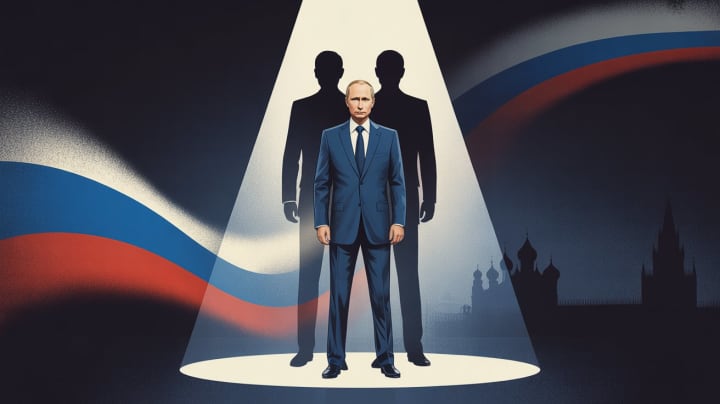
Of course, hard evidence for a real Putin double has never been publicly proven. But the power of the rumor is undeniable. It shapes how people think about him, it keeps global media buzzing, and it adds yet another layer to his carefully constructed mystique. Whether true or false, it serves its purpose: keeping Putin in the spotlight as a figure who cannot easily be pinned down, either physically or politically.
So, what do you think? Is the idea of Putin’s “second body” a clever piece of political myth-making, a practical security measure hidden in plain sight, or just another conspiracy theory we can’t resist believing? Share your thoughts in the comments below—I’d love to hear whether you see it as fact, fiction, or something in between.
About the Creator
John Smith
Man is mortal.
Keep reading
More stories from John Smith and writers in The Swamp and other communities.
Parallel Protests
I haven't written for quite some time, but I have A LOT of thoughts about yesterday's protest rally against our government's involvement and complicity in America's war on Iran, on the harbourside of my home city Bristol, and I need to put them somewhere. My gorgeous girlfriend is always a loving and listening ear and sharing it all with her will always be a healthy and happy way of processing the mental and emotional weight, but getting it straight in my brain to share means writing it all down in straight lines, so, here we are and thanks for being here.
By Steph Cole7 days ago in The Swamp
New Status Quo: Germany Reaches for European Conventional Military Dominance
Germany is moving rapidly to transform its armed forces and assume a leading role in Europe’s conventional military balance, signaling what analysts describe as a “new status quo” for the continent’s security architecture. After decades of restraint following the Second World War, Berlin is now investing heavily in defence capabilities, seeking to position itself as the central military power within Europe. The shift gained momentum after the Russian invasion of Ukraine, which fundamentally altered Europe’s perception of security threats. The conflict prompted Olaf Scholz to announce a historic “Zeitenwende,” or turning point, in German defence policy. Under this initiative, Germany pledged to dramatically increase military spending and modernize the Bundeswehr. Massive Defence Investment Germany created a special €100-billion fund dedicated to upgrading its armed forces. The plan includes new fighter jets, armored vehicles, air defence systems, and digital battlefield technologies. Berlin has also committed to consistently meeting the defence spending target set by NATO, which requires member states to spend at least 2% of their GDP on defence. Among the major acquisitions are the advanced F‑35 Lightning II jets, which Germany intends to use to maintain NATO’s nuclear-sharing arrangements. The country is also investing in missile defence, including participation in the European Sky Shield Initiative, designed to create a continent-wide shield against missile threats. German military planners believe these investments will allow the Bundeswehr to become Europe’s most capable conventional military force. The goal is not only national defence but also the ability to lead multinational operations across the continent. Leadership Within Europe Germany’s renewed military ambitions reflect broader changes in Europe’s security environment. For decades, European defence relied heavily on the United States. However, uncertainty about future American commitments has pushed European countries to strengthen their own capabilities. Berlin is increasingly positioning itself as the leader of these efforts. Germany has expanded its role within NATO’s eastern flank, deploying troops and equipment to countries such as Lithuania to deter potential aggression. German officials have also proposed forming a permanent brigade in the region, marking one of the most significant overseas deployments in the Bundeswehr’s history. At the same time, Germany is deepening defence cooperation with partners such as France and Poland, aiming to create a stronger, more integrated European military framework. Joint projects include next-generation tanks, fighter aircraft, and advanced defence technologies. Challenges and Debate Germany’s rapid military expansion has sparked debate both domestically and internationally. Some political groups worry about the financial burden of increased defence spending, especially at a time when Europe faces economic pressures. Others argue that Germany must overcome bureaucratic hurdles and procurement delays that have historically slowed military modernization. Within Europe, reactions have been mixed. While many allies welcome Germany’s willingness to shoulder greater responsibility for regional security, some countries remain cautious about the prospect of Berlin becoming the continent’s dominant military power. Historical sensitivities still shape perceptions of German military leadership. A Changing Security Landscape Despite these concerns, the broader trend toward stronger European defence appears irreversible. Russia’s war in Ukraine and rising global tensions have convinced many policymakers that Europe must be able to defend itself more independently. For Germany, this moment represents a profound transformation. The country is shifting from a cautious security posture to a leadership role in Europe’s military structure. If Berlin’s modernization plans succeed, the Bundeswehr could emerge as the central pillar of Europe’s conventional defence capabilities. The result may be a new strategic balance across the continent—one in which Germany plays a far more prominent role than at any time since the Cold War.
By Fiaz Ahmed 4 days ago in The Swamp
Writing To Succeed
If you want to find something that will help readers find your writing, possibly expand your audience, and maybe even get you noticed for other things, then you’re not alone. But how can you get it done in a world full of want-to-be writers? Look less at what you’re writing now, and more at what other writers have used to boost their views and reads.
By Jason Ray Morton 3 days ago in Writers



Comments (1)
yes