


The US today has become the antistes of what our nation was supposed to be. We have lost sight of our founding principles where life, liberty, and the ability to not only pursue but actually achieve relative happiness has ceased to exist for millions. Never before in our brief history have, we seen so much unapologetic behavior where lives and livelihoods have been lost due to the disingenuous policies that our politicians and many corporate leaders of industry continue to unleash unto the American public.
The wheels of injustice have already started turning. No longer are we in control of our own destiny. The erosion of our founding principles has unleashed the juggernaut of invasive and destructive policy directives eliminating any chance that we the public will ever regain our moral compass. We inadvertently succumbed to false pretenses fueled by our own disillusion to the realities of our own doing.
We are now living in a world void of the pleasantries of a time long since passed. The scope of the harshness of our world is vast complicated by the destructive nature that governments impose onto the public. With no rhyme and apparently no reason the new Trump administration has set off a chain of events that are bound to have almost irreversible consequences for millions the world over.
Many can remember what Christmas and the holiday season was like many years ago. Now we are thrust into an era where apprehension confronts our failure to recognize what we have actually done to society. Could it be that the tempo of life has moved to fast or that we again have failed to learn from what history is supposed to teach us?
It is at this time of year where remembrance of things past should come into focus and awaken a sense of nostalgia that all good things in life be passed on for generations to come. And yet what have we today is an awareness like that old song by Chad and Jeremy "all good things must end someday, Autumn leaves must fall" is the fate of our world.
Bleak, yes. But there is a way to save ourselves from ourselves in a way not too many realize. With the ever-encroaching dangers of global warming, the obsessiveness of Trump, Putin and others for power, control and wealth continue to push the world toward a destiny far removed from the hopes and dreams of millions. Still, we for the most part ignored what we should have learned the lessons history is supposed to teach us.
The probability of a second Trump administration falling in line with tactics similar to Nazi Germany of the 1930's is a reality we can't dismiss as just incoherent rhetoric. We the public have to realize that we as citizens of the United States have an obligation just like what Thomas Jefferson warned us about over 250 years ago. We have to preserve our heritage and restore our democratic republic to the principles of our founding. The future is in our hands. We cannot wallow in disbelief and ignore what has happened to our nation and the world.
Due diligence is at hand. Some may say it is too late to turn our nation around. We have allowed the infestation of corrupt demagoguery to take control of our nation's direction. We have strayed away from the sacred honor of our traditions and heritage. The transformation of America from the stewardship of democracy to one of oligarchy has almost cemented our greatest failure as a nation.
If we are to turn the US around from the destructive path that we ourselves allowed to happen then there must be the willingness of the public to see the train wreck that lies ahead. Our future depends on what we do.
I
About the Creator
Dr. Williams
A PhD in Economics. Author of National Economic Reform's Ten Articles of Confederation.
Keep reading
More stories from Dr. Williams and writers in The Swamp and other communities.
The Cosmopolitan
It was a cool autumn day and for Henry Hughes the day started out auspiciously enough. But all that was about to change. Henry now scratching his already graying hair began remembering what he was supposed to do today. Last night the reception for Prince Alexander was the event that all New Yorkers had been anticipating. Then of course there was Regina, a Egyptian delegate, a most sultry women whose flowing emerald gown seemed to draw the attention of most of the men. The way she wore that dress was like a magnate that would hypnotize any man who was close enough to fall for her charms. Henry, though could not be seduced. Not on that night. As an undercover operative for the secret service where only the President and the Chief of Staff knew of his assignment the balance of world power was at stake. At the reception Henry had made arrangements with Count Drackol to meet at the top of Freedom Tower around 10 this morning. Count Drackol whose real identity was a KBG agent sent on behave of President Putin where the two would collaborate to ensure that the balance of power would remain stable after the escalating insurgency of ISIS in Syria which had spread through Turkey and now is on Israel's front door.
By Dr. Williams3 years ago in The Swamp
A Gathering of Evil Bosses
“I’m the queen of chin jutting while I smooth my hair, attacking, insulting, and deflecting to protect my appointer.” “Oh, please, Blondi, my hair is curled, highlighted, and longer than yours. I feature television commercials telling immigrants that we will give them a free plane ride home, and if they voluntarily turn themselves in, they will be allowed to legally apply for re-entry. It runs everywhere, and I look good in it! You can’t compete because of your blond hair. Mine is nicer, and my lips are prettier than yours.”
By Andrea Corwin 11 days ago in The Swamp
War on the Brink: US-Israel Strikes on Iran Spark a New Middle East Crisis
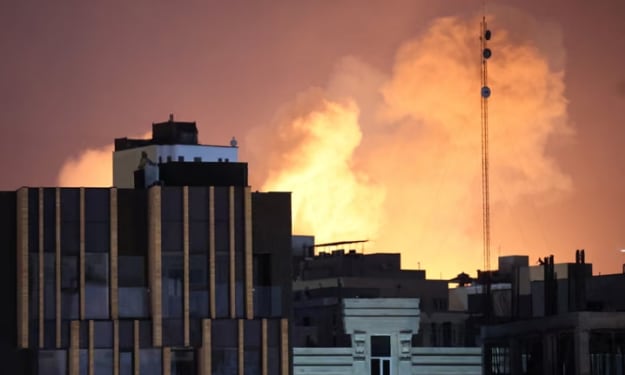
The Middle East has once again become the center of global attention after a dramatic escalation between United States, Israel, and Iran. What began as rising tensions over nuclear ambitions, military alliances, and regional influence has now erupted into a full-scale military confrontation. Recent coordinated strikes by the United States and Israel targeted multiple strategic locations inside Iran, including military facilities, missile bases, and command centers. The operation marks one of the most significant direct confrontations between the Western allies and Iran in modern history. As the situation unfolds, governments around the world are watching carefully, aware that this conflict could reshape the geopolitical landscape of the Middle East and possibly the entire world. How the Crisis Began For decades, tensions between the United States, Israel, and Iran have simmered beneath the surface. The roots of the conflict lie in ideological differences, regional power struggles, and disputes over Iran’s nuclear program. Iran has long insisted that its nuclear activities are intended for peaceful energy production. However, Washington and its allies believe Tehran has been pursuing nuclear weapons capabilities. Israel, which views Iran as its most significant strategic threat, has repeatedly warned that it will not allow Iran to obtain a nuclear bomb. These tensions escalated after intelligence reports suggested Iran was advancing its nuclear enrichment capabilities faster than expected. Diplomatic negotiations stalled, and the possibility of military action began to grow. The situation finally reached a breaking point when joint US-Israeli forces launched large-scale strikes aimed at crippling Iran’s military infrastructure. The Military Operation The coordinated attacks involved advanced fighter jets, long-range missiles, and sophisticated surveillance technology. Military analysts say the strikes were carefully planned to disable Iran’s air defense systems and command networks. Several key facilities reportedly targeted include missile depots, drone bases, and strategic command centers belonging to the Islamic Revolutionary Guard Corps. The Revolutionary Guard plays a crucial role in Iran’s defense strategy and is responsible for many of the country’s regional operations. By targeting this organization, the United States and Israel aimed to weaken Iran’s ability to coordinate military responses. According to reports, the operation involved dozens of aircraft and drones operating across multiple regions of Iran simultaneously. Statements from Washington Following the strikes, Donald Trump addressed the situation, stating that the operation was “moving along rapidly” and had achieved significant success. Trump argued that the mission was necessary to prevent Iran from developing nuclear weapons and to protect both American and Israeli security interests. In his statement, he suggested that several senior Iranian military leaders had been eliminated during the attacks. While exact numbers remain unclear, the claims indicate the operation was designed to disrupt Iran’s leadership structure. The White House emphasized that the strikes were meant as a defensive measure rather than an attempt to start a wider war. However, many analysts believe the consequences could extend far beyond a limited military operation. Iran’s Immediate Response Iran responded quickly, launching missile and drone attacks toward Israeli territory and targeting American military installations in the region. Iranian officials condemned the strikes as an act of aggression and warned that retaliation would continue if attacks persist. Iran’s military leadership declared that the country would defend its sovereignty and punish those responsible for the operation. In televised statements, Iranian leaders emphasized that their armed forces remain capable of responding strongly despite the damage caused by the initial strikes. The Risk of Regional Escalation One of the biggest fears surrounding the conflict is the possibility that it could expand into a much larger regional war. Iran maintains strong ties with several groups and governments across the Middle East. These alliances mean that fighting could spread quickly beyond Iran’s borders. Countries such as Lebanon, Syria, and Iraq could potentially become involved through various regional factions and military alliances. If that happens, the conflict may evolve into a broader confrontation involving multiple governments and armed groups. Such a scenario would dramatically increase the humanitarian and political consequences of the crisis. Global Reactions The sudden escalation has triggered strong reactions around the world. Several governments have called for restraint and urged both sides to return to diplomacy. United Nations officials warned that further escalation could destabilize the entire region and lead to a humanitarian disaster. Major global powers including China and Russia expressed concern over the military action and called for immediate dialogue to prevent a wider conflict. European leaders also emphasized the importance of maintaining diplomatic channels and avoiding steps that could push the region toward a full-scale war. Impact on Global Oil Markets The conflict has already begun to affect global financial markets, particularly energy prices. Iran sits near the Strait of Hormuz, one of the most critical shipping routes for global oil supplies. Nearly one-fifth of the world’s oil passes through this narrow waterway. Any disruption in the region could cause significant spikes in energy prices worldwide. Markets have already shown signs of volatility as investors react to the possibility of prolonged instability in the Middle East. Energy experts warn that if the conflict intensifies, oil prices could rise dramatically, affecting economies across the globe. Humanitarian Concerns Beyond the geopolitical consequences, the human cost of the conflict is also a growing concern. Airstrikes and missile attacks have caused casualties and damage to infrastructure in several areas. Hospitals, emergency services, and humanitarian organizations are preparing for the possibility of further violence. If the conflict spreads, millions of civilians could be affected through displacement, economic disruption, and shortages of essential goods. Humanitarian groups have called on all parties to prioritize the protection of civilians and respect international humanitarian law. Diplomatic Efforts to Prevent Wider War Despite the escalation, diplomatic efforts are continuing behind the scenes. International mediators are attempting to open channels of communication between the parties involved. Some governments are offering to act as intermediaries in order to reduce tensions and encourage negotiations. However, achieving a diplomatic breakthrough will likely be extremely difficult given the deep mistrust that exists between the opposing sides. The Future of the Conflict At this stage, the future of the crisis remains uncertain. There are several possible scenarios: The conflict could remain limited to targeted strikes and retaliatory attacks. Diplomatic efforts could lead to a temporary ceasefire. The situation could escalate into a broader regional war involving multiple countries. Military experts believe that the next few weeks will be critical in determining which path the conflict takes. The decisions made by leaders in Washington, Tehran, and Jerusalem will shape not only the future of this crisis but also the stability of the Middle East for years to come. A Defining Moment for the Middle East The confrontation between the United States, Israel, and Iran represents one of the most serious geopolitical crises of the decade. Beyond the immediate military actions, the conflict raises fundamental questions about nuclear security, regional power dynamics, and the limits of diplomacy. Whether the situation moves toward peace or deeper conflict will depend on the willingness of all sides to balance strategic goals with the urgent need to prevent a catastrophic war. For now, the world watches closely as events continue to unfold in one of the most volatile regions on Earth.
By Zahid Hussainabout 7 hours ago in The Swamp



Comments (1)
Hey Williams Subscribe me