

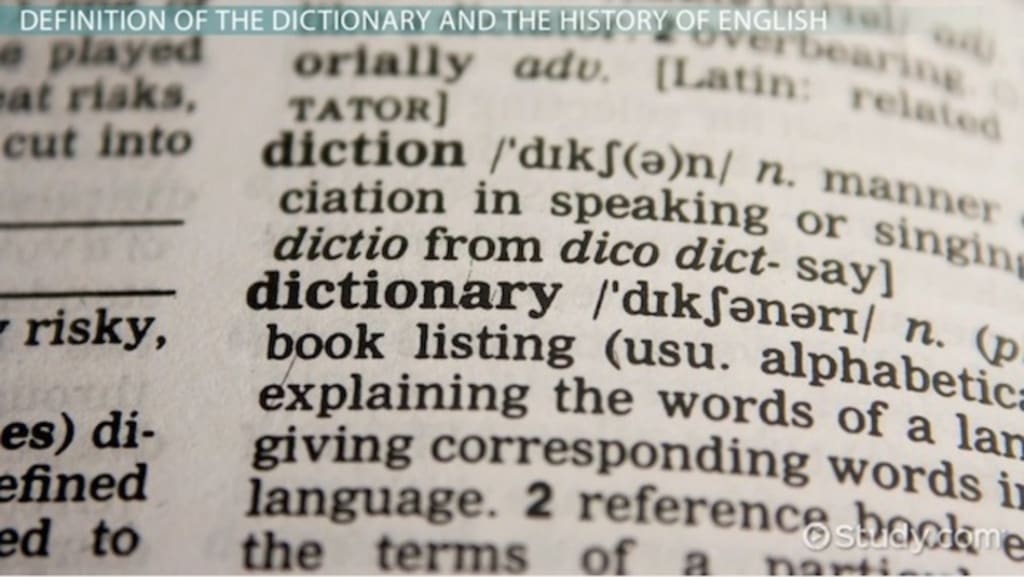
The dictionary definition of...
The dictionary defines ________ as:
Tell me you've heard this, tell me that you've been in a discussion where things were going swimmingly and then you find yourselves arguing in circles and someone trots out the dictionary, as if it was the end-all be-all source document for humanity.
It's a fairly good tool for etymology, proof-reading, and finding synonyms. It does not, and should not have the final say in a culture where meanings for words change every day.
The Oxford dictionary updates four times a year. What happens if important changes aren't employed in the newest version? Does the dictionary follow the language of the people or do we follow the language of the people? The answer of course is that the dictionary is always behind.
This came up most recently in a discussion about race, inequality, discrimination, and prejudice. All terms that have been relatively fluid in our culture today.

The quote that sparked the discussion was from actor/comedian Seth Rogen, when he said
“I mean personally, I think I am just actively trying to make less things starring white people."
The talking point started off with a trick question:
Which of the below statements is racist?
I mean personally, I think I am just actively trying to make less things starring white people.
I mean personally, I think I am just actively trying to make less things starring black people.
The author of the question intended it to point out an 'obvious' double standard, and that because this Seth Rogen character is not creating anymore films starring white people he is therefore racist.
It was an open forum discussion that I won't put the entirety of here, but a lot of people saw through the obvious trick question and answered deeper and more concerning issues.
Which is when the innocence card and 'call to origin' came into play. This is often seen by the author saying something along the lines of: "All I've done is ask a simple question that no one seems to be able to answer"
When that arises I try as best I can to not overreact so the response by one person was:
"The one about black people is the racist one. The bottom one is racist. The racist one is the one about black people - that's the racist one. To answer the simple question."
It got a few laughs, but the author was of course disappointed that the answer to the question was not what he expected. He even expressed his dismay by saying that it was "Unfortunate that we did not see that it is both statements that are racist."
Then
Then!
THEN!
He brought out the dictionary saying,
The dictionary definition of racism is this:
the belief that different races possess distinct characteristics, abilities, or qualities, especially so as to distinguish them as inferior or superior to one another
So by dictionary definition both statements were racist.
It should be noted that the dictionary has two definitions of racism, one of which he chose not to employ but here it is:
prejudice, discrimination, or antagonism directed against a person or people on the basis of their membership in a particular racial or ethnic group, typically one that is a minority or marginalized.
Which is better, but still not the whole picture is it?

Now I understood.
I understood why we couldn't see eye to eye. On a surface level I can comprehend that he had ill intentions from the start, and that he probably doesn't believe that systemic racism is real. But now I was coming to terms with what what was really happening.
We were arguing semantics.
There are other, and better definitions of racism defined by psychologists, by peer-reviewed articles, by anthropologists, historians, and social scientists. The dictionary then cannot be used in this type of forum to articulate our opinions adequately.
Both of his quoted statements are racially charged, prejudiced to an extent, discriminatory, but only one of them is racist. I won't go into the minutia of the differences between all of them, but most of them are opinion based, and racism has to have a power structure differential to be considered racism.
Without that basic understanding we can never agree.
We must agree on the terms and definitions of words that we use.
So in the future of debates, discussions, and arguments let's do this: Let's define all of the terms. Racism is only one of them, but there are far more that will need to be agreed upon: Sex. Gender. Equality. Justice. Equity. Wealth. Greed. Power. Rebellion. Protestation. Peace.
For every single one of those words, the dictionary has a succinct definition. Every single of them is also incomplete. The current dictionary fails to incorporate feelings, current status quos, current culture, distinct nuances, and finally context.
We must not isolate ourselves into two dimensional definitions for things which have three dimensional impacts.
The dictionary is a good record of things that exist already. Words that we already use.
It cannot contain pursuits, goals, ideals, and dreams -those are things of the future - and the future is undefined.
***
There are more than these, but here are a few sources that suggest the current dictionary definition for racism is insufficient.
https://www.vox.com/identities/2020/6/10/21286656/merriam-webster-racism-definition
https://journals.sagepub.com/doi/full/10.1177/0731121420964239
About the Creator
John Eva
I just like writing.
Why Black History Matters in America?
The United States of America is celebrating their 250th anniversary in 2026. I'm proud to be an American and as someone who was born here, I wouldn't imagine myself living anywhere else. This is a country where opportunities are possible. Where anyone can be successful in anything they desire to do. Equality, community, and togetherness are the backbones of what America is and should be about. However, we have an administration who wants to erase and disregard those who have made positive, meaningful impacts in our country, specifically Black figures, such as Martin Luther King, Jr., Rosa Parks, and Maya Angelou. President Trump and his administration have been constantly complaining and fighting against what they call the "Woke agenda". They use this excuse as a distraction from other issues they refuse to address, such as the high cost of living, climate change, and inflation. That equality is dividing America, when in reality, it's bringing us together. Being woke is not tied to a specific political party. No matter where you stand on the political spectrum, you can still care about other people and their plights. Compassion and empathy for others isn't tied to a political party, either. We were taught as children to treat others the way we want to be treated and not judge others because they're different from us. Caring about others isn't a personal attack on your beliefs. It doesn't make you any less of a person. People who are easily offended over African American figures, past or present, or anything related to it, are grasping at straws. Current and future generations need to know who people like Harriet Tubman and Shirley Chisholm were, especially in the classroom. Black History is part of American History. It should be recognized, not hidden or forgotten. Besides, you can't shield children from everything, just because your feelings are easily hurt.
By Mark Wesley Pritchard 27 days ago in The Swamp


Comments
There are no comments for this story
Be the first to respond and start the conversation.