
🎯 The Death of Spontaneity
🧠 In a world curated by data, what do we lose when we stop choosing for ourselves?

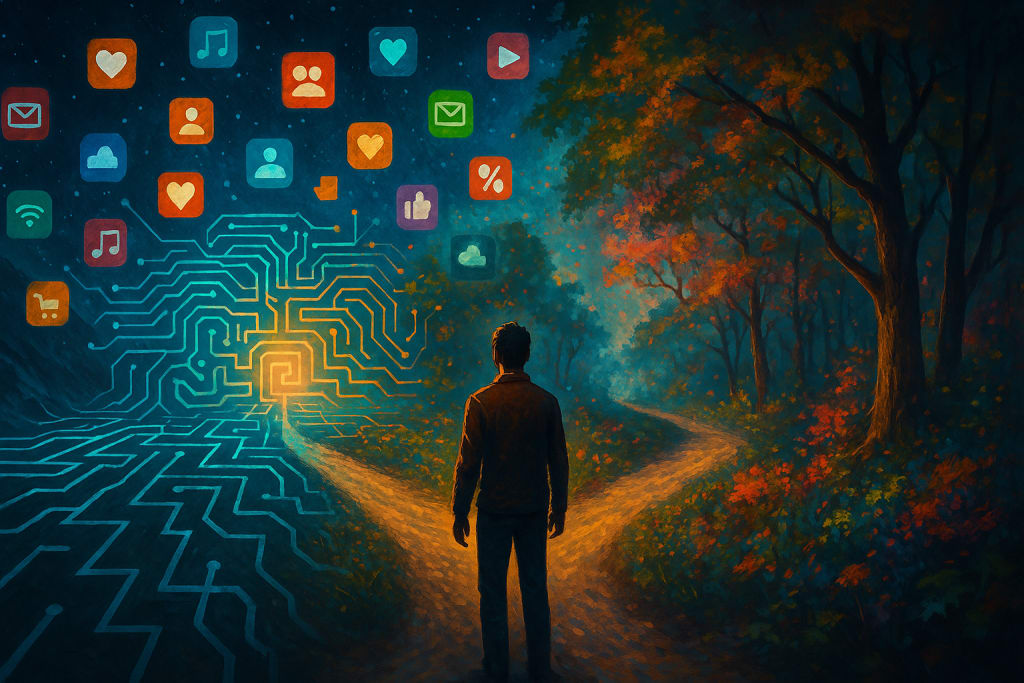
Once upon a time, you could get lost. You could stumble upon a book in a dusty bookstore, find a band by accident on late-night radio, or meet a stranger on a train who’d recommend a city you'd never thought to visit. Now, our lives are mapped by algorithms designed to predict what we’ll like, where we’ll go, and even who we might become. This is the age of engineered spontaneity—where every “surprise” is a calculated guess based on previous clicks.
But what happens to the human spirit when nothing is truly random anymore?
The All-Seeing Eye: How Algorithms Work
At their core, algorithms are just sets of rules designed to solve problems. But when they’re fed oceans of personal data—from your search history to your heartbeat—they evolve into something far more powerful: predictive engines that shape behavior.
Netflix recommends shows based on what you’ve already watched. Spotify predicts your moods through musical preferences. Instagram serves you content that reinforces your beliefs. Every swipe, scroll, and tap reinforces a pattern, a statistical model of you.
And what’s more disturbing? The models are getting better—and we’re getting more predictable.
The Illusion of Choice
You believe you're making choices. You pick that song, that jacket, that article. But how much of your decision was yours, and how much was the algorithm nudging you—subtly, invisibly?
When Spotify auto-generates your playlists, it isn’t asking what you want to hear. It’s reinforcing your comfort zone. When Instagram shows you reels of the same type over and over, it’s not expanding your view—it’s compressing it. These systems optimize for engagement, not enlightenment.
True spontaneity—a detour, a mistake, a chance encounter—is algorithmically discouraged. The unexpected is inefficient. But the unexpected is also what makes life vivid.
The Psychological Toll
Our inner lives are shrinking. Not because we don’t think, but because we don’t wander. Creativity thrives on randomness, on broken patterns, on the tension between the known and unknown.
When algorithms sterilize your experience, they also dull your curiosity. You start expecting instant gratification, perfect recommendations, seamless interfaces. But in this smooth, curated life, friction disappears—and so does growth.
Psychologist Mihaly Csikszentmihalyi, who coined the concept of flow, emphasized that challenge and novelty are essential for deep satisfaction. When life is too predictable, we become bored, anxious, and passive.
Dating Without Serendipity
Take love, for example. Dating apps have transformed courtship into a gamified market of calculated matches. While they claim to increase your chances of “compatible” partners, they also eliminate randomness—those magical, chaotic moments of locking eyes across a room or stumbling into a conversation in a bookstore.
When romance is pre-sorted by filters and preferences, it begins to resemble a grocery list more than a love story.
The Cultural Homogenization Effect
On a global scale, this hyper-personalization leads to something even stranger: cultural homogenization. Algorithms often push what's already popular—creating echo chambers not just of opinions, but of aesthetics, humor, fashion, and even morality.
As a result, cities around the world begin to feel eerily similar. Cafés serve the same viral dishes. Tourists seek out “Instagrammable” spots. People dress alike, talk alike, think alike—not because they’ve been told to, but because they’ve been gently steered that way.
We are slowly being funneled into one vast cultural monoculture.
Reclaiming Randomness
So, how do we fight back?
It begins with intentional randomness. Read a book outside your genre. Listen to a playlist someone else made. Take a walk without your phone. Ask a stranger what their favorite film is—and watch it.
Some companies are even trying to build anti-algorithmic features. There are apps that recommend random destinations, Spotify plug-ins that inject unfamiliar tracks, browser extensions that block algorithmic feeds.
But the best antidote might be something ancient: boredom. Unstructured time forces the mind to wander, imagine, and create. In boredom, spontaneity is born.
Conclusion: The Right to Be Surprised
We’ve gained convenience, connection, and content beyond our wildest dreams. But we’ve lost the joy of not knowing what comes next. In surrendering our choices to algorithms, we’ve risked something deeper: our agency, our uniqueness, and our inner complexity.
Spontaneity isn’t just an aesthetic preference—it’s a psychological need. It’s the breath of freedom in a predictable world. If we don’t reclaim it, we may wake up one day to find our lives perfectly curated—but utterly lifeless.
So the next time you’re about to let an app decide for you, ask yourself: what would happen if I chose differently?
About the Creator
Ahmet Kıvanç Demirkıran
As a technology and innovation enthusiast, I aim to bring fresh perspectives to my readers, drawing from my experience.
Keep reading
More stories from Ahmet Kıvanç Demirkıran and writers in The Swamp and other communities.
The Subscription Society: Renting Happiness in a World That No Longer Sells It
Imagine waking up one morning and realizing that nothing in your life is truly yours—not your apartment, not your furniture, not even your playlists. You don’t own your entertainment; you stream it. You don’t own your clothes; you subscribe to monthly fashion drops. You don’t even own your data; it's leased to the highest bidder. Welcome to the Subscription Society, where permanence is passé, and everything—including happiness—comes with a recurring fee.
By Ahmet Kıvanç Demirkıran9 months ago in The Swamp
A Dart at Dusk
Seconds ago, the sullen sun set on the two of us… my exuberant furry companion and me. A fresh breeze embraces us, delivering welcome relief from the day’s oppressive heat. His typical stumbling and staggering along — apace with a sloth — has turned into trip-trapping, high-stepping, almost skipping along.
By Angie the Archivist 📚🪶5 days ago in Petlife


Comments (2)
This is an interesting story and well written.
Ihave read your story very nice. you have written good words in last story those like me So the next time you’re about to let an app decide for you, ask yourself: what would happen if I chose differently?