
The Cracks in the Coalition: Inside the Unraveling of Trump’s Once-Unstoppable Alliance
How Economic Strain, Immigration Battles, and the Epstein Files Are Pulling Trump’s Once-Unified Movement Apart

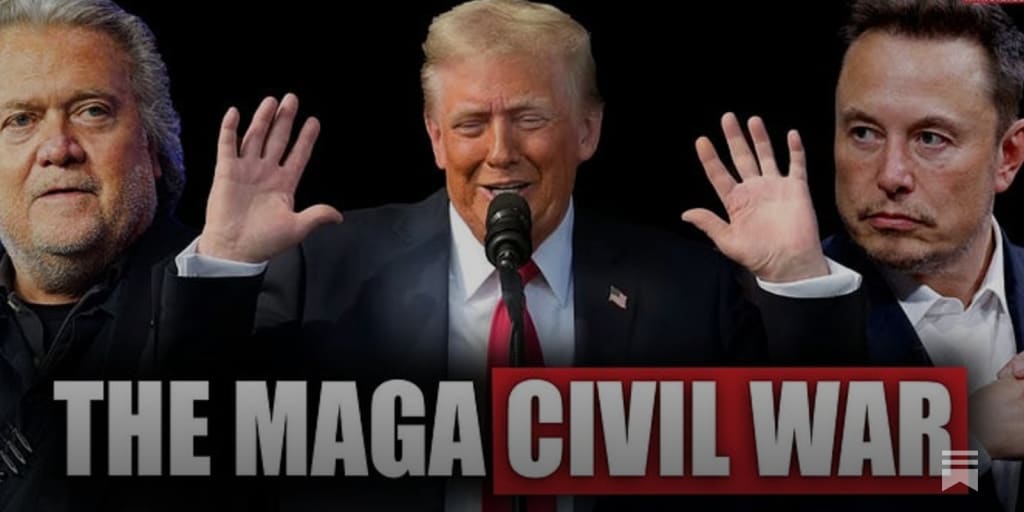
When Donald Trump descended that now-legendary golden escalator inside Trump Tower on June 16th, 2015, he launched what most pundits assumed would be a doomed vanity campaign. What followed, of course, was anything but. Trump assembled one of the most unusual political coalitions in modern American history: Rust Belt factory workers and Wall Street donors, rural evangelicals and suburban business owners, border hawks and free-market Republicans. Groups that historically regarded each other with suspicion—or outright hostility—somehow found themselves voting in the same direction.
For nearly a decade, even through a global pandemic, economic chaos, and two impeachments, that alliance held. Until now.
By late 2025, the seams on the once iron-clad MAGA coalition have begun to fray. From small business owners squeezed by tariffs, to populist conservatives furious about immigration messaging, to conspiracy-minded voters now turning their ire toward the very leader who fed their suspicions—the fractures are widening in ways Trump himself may no longer be able to hold together.
Whether these tensions are temporary growing pains or the beginning of a full-blown civil war within the Republican Party is the political question of the moment.
A Coalition Built on Contradiction
Political divisions inside parties are nothing new—America’s two-party system practically guarantees internal conflict. Republicans have long been home to both moderates like Susan Collins and hardline conservatives like Ted Cruz. And now, the rise of the “New Right”—epitomized by Vice President J. Dance—has added a new economic-populist wing that openly challenges the pro-business orthodoxy of traditional GOP donors.
Democrats have endured their own ideological war between centrists and progressives, with figures like Bernie Sanders and Alexandria Ocasio-Cortez pulling the party leftward while moderates like Joe Manchin and Kyrsten Sinema broke ranks entirely.
Trump’s unlikely genius was not in eliminating these differences but absorbing them. Under his leadership, Republicans became younger, more diverse, and far more populist. By 2024, one in five GOP voters were non-white. Hispanic men supported Trump at rates that once seemed impossible for a Republican candidate. Younger working-class men who skipped previous elections showed up for him.
And in his first term, he delivered just enough to keep each faction satisfied.
The 2017 tax cuts reassured the business wing. Early tariffs on China gave Rust Belt workers a sense of protection—and, perhaps more importantly, a sense of being seen. Wages rose, unemployment fell to historic lows, and inflation barely registered. For a brief moment, it felt as if every slice of the Republican coalition had something to brag about.
Strong economies have a way of making internal contradictions look like harmony.
But 2025 is not 2019.
A New Economic Reality—and a New Kind of Discontent
When Trump was inaugurated again in January 2025, he declared—without irony—that a “golden age of America” had arrived.
But the country he inherited wasn’t primed for golden anything.
Inflation had peaked at over 9% during Biden’s term. While it gradually cooled, prices didn’t fall—they simply rose more slowly. Everyday Americans still walked into grocery stores and gas stations shocked at how much more life cost.
Trump leaned into his favorite economic weapon: tariffs. But these were different from the surgical hits of 2018. In 2025 he launched sweeping, unpredictable tariff waves—on allies, rivals, even nations with no meaningful trade relationship. His “Liberation Day” tariffs in April hit almost every major importer at once.
While the most catastrophic predictions didn’t materialize, the price hikes did. Inflation remained far above the Federal Reserve’s target. Consumers believed—accurately—that costs would keep rising. And the affordability crisis that had been building for years finally crested.
Household debt swelled to historic levels. Credit-card delinquencies hit highs not seen since the Great Recession. Auto loan defaults matched 2009 levels. Personal bankruptcies jumped 15% year-over-year.
Small business owners—long the backbone of the GOP—were the first to break ranks. Tariffs squeezed their supply chains while their customers, maxed out on debt, stopped spending. Meanwhile, large corporations with powerful lobbyists quietly obtained tariff exemptions.
It felt like the swamp was winning again.
When multi-billionaire Republican donor Ken Griffin publicly accused Trump of “crony capitalism,” it signaled something deeper: not just grumbling, but rebellion.
Marjorie Taylor Greene Sounds the Alarm
Perhaps the sharpest sign of trouble came not from business leaders but from one of Trump’s most loyal defenders: Representative Marjorie Taylor Greene.
Greene has long been synonymous with the MAGA movement. She wore a “Trump Won” mask on the House floor after the 2020 election. She defended him through controversies many Republicans avoided. But in late 2025, she broke ranks—with force.
“Gaslighting people into thinking prices are coming down,” she warned, “is infuriating them.”
Greene escalated her criticism when she revealed her own adult children’s health insurance premiums were set to double in 2026. She lambasted Republican leadership for offering “no plan” and “no solutions.”
When MTG is the voice of economic caution, it’s not business as usual.
She wasn’t wrong, either. Employer-sponsored health insurance for a family now cost nearly $27,000 a year. Individual market premiums had exploded. Housing affordability was worse than at any point since the 1970s.
A populist movement built on protecting the working class was being crushed by the basic cost of being alive.
Immigration: The Coalition’s Breaking Point
If economics opened cracks, immigration drove wedges into them.
For years, Trump finessed immigration masterfully: hardline rhetoric on illegal crossings, but steady support for legal migration programs businesses relied on. It allowed him to satisfy both the populist base and the Chamber of Commerce.
That balancing act collapsed in 2025.
In September, Trump unveiled a $100,000 fee for each new H-1B visa. Populists cheered—finally, America First in action. Tech companies panicked, warning it would cripple innovation.
But then, in a Fox News interview, Trump dismissed claims that America had enough domestic talent.
“No, you don’t,” he snapped at host Laura Ingraham, interrupting her.
For a base conditioned to hear America First at every turn, it felt like betrayal.
Steve Bannon’s War Room lit up with callers demanding answers. MAGA influencers split. Some defended Trump; others accused him of selling out to Silicon Valley.
And then came a new wildcard: Nick Fuentes.
Banned from mainstream platforms only a few years earlier, Fuentes exploded into relevance after a viral interview with Tucker Carlson. His rhetoric—openly racist, authoritarian, and extremist—was cheered by a growing cohort of disillusioned young men on the right. He declared the MAGA movement “dead,” blamed legal immigration for eroding national unity, and mocked Trump as a “scam.”
And disturbingly, mainstream figures began echoing pieces of his message.
Even Nikki Haley’s 24-year-old son went viral arguing that foreign workers were pricing American graduates out of jobs.
Suddenly, legal immigration—once a quiet middle-ground issue—became a firestorm.
The Epstein Files: Where Conspiracy Became Reality
If there was one issue explosive enough to detonate an already-shaken coalition, it was Jeffrey Epstein.
For years, the Epstein saga functioned like an all-purpose conspiracy vessel—QAnon for the slightly more educated. A secret island. Elite connections. A suspicious prison death. Whispered blackmail schemes.
Trump allies spent years hyping the idea of an imminent “client list.” Trump himself teased releasing the Epstein files while simultaneously downplaying their significance.
Once back in power, his Attorney General Pam Bondi promised the long-awaited disclosures. “Phase 1” of the files dropped in February.
It was a dud.
Mostly flight logs and documents the public had already seen.
MAGA influencers felt humiliated. Conservative media revolted. Megan Kelly called it “a disaster.” Bondi kept promising more revelations. Nothing materialized.
Then Elon Musk—amid his own feud with Trump—posted a bombshell claim: Trump was named in the files, he wrote, implying that’s why they weren’t being released.
He deleted the post, but the damage was irreversible.
A DOJ memo in July declared the case effectively closed and insisted there was no “client list.” Trump’s supporters didn’t buy it. Not after years of being told otherwise.
Polling showed nearly 90% of Americans wanted the files released, and three-quarters wanted all of them released—victim names redacted.
Congress seized the moment.
Democrats introduced a bill forcing the release. A tiny group of Republicans—Thomas Massie, Marjorie Taylor Greene, Lauren Boebert, and Nancy Mace—signed the discharge petition. Under enormous pressure, they held firm.
When the petition hit 218 signatures, Trump caved and ordered Republicans to support the bill.
It was too late. His base had watched him dance, stall, and resist—until Congress forced his hand.
For a movement built on exposing corruption, the optics were catastrophic.
A Coalition Under Stress
By the end of 2025, the signs were everywhere:
- Populists furious about immigration
- Business Republicans defecting over tariffs
- Small business owners abandoning ship
- Conservative media openly criticizing the administration
- Extremist voices filling the vacuum
- MAGA loyalists breaking ranks over Epstein transparency
And hovering over it all: a sluggish economy offering no unifying “wins” to paper over the fractures.
In 2019, America enjoyed low unemployment, low inflation, rising wages, and record stock markets. Under those conditions, contradictory factions could coexist because everyone felt like they were winning.
In 2025, the economy is tight, wages are stagnant, and the middle class is squeezed to the point of breaking.
When resources feel scarce, political unity becomes impossible.
Is the MAGA Movement Headed for Civil War?
Trump’s coalition was always a miracle of timing: a fragile mix of populism, nationalism, corporate conservatism, culture war energy, and old-school Republicanism.
In good economic times, it worked.
In hard times, its contradictions are coming apart.
Some of these fractures may heal. Coalitions evolve. Movements shift. Trump has survived political death more times than anyone expected.
But the forces pulling MAGA apart in 2025 aren’t minor disagreements—they’re deep, identity-level conflicts:
- What should the future of immigration look like?
- Is economic nationalism still viable?
- Who truly controls the movement?
- How much transparency does the base expect—and demand?
- And is Trump still the one holding the reins?
The only certainty is that we’re reaching a breaking point. Whether the movement stabilizes, splinters, or transforms into something new entirely remains to be seen.
But for the first time since that golden escalator ride, the coalition that redefined American politics is showing cracks big enough for everyone to notice.
Whatever comes next, we won’t have to wait long to find out.
About the Creator
Lawrence Lease
Alaska born and bred, Washington DC is my home. I'm also a freelance writer. Love politics and history.
Keep reading
More stories from Lawrence Lease and writers in The Swamp and other communities.
“Kill Everybody”: The Double-Tap Scandal Rocking Washington—and Why the World Is Paying Attention
For a story involving two words, the political fallout has been seismic. According to a bombshell Washington Post investigation, U.S. Defense Secretary Pete Hegseth allegedly issued a verbal command on September 2nd that may go down as the most consequential utterance of his career—and perhaps the most dangerous for America’s global standing.
By Lawrence Lease2 months ago in The Swamp
Trump Seeks to Quell Data Center Rebellion
In a surprising twist in the ongoing saga of American politics, former President Donald Trump has reportedly turned his attention to a growing conflict with the nation's data center operators. What started as a series of private frustrations has now become a public spectacle, raising questions about the intersection of politics, technology, and the control of critical infrastructure. The Emergence of the Data Center Rebellion Over the past year, multiple reports have emerged of discontent among U.S. data centers, the facilities that house servers, manage cloud storage, and underpin everything from banking systems to social media platforms. According to insiders, these operators are increasingly resisting directives or policies perceived to be influenced by Trump or his allies. The rebellion is not a traditional labor dispute. It is a high-tech clash, rooted in concerns over data security, political influence, and the autonomy of companies that manage some of the most sensitive information in the country. Sources suggest that Trump’s team had attempted to influence data operations, particularly around voter information databases, election-related data, and the handling of federal contracts. Some executives reportedly pushed back, citing legal, ethical, and reputational risks. Trump’s Response and Strategy In response, Trump is said to be taking direct action to regain control and “quell” what his advisors call a rebellion. While details remain murky, strategies appear to include: Political pressure on executives of major data center operators Public messaging aimed at framing the issue as a matter of national security Legal avenues, including the threat of federal oversight or contract review Trump’s move to intervene in the operations of private tech infrastructure highlights a broader tension in the U.S.: the balance between private enterprise autonomy and government influence, especially in sectors deemed critical to national security. Why Data Centers Matter Data centers are often called the “nervous system of the digital age.” They store and manage the information that powers: Banking and financial systems Healthcare records Social media platforms Cloud services for businesses and government agencies Disruptions or interference in data centers can have wide-reaching consequences, including system outages, security vulnerabilities, and breaches of privacy. This makes Trump’s confrontation with the sector particularly sensitive. Industry analysts warn that political clashes with data center operators could undermine investor confidence, slow infrastructure investment, and even threaten U.S. competitiveness in the global tech landscape. The Political Angle The situation is as much political as it is technological. Trump’s interest in data center operations appears linked to: Election-related concerns, including access to voter registration information Influence over political narratives, especially as data and algorithms increasingly shape public opinion Control over federal contracts, which can have massive financial implications for tech companies Critics argue that Trump’s push into data infrastructure is unprecedented for a former president and could blur the lines between private business and political influence, raising legal and ethical questions. Tech Industry Pushback Executives and insiders describe the resistance from data centers as a defensive move rather than an act of defiance. Key concerns include: Protecting client data from political manipulation Maintaining operational independence Avoiding regulatory or legal repercussions that could arise from compliance with politically motivated directives Industry groups have quietly advised operators to document all interactions with political figures, strengthen compliance frameworks, and prepare for potential media scrutiny. Public Perception and Media Coverage Media outlets have highlighted the story as part of a broader narrative about Trump’s post-presidential influence. Headlines have described it as a “tech rebellion” or a “standoff between politics and infrastructure”, emphasizing the unusual nature of a former president seeking to directly influence private companies critical to national operations. Public reactions are mixed. Some Trump supporters see his actions as a defense of American sovereignty and security, while critics warn of overreach and potential threats to data privacy. Potential Outcomes The conflict between Trump and data center operators could unfold in several ways: Negotiation and Compromise: Trump’s team may reach agreements with key operators, ensuring cooperation without legal confrontation. Legal Challenges: Operators may fight back in court, asserting their independence and protection under federal law. Political Escalation: If the dispute becomes highly public, it could influence Trump’s political narrative, campaign strategy, and public perception. Industry Shifts: Companies may invest more in security, decentralization, or overseas operations to reduce vulnerability to political influence. Experts note that how this rebellion resolves could set a precedent for the relationship between political figures and tech infrastructure for years to come. Why This Matters to Americans While the dispute may seem distant to the average citizen, its implications are significant: Data Security: Political interference can create vulnerabilities in systems holding sensitive personal and financial information. Service Reliability: Any disruptions could affect cloud services, banking, healthcare, and government services. Economic Impact: Investor confidence in tech infrastructure could waver, influencing stock markets and job creation. Political Precedent: The case may influence how future leaders interact with private infrastructure critical to national operations. As Americans increasingly rely on digital platforms for work, finances, and communication, conflicts like this serve as a reminder that technology and politics are deeply intertwined. Looking Ahead Trump’s attempt to quell the data center rebellion is still unfolding, and its full consequences remain uncertain. What is clear, however, is that the clash highlights a new dimension of political influence in the digital age. For industry executives, lawmakers, and the public alike, the question is no longer just about political ideology — it’s about who controls the infrastructure that underpins modern life.
By Muhammad Hassan7 days ago in The Swamp



Comments
There are no comments for this story
Be the first to respond and start the conversation.