
The Baltimore Conventions
Democratic Conventions 1832-1856


The First in a 20 party series on the history of the Democratic Convention
The first six Democratic national conventions were held in Baltimore. Given that much of the population of the US still lived on the east coast, it was convenient, especially for Washington politicians. Here is a rundown of the first conventions.
First: May 21 – 23, 1832
Venue: Athenaem, St Paul and East Lexington Streets. The building burned down in 1835. Today, the site houses the Baltimore Plaza Hotel.
Events: Andrew Jackson, seeking re-election, is unanimously re-elected by the delegates. Vice President John Calhoun is ousted over the issue of nullification; Jackson replaces him with Martin Van Buren, who had been both Senator and Governor of New York, as well as Secretary of State.
November: Jackson coasts to a fairly easy re-election over Henry Clay of Kentucky.
Second: May 20-22, 1835
Venue: Fourth Presbyterian Church, location uncertain.
Events: Jackson was able to handpick Van Buren as his successor, and he was nominated unanimously. Van Buren chose Richard Mentor Johnson, a former Senator and Congressman from Kentucky as his running mate. Johnson made history as the only Vice President ever selected by the United States Senate.
November 1836: Van Buren defeats four regional Whig candidates, with William Henry Harrison being the strongest.
Third: May 5-6, 1840
Venue: The Assembly Rooms, location uncertain.
Events: Van Buren is renominated unanimously. Johnson, seen as a liability, is dumped as Vice President, but delegates cannot agree on a replacement. Van Buren is the only candidate since the 12th amendment (1804) to run without a Vice President. The convention is the first to pass a platform; it includes an explicit pro-slavery plank.
November: Harrison, a war hero from 1812, soundly defeats Van Buren. The economic crisis of 1837 played a major role in his defeat. Harrison would only serve one month before dying of pneumonia.
Fourth: May 27-29, 1844
Venue: Odd Fellows Hall, North Gay Street. The building was demolished in 1899. Today the site contains War Memorial Plaza, directly across from Baltimore’s City Hall.
Events: This was the first contentious Democratic convention. For eight ballots, the vote was divided fairly evenly between former president Martin Van Buren and Lewis Cass of Michigan. Once delegates decided they were going nowhere, the settled on “dark horse” James Knox Polk, former Speaker of the House with 231 votes on the ninth ballot. After NY Senator Silas Wright declined, delegates chose Pennsylvania Senator George Dallas as Polk’s running mate.
November: Polk defeated Henry Clay of Kentucky in an extremely close election.
Fifth: May 22 – 25, 1848
Venue: First Universalist Church, 12 West Franklin (Franklin and Charles). The church celebrated its 200th anniversary in 2017, and is still standing.
Events: Senator Lewis Cass of Michigan was the frontrunner from the beginning, defeated Supreme Court Justice Levi Woodbury and future president James Buchanan. Delegates chose former congressman William Orlando Butler of Kentucky for Vice President, in hopes he would finance the presidential campaign (he did, substantially).
November: War hero Zachary Taylor defeats Cass in a fairly close election, with Taylor winning due to large states such as New York and Pennsylvania. Taylor dies in 1850, and Vice President Millard Fillmore takes over.
Sixth: June 1-5, 1852
Venue: Maryland Institute, Baltimore and Frederick. The building was destroyed in the Baltimore fire of 1904. Today the site contains the Central District Baltimore Police Department station. The school still exists as the Maryland College of Art and Design.
Events: If you are looking for the ultimate “dark horse” pick Franklin Pierce. The former New Hampshire senator’s name was only put into contention after 35 failed ballots, and he was finally selected as the nominee on the 49th ballot. Cass, the 1848 nominee, started strong but faded as James Buchanan of Pennsylvania grew in strength. Stephen Douglas of Illinois was also a contender. Delegates chose William Rufus King of Alabama, with whom Buchanan had a very close relationship, as vice president.
November: Pierce defeated General Winfield Scott by a decent margin in the popular vote and a huge margin electorally. King was Vice President for only 45 days before dying of tuberculosis; he never spent a day in Washington as VP.
About the Creator
Keep reading
More stories from John Heckenlively and writers in The Swamp and other communities.
Bryan Watch: Corona Edition
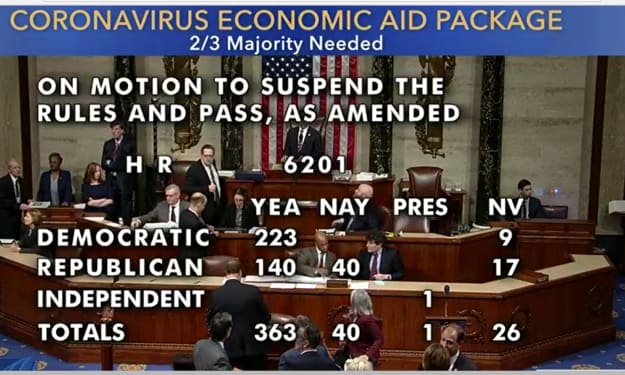
Bryan Watch: Corona Watch Edition Apologies for not posting a Bryan Watch in a while, but Congress has simply not been that busy due to the COVID crisis. So here is what Congress has done since the WHO declared the Pandemic on March 11.
By John Heckenlively6 years ago in The Swamp
A Gathering of Evil Bosses
“I’m the queen of chin jutting while I smooth my hair, attacking, insulting, and deflecting to protect my appointer.” “Oh, please, Blondi, my hair is curled, highlighted, and longer than yours. I feature television commercials telling immigrants that we will give them a free plane ride home, and if they voluntarily turn themselves in, they will be allowed to legally apply for re-entry. It runs everywhere, and I look good in it! You can’t compete because of your blond hair. Mine is nicer, and my lips are prettier than yours.”
By Andrea Corwin 14 days ago in The Swamp
Middle East Conflict Offers Economic Lifeline to Russia’s Flagging War Machine
The widening conflict in the Middle East has unexpectedly provided an economic boost to Russia, whose war-driven economy has been showing signs of strain after years of sanctions and battlefield losses. Rising oil and gas prices triggered by regional instability are replenishing Moscow’s revenues and easing pressure on a budget stretched by the prolonged war in Ukraine. Since the outbreak of renewed hostilities across the Middle East, energy markets have reacted sharply to fears of disrupted supply routes, especially around the Strait of Hormuz and the Red Sea. For Russia, one of the world’s largest exporters of crude oil and natural gas, higher prices translate directly into increased export earnings — even as volumes remain constrained by Western sanctions. Russian officials have publicly downplayed any connection between Middle East turmoil and their own economic position. Privately, however, analysts say the surge in energy income is acting as a financial cushion for a war machine that was beginning to falter under the combined weight of military spending and international isolation. Energy Windfall Amid Global Uncertainty The conflict has injected fresh volatility into global markets, pushing crude prices upward and boosting demand for alternative suppliers. With Europe still partially dependent on non-Russian LNG and Asia continuing to buy Russian energy at discounted rates, Moscow finds itself benefiting from a market hungry for supply security. Russia’s oil and gas revenues are the backbone of its federal budget. Even after sanctions capped prices and restricted access to Western insurance and shipping services, the Kremlin developed parallel trade networks and so-called “shadow fleets” to move its energy exports. The Middle East crisis has strengthened this system by making Russian oil more attractive to buyers seeking stability amid chaos. An energy economist in Europe noted that “every geopolitical shock that tightens supply elsewhere makes Russian barrels more valuable, regardless of sanctions.” Supporting the War in Ukraine The timing of this windfall is critical. Russia’s war effort in Ukraine has become increasingly expensive, with massive spending on weapons production, troop recruitment, and compensation for casualties. Industrial output has been redirected toward defense manufacturing, while social programs face mounting pressure. Higher export earnings allow Moscow to maintain this pace. Increased revenues are already being channeled into weapons factories and logistical support, helping sustain artillery production and missile stockpiles. Western intelligence officials warn that the improved cash flow could prolong the conflict by reducing the financial urgency for compromise. President Vladimir Putin has framed the war as a long-term struggle against Western influence. The Middle East conflict, he argues, exposes what Moscow calls the hypocrisy and instability of U.S.-led global order. Russian state media has used the crisis to shift attention away from Ukraine and portray Russia as a stable energy partner amid global disorder. Diplomatic Leverage and New Partnerships Beyond economics, the crisis offers Russia renewed diplomatic space. Several Middle Eastern states maintain relations with Moscow while also engaging Western powers. Russia has positioned itself as a potential mediator and arms supplier, reinforcing ties with Iran and strengthening coordination with Gulf states within energy frameworks such as OPEC+. For Moscow, this creates an opportunity to present itself as indispensable to global stability — a narrative sharply contrasting with its pariah status in much of Europe and North America. The Kremlin has also used rising oil prices as leverage in negotiations with Asian buyers, particularly China and India, who remain key customers for discounted Russian crude. Risks and Long-Term Fragility Despite the short-term gains, economists caution that Russia’s reliance on conflict-driven energy spikes is unsustainable. Sanctions continue to limit access to advanced technology, foreign investment, and financial markets. Infrastructure damage from Ukrainian drone attacks on refineries and pipelines also threatens export capacity. Moreover, any prolonged escalation in the Middle East could trigger a global recession, reducing overall energy demand and eventually harming Russia’s export revenues. The same volatility that benefits Moscow today could undermine it tomorrow. There is also political risk. If Russia is perceived as exploiting Middle Eastern instability for financial gain, it could deepen mistrust among regional partners and invite further sanctions. Western governments are already discussing tighter enforcement mechanisms to close loopholes in Russian oil shipping and insurance arrangements. A Conflict That Reshapes the Battlefield For now, the Middle East conflict has provided Russia with breathing room at a critical juncture in its war effort. Higher prices mean fuller coffers, and fuller coffers mean more missiles, more ammunition, and more staying power on the Ukrainian front. The paradox is stark: while war devastates economies on the ground in the Middle East, it indirectly fuels another war thousands of miles away. As long as instability keeps global energy markets on edge, Russia’s war machine may continue to find lifelines in the chaos of distant conflicts. In this sense, the Middle East crisis has become not only a regional tragedy but a global economic shockwave — one that Moscow is strategically positioned to exploit as it presses on with its campaign in Ukraine.
By Fiaz Ahmed about 6 hours ago in The Swamp



Comments
There are no comments for this story
Be the first to respond and start the conversation.