
The 2024 U.S. Presidential Election: A Choice Between Two Uninspiring Visions
As Americans face one of the most polarized elections in history, disillusionment with the candidates looms large, while deeper ideological forces shape the nation’s future.

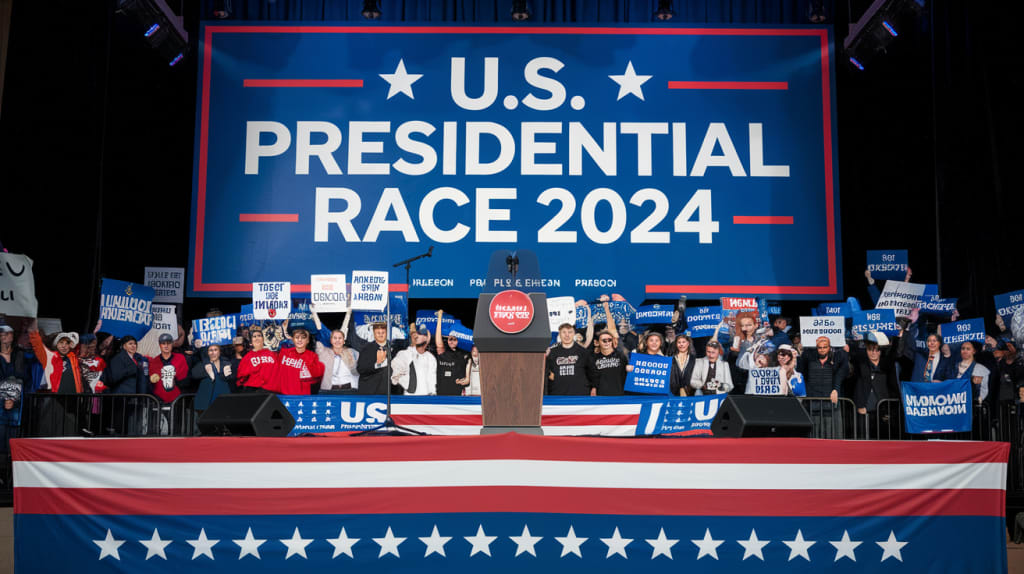
The 2024 U.S. presidential election is less a celebration of democracy than a study in disenchantment. Both candidates—Kamala Harris and Donald Trump—have come to represent not so much the best and brightest of American leadership, but rather the last resorts of their respective parties. With Biden’s unexpected withdrawal from the race and Harris stepping up in his place, voters are left with a stark choice that feels less about inspiration and more about resignation.
It’s a turbulent time in American politics, marked by discontent, polarized views, and an unrelenting divide between two competing visions of the country’s future. This election isn’t about ideas; it’s about holding the line, as each side tries to prevent the other from shaping the nation according to vastly different ideals.
If there’s one thing that defines the 2024 election, it’s the lack of substantive debate. From the debates to the campaign trail, it’s been a season of slogans, not solutions. Both campaigns have poured their energy into hyper-personal attacks, leaving little room for actual discussion about policy. The candidates seem content to paint the other side as disastrous without articulating clear visions for tackling the country’s problems.
What’s missing is a sense of direction. At a time when America faces challenges from climate change to economic insecurity, healthcare woes, and widening social divides, voters are craving leadership that doesn’t seem to be on offer.
Vice President Kamala Harris, propelled into the presidential spotlight after Biden’s withdrawal, has had a tough time establishing herself as a credible, inspirational candidate. Despite her years in Washington and a prominent role as vice president, she has struggled to connect with voters on a meaningful level, often reduced to a series of political clichés and canned responses. Her campaign has been an uphill struggle, focused more on demonstrating her “potential” than on actual accomplishments.
Harris’s reputation has also been hurt by her frequent changes of stance on key issues, which have made her seem more tactical than principled. Although she has the Democratic establishment rallying behind her, the support appears to be driven more by fear of a Trump comeback than by genuine enthusiasm for Harris’s leadership.
On the other side of the aisle, Donald Trump has returned to the campaign trail, but the energy and defiant novelty that once characterized his rallies have dimmed. His original appeal as a blunt outsider, unafraid to shake up Washington, has been dulled by years of public battles and controversies. The confident, flamboyant figure of 2016 has been replaced by a version that often seems weighed down by grievances.
Once touted as a potential populist savior, Trump now seems more like a familiar figure in American politics than a disruptive outsider. Despite this, the Republican Party has unified behind him, seeing him not only as a candidate but as a symbol of its core values. Whatever appeal he may have lost, Trump remains the standard-bearer for an anti-establishment vision that resonates deeply with his base.
Neither candidate is particularly beloved, and much of their support stems not from fervent enthusiasm but from a profound fear of the other side winning. For Democrats, Harris represents a bulwark against what they view as a regressive agenda under Trump. Conversely, Trump supporters rally around him as a defense against what they see as a radical left-wing agenda within the Democratic Party.
It’s a bleak prospect when fear of the opposition outweighs genuine support for one’s own candidate, yet this is the reality of the 2024 election. The result is an atmosphere in which voters are choosing sides based not on who best represents their values but on who poses the least threat to them.
Beyond the candidates, this election highlights a deeper ideological struggle that has been building for decades. For the Democrats, the legacy of the late 20th century—marked by a spirit of globalism and progressivism—continues to shape the party’s goals. After the Cold War, Democrats embraced a vision of America as a global leader, a “city upon a hill” meant to inspire other nations and push for progressive reforms at home and abroad. This worldview persists among today’s Democrats, many of whom see the party as a vehicle for radical social change.
The Republicans, by contrast, have moved from the interventionist leanings of the early 2000s to a more isolationist stance, now emphasizing a “take care of our own” philosophy. This shift reflects a rejection of the burdens and complexities of international leadership, with many Republicans believing that America’s priority should be protecting its sovereignty and economic stability.
Together, these competing visions create a sharp contrast, with Democrats committed to a global, inclusive vision for America and Republicans advocating for a national, protectionist one. The ideological divide is significant and mirrors deeper cultural rifts within American society.
Boiled down, the 2024 election is a choice between two starkly different ideas of what America should be. On one side are the “liberal-globalists,” who see the U.S. as an integral player in international affairs and an advocate for progressive social change. On the other are the “national-patriots,” who believe America should prioritize its own needs, protect its borders, and reduce its global footprint.
This election isn’t a decisive turning point; America is far too complex and diverse for that. But it does reflect a fundamental disagreement about the country’s future. The ideological stakes are high, and whichever side wins will shape the direction of American policy on key issues, from immigration to international alliances, for years to come.
American politics has always had a flair for the dramatic. Alexis de Tocqueville, in his observations on American democracy nearly two centuries ago, noted the country’s tendency toward theatrical public policy. Today, the influence of media and marketing has taken this aspect of American politics to new extremes. With the rise of social media and targeted advertising, campaigns are carefully crafted spectacles, designed to manipulate and shape public opinion rather than encourage open debate.
This has only intensified as advanced digital tools allow campaigns and interest groups to create sophisticated messaging that resonates with specific demographics. It’s a climate ripe for manipulation, where facts take a back seat to narratives, and where political strategies are fine-tuned not to inform, but to provoke emotional responses.
What’s at Stake for America’s Future?
The 2024 election is more than just a contest between two flawed candidates. It’s a referendum on America’s identity and priorities. Will the country continue on a path that emphasizes global engagement and progressive ideals, or will it turn inward, focusing on national issues and preserving traditional values?
In many ways, this election is a mirror reflecting the deep divisions within American society. It’s a fight for control over the nation’s future, with each side determined to claim victory, not through policy or leadership, but through sheer force of ideological will. The stakes are high, but the path forward remains uncertain, as Americans confront not only their political differences but also the profound question of what they want their country to stand for.
About the Creator
The INFORMER
Source for in-depth news, investigations, whistleblower leaks, and insightful analysis you won't find anywhere else, produced by independent journalists exploring the fringes of society, technology, and culture.
Keep reading
More stories from The INFORMER and writers in The Swamp and other communities.
The Complex Dynamics of Dialogue: "10 Essential Insights for the West Before Engaging with Putin"
When we read an article titled "10 Facts the West Must Understand Before Talking to Putin," penned by Konstantin Remchukov, one can't help but feel a bit like we've stumbled into a conversation where the punchline is missing, but everyone's laughing anyway. It feels a little like watching a magician perform sleight of hand – you know something's up, but you can't quite figure out what's been pocketed. In this case, it might be the author's intent, logic, or our sanity.
By The INFORMERabout a year ago in The Swamp
Trump Pushes for a 1-Year, 10% Cap on Credit Card Interest Rates — and Banks Push Back
In a move that has reignited debate over consumer protection and financial regulation, former U.S. President Donald Trump has floated a proposal to cap credit card interest rates at 10% for one year. The idea is simple on its surface: provide immediate relief to millions of Americans struggling under high-interest debt. But the reaction from banks and financial institutions has been swift and hostile, revealing deep divisions over how the U.S. credit system should function. At a time when credit card interest rates in the United States routinely exceed 20% and, in some cases, climb above 30%, Trump’s proposal strikes a populist chord. Yet critics argue that such a cap could disrupt lending markets, reduce credit availability, and create unintended economic consequences. So why is Trump pushing this plan, why are banks balking, and what could it mean for consumers? Why Credit Card Interest Rates Are Under the Spotlight Over the past few years, American households have increasingly relied on credit cards to cope with inflation, rising rent, and higher everyday expenses. As the Federal Reserve raised benchmark interest rates to fight inflation, credit card APRs surged alongside them. For many consumers, this has meant: Growing balances that are harder to pay down Monthly interest charges that exceed minimum payments A cycle of debt that feels nearly impossible to escape Against this backdrop, Trump’s proposal taps into widespread frustration. By capping interest rates at 10% for a limited, one-year period, the plan aims to give borrowers breathing room and slow the growth of household debt. The Political Strategy Behind the Proposal Trump has long positioned himself as a champion of “forgotten” or financially stressed Americans. This proposal fits neatly into that narrative, allowing him to argue that he is standing up to powerful banks on behalf of everyday consumers. Politically, the idea is strategic: It appeals to working-class voters burdened by debt It contrasts sharply with what many see as Wall Street-friendly policies It reframes economic debate around fairness rather than market efficiency Even though the proposal is temporary, its symbolism is powerful. A one-year cap suggests urgency without committing to a permanent overhaul of the credit system, making it easier to sell to voters while still appearing bold. Why Banks Are Pushing Back Hard Financial institutions wasted no time expressing concern. From their perspective, a 10% cap—especially one imposed quickly—poses serious risks. Banks’ main arguments include: 1. Reduced profitability Credit cards are one of the most profitable products for banks. Interest revenue helps offset defaults, fraud, and operational costs. A sharp cap would significantly reduce margins. 2. Higher risk, lower reward Banks argue that high interest rates compensate for lending to higher-risk borrowers. If rates are capped, they may simply stop offering credit to those consumers. 3. Less access to credit Rather than lowering rates, banks could tighten approval standards, leaving many Americans—especially those with lower credit scores—without access to credit at all. 4. Market interference concerns The banking industry maintains that interest rates should reflect market conditions, not political decisions. They warn that government-imposed caps distort lending behavior. In short, banks claim the proposal could hurt the very people it intends to help. Would Consumers Actually Benefit? For consumers carrying balances, the immediate benefits are obvious. A 10% cap could: Dramatically reduce monthly interest charges Help borrowers pay down principal faster Prevent balances from ballooning However, the longer-term impact is less clear. If banks respond by: Cutting credit limits Closing accounts Rejecting new applicants Then access to short-term credit could become more limited, particularly for lower-income households. Still, supporters argue that the current system already fails many consumers. With interest rates exceeding 25%, critics say the credit card market borders on exploitative, especially when borrowers are already financially vulnerable. How This Fits Into the Broader Economic Debate Trump’s proposal revives a long-standing debate in U.S. politics: Should there be a legal limit on how much lenders can charge? Historically, usury laws capped interest rates at the state level. Over time, deregulation and federal preemption weakened those limits, allowing banks to charge far higher rates nationwide. The proposal also intersects with broader questions about: Corporate responsibility Income inequality The role of government in regulating financial markets Supporters see the cap as overdue consumer protection. Opponents see it as economic overreach with potentially destabilizing effects. Is the Proposal Likely to Become Law? Realistically, the chances of this policy being enacted in its current form are slim—at least in the short term. Implementing a nationwide cap would require congressional support and face intense lobbying from the financial industry. However, even if it never becomes law, the proposal serves another purpose: shifting the conversation. By putting credit card interest rates front and center, Trump has forced policymakers, banks, and the public to confront an issue that often receives little attention. In that sense, the plan may already be achieving one of its goals. What Happens Next? As banks continue to push back and economists debate the consequences, consumers are watching closely. Whether through legislation or public pressure, calls for relief from high credit card interest rates are unlikely to fade. Trump’s proposal may be temporary, controversial, and politically charged—but it highlights a reality many Americans live with every day: debt is expensive, and the system often feels stacked against borrowers. Even if the 10% cap never materializes, the question remains: how long can sky-high interest rates persist before meaningful reform becomes unavoidable?
By Muhammad Hassan7 days ago in The Swamp



Comments
There are no comments for this story
Be the first to respond and start the conversation.