
Sindh May Return to India: Rajnath Singh's "Borders May Change" Remark Stirs Debate
"Rajnath Singh's Remark on Changing Borders Sparks Debate Over Sindh's Future"

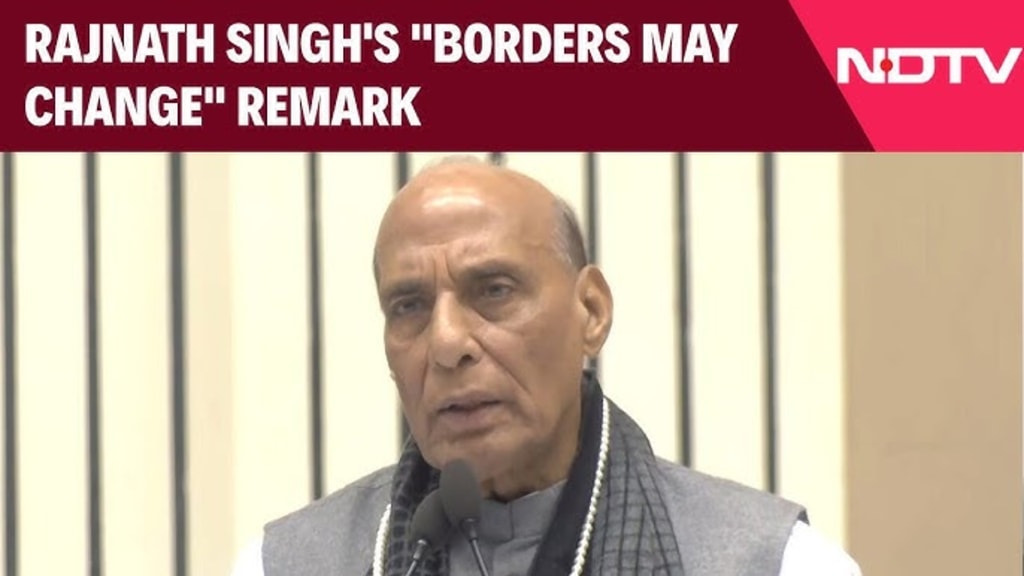
In a political landscape marked by shifting alliances, intense nationalistic sentiment, and a complex history of territorial disputes, recent remarks made by Indian Defense Minister Rajnath Singh have ignited a wave of discussion and controversy. During a speech that has since garnered significant media attention, Singh suggested that "borders may change," a comment that has stirred debate over the status of regions like Sindh, and their historical ties to India. The statement, in the context of the long-standing India-Pakistan conflict, raises questions about the potential redefinition of borders in South Asia and what such a change might mean for the future of the region.
The Context of Rajnath Singh's Statement
Rajnath Singh's remarks were made during a public event where he was addressing various security concerns, particularly in light of the ongoing tensions between India and Pakistan. In his speech, Singh alluded to the possibility of "borders changing," which some political analysts interpreted as a reference to territorial disputes in the subcontinent, including the possibility of Sindh, a province in Pakistan, rejoining India. This suggestion quickly went viral, prompting a flurry of discussions about its implications, both politically and diplomatically.
It's important to understand the historical context surrounding Sindh and its separation from India. Sindh, once part of the princely state of Sindh, became a part of Pakistan when the country was created in 1947. Prior to partition, Sindh had a large Hindu population and was culturally and historically tied to India. However, the partition of British India created Pakistan and led to the separation of Sindh from India. Since then, relations between India and Pakistan have been fraught with tension, especially concerning territorial disputes, religious conflicts, and political instability.
Sindh's Historical Connection to India
Sindh has always held a significant place in India's history. Located on the banks of the Indus River, the region was home to one of the world's oldest civilizations, the Indus Valley Civilization, which flourished long before the partition. Sindh's historical, cultural, and geographical proximity to India makes it a subject of ongoing debate among historians, nationalists, and political commentators.
Before the partition in 1947, Sindh was part of undivided India. After the partition, the region became part of Pakistan, and over time, the Hindu population, which once constituted a significant portion of the province’s demographic, dwindled due to migration, persecution, and religious polarization. Despite this, the historical bond between Sindh and India remains strong in the collective memory of many, particularly in the Indian Sindhi diaspora.
Rajnath Singh’s Comments and Nationalism
Rajnath Singh’s comment on “changing borders” resonates deeply with nationalist sentiments in India. His remark taps into a long-standing desire among some sections of the Indian population to reclaim what they believe is rightfully India’s—whether it’s the disputed region of Kashmir, which remains a point of contention with Pakistan, or other territories once part of British India. Singh’s words also bring back memories of the Partition, which left millions displaced, and families divided. The idea of changing borders is thus seen by some as an attempt to correct historical wrongs, with Sindh being a symbolic representation of lost territory.
However, these remarks also invite criticism. Many argue that comments about changing borders only stoke tensions with Pakistan and could undermine diplomatic efforts for peace. Pakistan’s response to such remarks is likely to be one of anger and suspicion, further complicating efforts to resolve outstanding issues such as the Kashmir dispute, terrorism, and regional security.
The Potential for a Shift in Geopolitics
The most important question arising from Singh’s statement is whether there is any realistic potential for a change in borders between India and Pakistan. While Singh's comments may be seen as rhetorical, they have implications for the future of regional geopolitics. The prospects of any territorial redrawing are remote, but the statement could nonetheless spark discussions within nationalist and political circles about what India’s territorial ambitions might be in the future.
Sindh rejoining India, while a provocative thought, is highly unlikely in the contemporary political environment. Since the 1971 war, which led to the creation of Bangladesh, both India and Pakistan have made significant efforts to maintain peace and stability in the region. Attempts to alter established borders would risk reigniting a conflict that could destabilize not only the two countries involved but the entire region.
The Role of Diplomacy in Border Disputes
Despite the provocative nature of Singh's comments, it is essential to understand that geopolitics is rarely so simple as "borders may change." International law, national sovereignty, and longstanding diplomatic ties all play a significant role in maintaining the integrity of borders. India and Pakistan are both nuclear-armed states, and any territorial dispute could escalate into a catastrophic war. The international community, including the United Nations and key players like the United States, China, and Russia, have a vested interest in preventing such an outcome.
Moreover, while nationalist rhetoric may appeal to certain sections of the population, most governments prioritize diplomatic solutions and regional cooperation over territorial expansion. Both India and Pakistan have much to gain from peace, stability, and economic cooperation, and altering borders would be detrimental to these goals.
Conclusion
Rajnath Singh’s remark about changing borders and the potential return of Sindh to India has opened a Pandora’s box of historical grievances, nationalistic fervor, and diplomatic challenges. While the comment has undoubtedly sparked excitement among some sections of the Indian public, it is also fraught with the risk of inflaming tensions with Pakistan and complicating already delicate bilateral relations. The future of the region rests on diplomatic dialogue, economic cooperation, and mutual respect for sovereignty. For now, the idea of Sindh rejoining India remains a distant dream, and a peaceful resolution to the issues at hand will require careful diplomacy, understanding, and patience.
As the world watches, the challenge remains: can history be rewritten, or must we focus on building a better, more peaceful future? Only time will tell.
About the Creator
Fiaz Ahmed
I am Fiaz Ahmed. I am a passionate writer. I love covering trending topics and breaking news. With a sharp eye for what’s happening around the world, and crafts timely and engaging stories that keep readers informed and updated.
Keep reading
More stories from Fiaz Ahmed and writers in The Swamp and other communities.
Trump Blasts Ukraine for ‘Zero Gratitude’ as Germany Says Deal to End War Unlikely to Be Reached by Thursday Deadline
The ongoing war in Ukraine continues to cast a shadow over global politics, with leaders from various countries weighing in on the escalating conflict and its possible resolution. Former U.S. President Donald Trump has recently caused a stir by criticizing Ukraine for what he perceives as a lack of gratitude for the support it has received from the United States. Meanwhile, in Europe, German officials have expressed doubts about the feasibility of reaching a peace deal by the Thursday deadline, raising concerns about the war's prolonged nature.
By Fiaz Ahmed 2 months ago in The Swamp
What Is the Old Name of Turkey? A Journey Through History, Empires, and Identity
When people hear the name Turkey, they often think of a modern nation bridging Europe and Asia, rich with culture, cuisine, and history. But Turkey’s land has carried many names long before it became the Republic of Türkiye in the 20th century. Understanding the old names of Turkey is more than a geography lesson—it is a journey through ancient civilizations, powerful empires, and shifting identities that shaped the world. Anatolia: The Earliest Known Name The oldest and most widely used historical name for much of modern-day Turkey is Anatolia. Derived from the Greek word Anatolē, meaning “the east” or “sunrise,” Anatolia referred to the lands east of mainland Greece. For ancient Greeks, this region was literally where the sun rose. Anatolia was not a single kingdom but a vast region that hosted some of the world’s earliest civilizations, including the Hittites, Phrygians, Lydians, and Urartians. Archaeological discoveries show that Anatolia was a cradle of early human settlement, agriculture, and trade, making it one of the most historically dense regions on Earth. Even today, historians and scholars frequently use “Anatolia” to describe Turkey’s Asian portion, which makes up about 97% of the country. Asia Minor: A Roman and Byzantine Label Another well-known old name for Turkey is Asia Minor. This term was popularized during the Roman and Byzantine Empires to distinguish the region from the larger continent of Asia. “Asia Minor” literally means “Lesser Asia,” emphasizing its role as a western extension of the Asian landmass. Under Roman and later Byzantine rule, Asia Minor became a hub of administration, commerce, and Christianity. Many early Christian communities, councils, and churches—mentioned in biblical texts—were located in this region. Cities like Ephesus, Smyrna, and Nicaea were central to religious and political life for centuries. Constantinople and the Byzantine Identity While the land itself had regional names, the capital city—Constantinople—often symbolized the entire territory. Founded by Roman Emperor Constantine the Great in 330 AD, Constantinople became the heart of the Byzantine Empire. For over a thousand years, the Byzantine Empire ruled much of what is now Turkey, blending Roman governance, Greek culture, and Christian theology. During this period, the region was not called Turkey at all, as the term “Turk” had not yet become dominant in Anatolia. The Arrival of the Turks and the Name “Turkey” The name Turkey comes from the word “Turk”, referring to the Turkic peoples who migrated from Central Asia. After the Battle of Manzikert in 1071, Seljuk Turks defeated the Byzantine army, opening Anatolia to Turkish settlement. Over time, European sources began referring to the region as “Turcia” or “Turkey,” meaning “the land of the Turks.” This marked a major shift in identity—from a Greco-Roman-Christian region to a predominantly Turkic and Muslim one. The Ottoman Empire: A Global Power Without the Name “Turkey” Interestingly, during the height of Turkish power, the state was not officially called Turkey. Instead, it was known as the Ottoman Empire, named after its founder Osman I. From the late 13th century until the early 20th century, the Ottoman Empire controlled vast territories across Europe, Asia, and Africa. Ottoman rulers referred to their realm as the Devlet-i Aliyye-i Osmaniye (The Sublime Ottoman State). However, European diplomats and writers still casually referred to the empire’s core lands as Turkey, reinforcing the name internationally. From Ottoman Empire to the Republic of Turkey After World War I and the collapse of the Ottoman Empire, Mustafa Kemal Atatürk led a successful independence movement. In 1923, the modern Republic of Turkey was officially established. This marked the first time “Turkey” became the formal name of the state, symbolizing a break from imperial rule and the beginning of a secular, nation-based identity. In recent years, the country has also emphasized the spelling “Türkiye” internationally to reflect its native pronunciation and cultural identity. Why These Old Names Still Matter The old names of Turkey—Anatolia, Asia Minor, Byzantine lands, and Ottoman domains—tell a story of continuity and transformation. They reveal how geography, culture, religion, and power shape national identity over time. Turkey is not just a modern nation-state; it is a living archive of human civilization. Each old name represents a chapter in its long and complex story, making Turkey one of the most historically layered countries in the world. Final Thoughts So, what is the old name of Turkey? The answer depends on the era. From Anatolia and Asia Minor to Byzantine territories and the Ottoman Empire, Turkey has worn many names—each reflecting the people and powers of its time. Understanding these names helps us appreciate Turkey not just as a country, but as a crossroads of civilizations that continues to influence global history today.
By Fiaz Ahmed Brohi2 days ago in The Swamp



Comments
There are no comments for this story
Be the first to respond and start the conversation.