
Should the UK have a sugar tax on soda?
Effect of the sugar tax on sugary drinks and the negative externality of consumption!

Over-consumption of sugar causes negative externalities in the UK (1). This article explains the imposition of a sugar tax (market-based policy) on soda firms, aiming to decrease the health risks, Negative Externalities of Consumption (NEoC), caused from overconsumption.
Market failure is the failure to achieve allocative efficiency. In the context of the article (1), UK experiences NEoC from over-allocation of sugar as a resource; resulting in over-consumption of soda that doesn’t take account of social external costs. A sugar tax is imposed to discourage further consumption and reduce external costs.
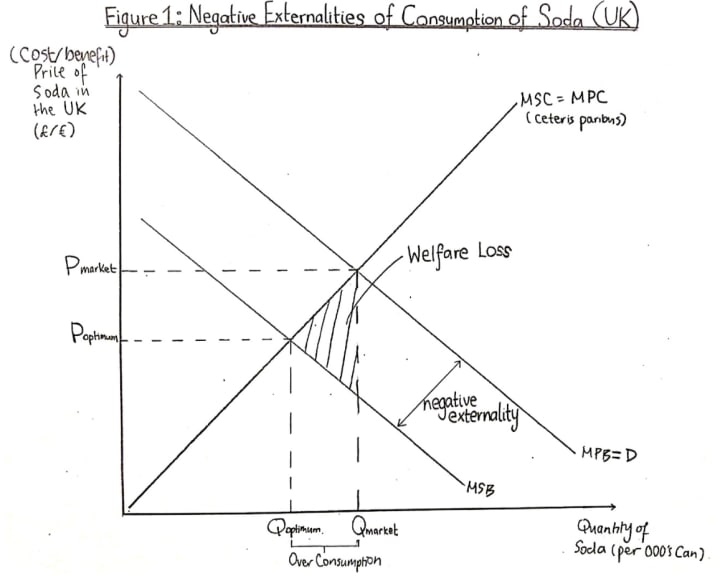
Figure 1 illustrates the NEoC from overconsumption of soda in the UK, hence measured in pounds or euros. The MPB of consuming soda is greater than the MSB, hence creating the gap of negative externality and the shaded triangle of welfare loss. External costs to soda consumption that are in the “welfare-loss triangle” includes the medical expenses needed to care for the obese, diabetic or teeth decaying patients (1), also, the reduction of efficiency to the workers with poor health will, on a wider scale, decrease contribution to the economy.
The disparity between Qoptimum and Qmarket is from the overconsumption of soda, resulting in welfare loss. The quantity of soda consumed is at Qmarket at price Pmarket. However the optimal equilibrium, when MSC=MSB, at Qoptimum and Qmarket, is when there are no external cost. This can be fixed with the imposed sugar tax, however, dependent on the PED for soda.
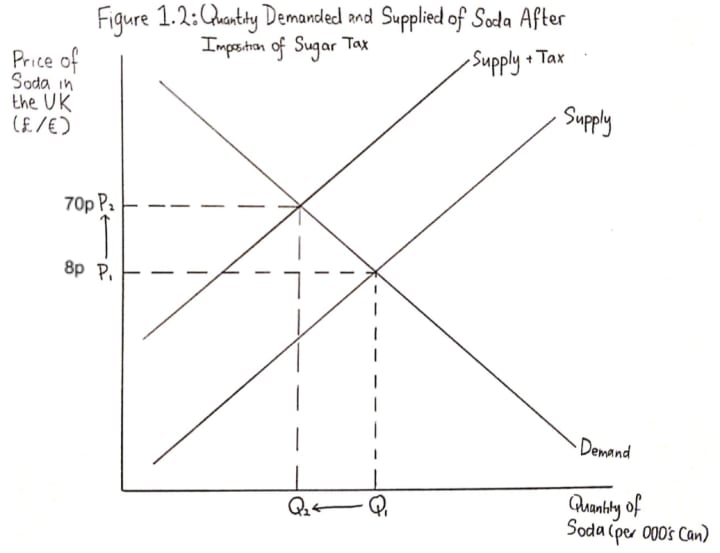
Figure 1.2 illustrates the quantity demanded and supplied of soda after imposition of tax to soda firms in the UK, in £/€. Soda firms such as Coca-Cola (2) according to the context of the article, will produce at Q1 at price P1 of 8p initially. After taxation, the supply curve will shift inwards from Supply to Supply+Tax. Quantity demanded will subsequently fall to Q2 due to the law of demand as price will increase to P2 of 70p (2). However, the producer and consumer burden will depend on the PED of Coca Cola (2), Irn Bru (6), Red Bull (7), Dr Pepper (8), Old Jamaica Ginger Beer (9), Fever Tree Indian tonic water (10) and other sodas. Consumer burden will be high if PED is inelastic, and therefore tax will be ineffective.
Indirect taxes, such as the sugar tax, as a solution to problems of NEoC may be preferred as they internalise the externality. It creates incentives for consumers to change their consumption patterns by changing relative prices, which can be seen successful in Mexico (11) , with a 12% reduction in consumption. It could also create incentives for producers to alter production decisions, which can be seen successful in Hungary (12), with a 40% reduction in sugar content. The positive reaction in Mexico and Hungary can be compelling evidence for the sugar tax to be a success in the UK. However, if the sugar tax is successful, it may affect the producers when less revenue is generated, and even cause unemployment if budget cuts are made to compensate for increased cost of production. As mentioned before, this depends on the PED of soda, and if demand is inelastic, the consumer burden will be larger than the producer, and therefore minimal negative effect to producers. Moreover, the sugar tax can benefit the UK government as an estimated £520 million tax revenue can be produced, and can be used to fund sports in primary school (4). This is an example of internalising the social costs, where the external costs (e.g. diabetes, health problems) can be mitigated and prevented through the raised tax.
As mentioned above, soda can have an inelastic demand, therefore the sugar tax can increase government revenue but fail to decrease quantity demanded to optimum level. Referring to the context of the article, the tax will hence “hit the poor hardest;” (13) as they are least educated about the harms of over-consumption and hence will still purchase soda despite price increase. The tax may also “miss out some of the most sugary drinks” (14), which can be “fruit juice” (15) and “high milk content” (16) beverages (e.g. coffee); this being an example of technical difficulties when imposition of indirect tax is chosen as a solution. Therefore, some may argue generating advertisement and health campaigns may be a better solution as it fixes consumer ignorance, especially for the “poor”. Better knowledge on the consequences and harm can be established, which can directly decrease the demand and consumption of soda. Ultimately, effectively reducing consumption of demerit goods and correcting market failure.
About the Creator
Rowaboat
I see you reading into my Bio... ;) Nothing much to read here tbh, just a girl who loves talking about dietetics, relationships, motivation, morality, family, Korean and moreeee~ If I said anything you like, we are automatically friends :)
Danish and Greenlandic Foreign Ministers to Meet US Vice President JD Vance and Secretary of State Marco Rubio in Washington
The Danish and Greenlandic foreign ministers are set to meet US Vice President JD Vance and Secretary of State Marco Rubio in Washington on Wednesday, signaling a significant moment in transatlantic diplomacy. The talks are expected to focus on Arctic security, economic cooperation, climate change, and the evolving geopolitical importance of Greenland. As global interest in the Arctic intensifies, this meeting highlights how a once-remote region has become central to international strategy and great-power competition.
By Aarif Lashari7 days ago in The Swamp
Ludacris and Nelly draw backlash over bookings at MAGA-coded music festival
Ludacris and Nelly headlining a mostly right-wing event is good for them. It’s also great for the genre of hip hop. The two rap veterans have showcased their talents on other stages. Why can’t they perform for mostly MAGA folks and grab that bag?
By Skyler Saunders5 days ago in Beat


Comments
There are no comments for this story
Be the first to respond and start the conversation.