
Rise of the Unaffiliated Voter
Maryland Joins a National Rebellion Against the Two-Party System

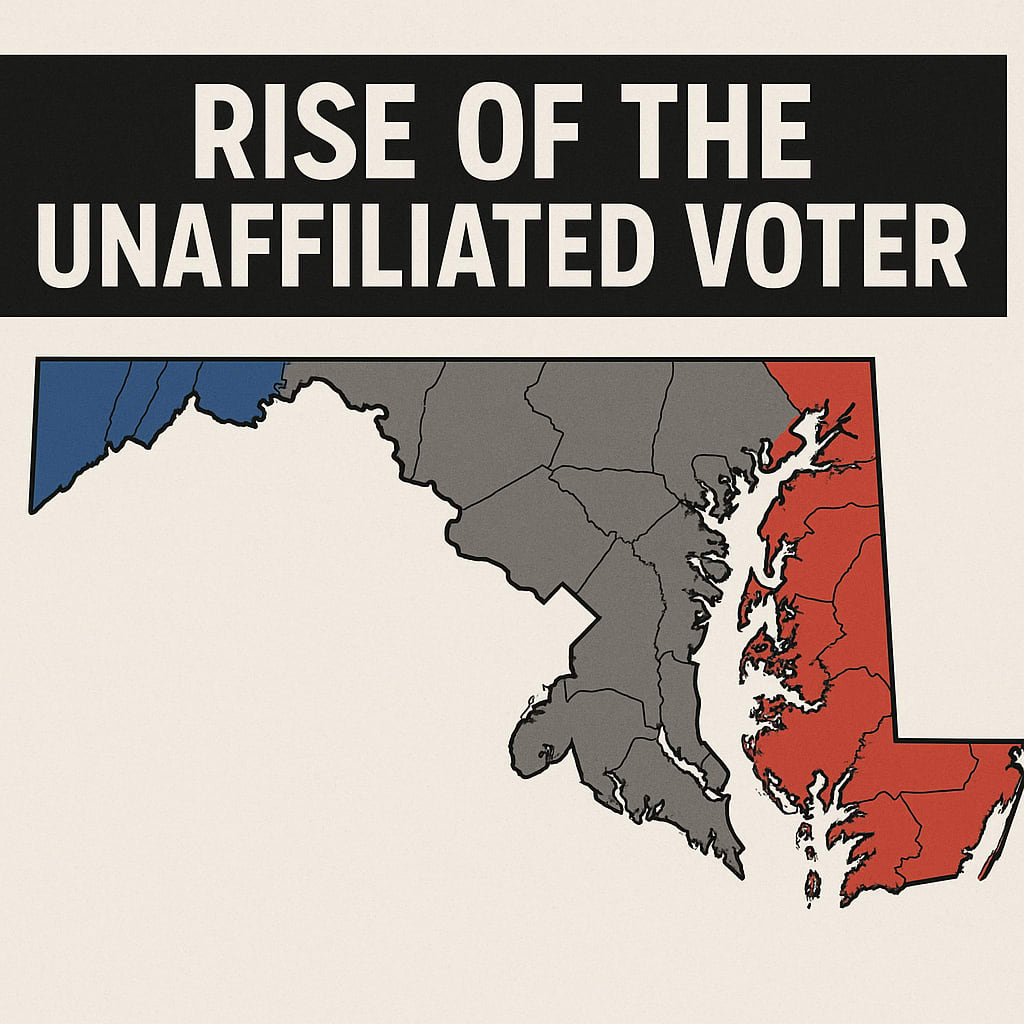
Maryland’s voter rolls tell a story politicians can’t afford to ignore. Since January 2025, Democrats have lost 9,024 registered voters statewide, Republicans have shed 1,924, and Unaffiliated/Other registrations have surged by 29,690.
That’s not a blip—it’s a seismic shift.
For the first time, Unaffiliated/Other voters are now Maryland’s second largest voting bloc, leapfrogging Republicans and steadily closing the gap on Democrats. Over the last decade, Democrats’ share of registered voters has dropped in every single county in Maryland. And this isn’t just a local curiosity—it’s part of a larger national trend.
From Maine to Arizona, a growing share of Americans are rejecting the “red” and “blue” labels in favor of political independence. These voters aren’t apolitical—they’re just done with what they see as broken, tribalistic politics that serve parties before people.
Why It’s Happening
Political scientists and pollsters point to several reasons for the surge:
- Disillusionment with Partisan Extremes – Many feel both parties have abandoned the political center in favor of catering to their most vocal—and often most radical—wings.
- Broken Promises – From Washington to Annapolis, voters see campaign promises dissolve into gridlock or self-serving political theater.
- Generational Shifts – Younger voters, especially Millennials and Gen Z, are far less loyal to political parties than their parents or grandparents.
- Single-Issue Breakaways – On topics like climate change, gun rights, abortion, tech regulation, and free speech, neither party consistently represents these voters’ nuanced views.
Why This Matters in 2026 and 2028
Unaffiliated voters are now the political wildcard in both state and national elections. In Maryland, their growing share means that neither Democrats nor Republicans can rely solely on their base to win competitive races.
In national battlegrounds, this bloc could determine the presidency, control of Congress, and key gubernatorial races. The party—or candidate—that figures out how to genuinely engage these voters will have a massive advantage.
How to Win Over the Unaffiliated
Winning these voters isn’t about chasing the loudest voices on social media. It’s about addressing the growing demand for authenticity, pragmatism, and independence in politics. That means:
- Stop Preaching to the Choir – Tailor messaging beyond the base. Avoid the “red meat” talking points that play well on partisan media but alienate the center.
- Lead With Solutions, Not Slogans – Voters are tired of grandstanding. Offer detailed, actionable plans to fix problems—without blaming the other side for everything.
- Show Independence from Party Bosses – Candidates who break ranks when it’s in their constituents’ interest earn credibility. Rubber-stamp politicians don’t.
- Listen, Don’t Lecture – Hold town halls that are actually open conversations, not campaign ads. Take real questions. Answer honestly, even when it’s uncomfortable.
- Prove Competence – More than ideology, unaffiliated voters want competent governance. Deliver results, and they’ll reward you.
The Takeaway
The two-party system may not collapse tomorrow, but it’s bleeding loyalty. Maryland’s voter rolls are the canary in the coal mine—proof that Americans are moving away from rigid partisan identities.
For politicians, this is either a threat or an opportunity. For voters, it’s a sign that they may finally have the leverage to demand a politics that works for them, not the parties.
The unaffiliated revolution is here. The only question is: who’s ready to lead it?
About the Creator
Michael Phillips
Michael Phillips | Rebuilder & Truth Teller
Writing raw, real stories about fatherhood, family court, trauma, disabilities, technology, sports, politics, and starting over.
Keep reading
More stories from Michael Phillips and writers in The Swamp and other communities.
Junk Food Bans Miss the Point
Robert F. Kennedy Jr. recently floated the idea of banning “junk food” from the Supplemental Nutrition Assistance Program (SNAP), better known as food stamps. On paper, the move is pitched as a way to improve the health of low-income Americans. In reality, it’s a sound bite that ignores the structural problems baked into the SNAP system itself.
By Michael Phillips7 months ago in The Swamp
A Gathering of Evil Bosses
“I’m the queen of chin jutting while I smooth my hair, attacking, insulting, and deflecting to protect my appointer.” “Oh, please, Blondi, my hair is curled, highlighted, and longer than yours. I feature television commercials telling immigrants that we will give them a free plane ride home, and if they voluntarily turn themselves in, they will be allowed to legally apply for re-entry. It runs everywhere, and I look good in it! You can’t compete because of your blond hair. Mine is nicer, and my lips are prettier than yours.”
By Andrea Corwin 23 days ago in The Swamp


Comments
There are no comments for this story
Be the first to respond and start the conversation.