
Reflecting on Progress and Challenges: Martin Luther King Day and Trump's Inauguration
"Unity or Division: Reflecting on America's Path Forward"
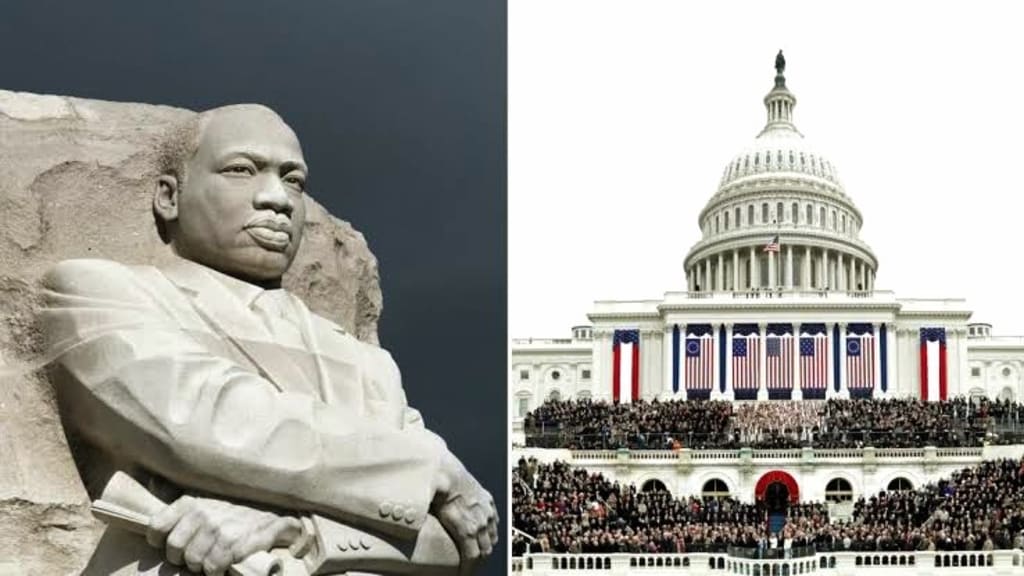
This year, Martin Luther King Day coincides with a unique moment in history: the second inauguration of President-elect Donald J. Trump. The dual observance highlights two different visions for America—one rooted in Dr. Martin Luther King Jr.'s dream of equality and racial justice, and the other shaped by Mr. Trump’s political resurgence, which has sparked debates over inclusion and leadership in today’s America.
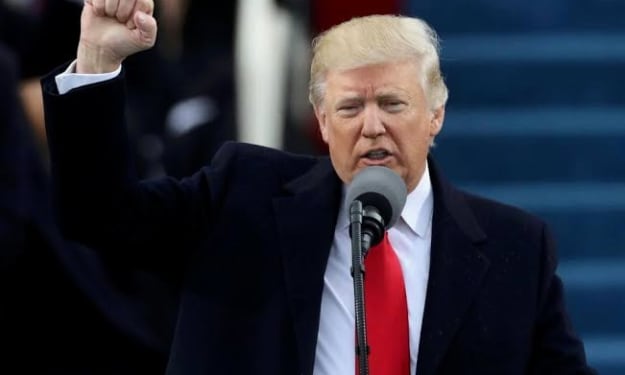
Dr. Martin Luther King Jr. is remembered as one of the most influential civil rights leaders of the 20th century. His dream of democracy, racial equality, and justice still resonates deeply across the nation. On the other hand, Donald Trump’s return to the White House, after a turbulent first term and a dramatic comeback, reflects a different reality. While his rise to power has been supported by growing gains with voters of color, his movement has also been criticized as a rejection of inclusion and diversity—values central to Dr. King’s legacy.
The pairing of these two events—a national holiday celebrating a champion of civil rights and the inauguration of a polarizing leader—brings mixed emotions. Some view this moment as a chance for reflection. For others, it’s a stark reminder of the deep divides in America, particularly over race and equality.
“It’s almost a Godsend,” said the Rev. Dr. William J. Barber II, a prominent preacher who plans to honor King’s legacy from the pulpit of Atlanta’s Ebenezer Baptist Church, where Dr. King himself once spoke. Barber sees the moment as an opportunity to contrast two visions for America: one rooted in unity and justice, and another shaped by division and self-interest.
A Time for Reflection
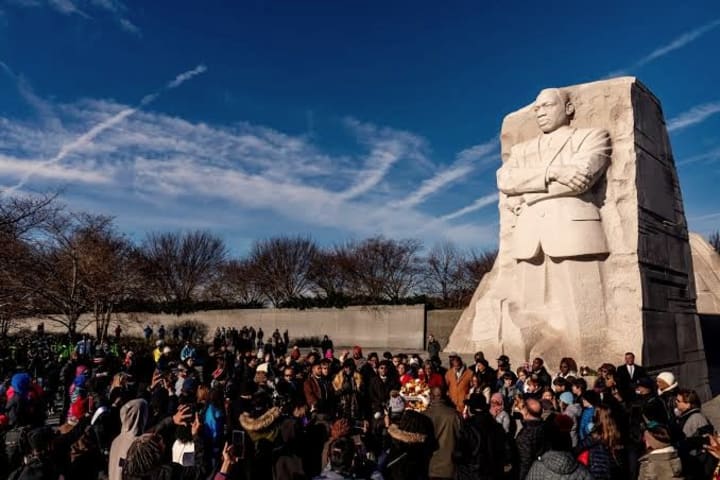
The convergence of Martin Luther King Day and Trump’s inauguration comes at a critical point for Black leadership and its historical relationship with the Democratic Party. Traditionally, Black voters have been a cornerstone of Democratic support. However, Trump’s success in securing significant votes from communities of color has shaken the longstanding alliance.
Dr. King’s dream envisioned a nation where race would no longer determine a person’s opportunities or treatment in society. But decades later, the fight for equality continues, with many Americans questioning how far we’ve come—and how far we still need to go.
This year also raises questions about the future of Black leadership in the U.S. Despite the opportunity to elect the first Black woman as president, voters chose another path. This decision has sparked debates about what effective Black leadership looks like in modern America, especially under the influence of Trump’s policies.
Marking the Day
Across the country, Martin Luther King Day will be celebrated in familiar ways. Churches will hold services to honor his legacy, and volunteers will participate in service projects, reflecting King’s commitment to community and giving back. At the same time, Washington, D.C., will be preparing for the spectacle of Trump’s second inauguration. Crowds of dignitaries and supporters will gather for the peaceful transfer of power, a stark contrast to the chaos of four years ago.
Despite the contrast, the intersection of these two events is a reminder of how closely politics and social progress are intertwined in America. In fact, the politicization of Martin Luther King Day is nothing new. Since its first celebration in 1986, the holiday has often been used by political figures to push their own agendas.
President Ronald Reagan, for example, initially opposed making King’s birthday a federal holiday. However, in 1986, Reagan used one of King’s most famous quotes—about judging people by the content of their character rather than the color of their skin—to argue against affirmative action. Decades later, Trump has adopted a similar stance, opposing policies designed to address racial disparities, while claiming to embrace King’s vision of a "colorblind society."
Progress or Setback?
The dual observance of Martin Luther King Day and Trump’s inauguration raises important questions about the country’s progress. Are we moving closer to Dr. King’s dream, or are we drifting further away?
For some, Trump’s appeal to voters of color signals a shift in political dynamics, one that challenges traditional ideas of Black leadership and party loyalty. For others, his presidency represents a step backward, marked by a rejection of the very principles King stood for: inclusion, equality, and justice.
As Americans celebrate King’s legacy this year, the country stands at a crossroads. The vision of a more inclusive and united nation remains an aspiration, but the path to achieving it is far from clear. In the face of division and uncertainty, King’s words still offer hope and guidance: “The arc of the moral universe is long, but it bends toward justice.”
This year, more than ever, his message reminds us of the work that lies ahead—and the need to keep striving for the dream he gave his life to achieve.
About the Creator
The Forsyth House Fire
Since 1851, Forsyth House has stood on the corner of Union Street and Gordon Street in the heart of Glasgow. Its iconic, or was... because on Sunday 8th of March, 2026, a fire broke out in a small, seemingly un-named shop in the building and tore all that history down. As I write, the rubble is still unsettled and the street is still blocked off. Central Station is quiet on the upper level, and around 30 small businesses have quite literally gone up in smoke.
By S. A. Crawford2 days ago in The Swamp
FBI Alerts California Law Enforcement to Potential Iranian Drone Threat
Federal authorities alerted California law enforcement that Iran may have explored launching drone attacks against the U.S. West Coast from offshore vessels. The warning came through an FBI intelligence bulletin distributed to law enforcement agencies and highlights concerns that escalating tensions in the Middle East could have broader security implications for the United States.
By Jacqueline Bowser4 days ago in The Swamp



Comments (1)
Good to know! Great work!