
Ordinary Thief vs Political Thief: The Real Cost of Corruption
Understanding the Difference That Affects Every Citizen
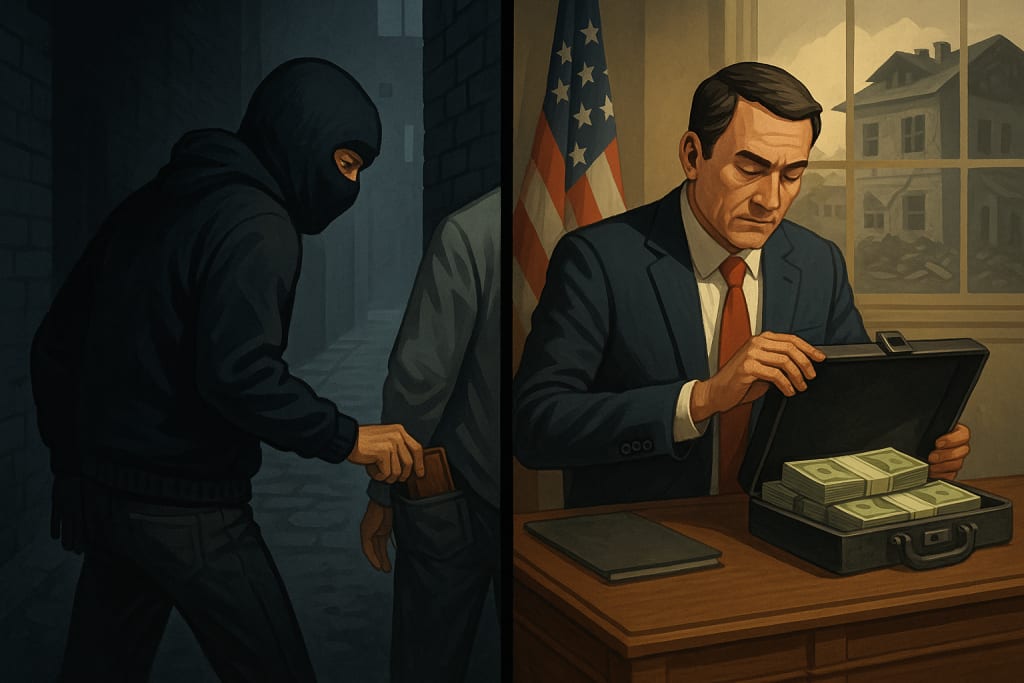
The word “thief” usually brings to mind someone who steals wallets, breaks into homes, or snatches phones on the street. But there’s another kind of thief that operates on a much larger scale, often in plain sight — the political thief. While both are involved in theft, the consequences of their actions are vastly different. In this article, we’ll explore the differences between an ordinary thief and a political thief — and why the latter often causes far more damage to society.
1. Who Is an Ordinary Thief?
An ordinary thief is someone who steals personal property, usually for survival or personal gain. They may rob a store, snatch a purse, or break into a house. Their crimes are visible, punishable, and often driven by desperation or lack of opportunity.
Key Traits:
Targets individuals or small businesses
Steals tangible items like money, electronics, or jewelry
Motivated by poverty, addiction, or greed
Usually punished quickly if caught
Impact is limited to a few people
While their actions are illegal and wrong, ordinary thieves are often operating at a small scale. Their crimes hurt, but the damage is usually local and recoverable.
2. Who Is a Political Thief?
A political thief is a public official who steals from the people — often through corruption, embezzlement, bribery, or abuse of power. They misuse public funds, rig contracts, inflate budgets, or exploit government positions for personal gain.
Key Traits:
Steals from the entire nation or public system
Hides behind laws, policies, or bureaucratic processes
Motivated by power, wealth, and control
Rarely faces justice due to influence or connections
Impact is massive: affects education, healthcare, infrastructure, and trust in democracy
Unlike an ordinary thief, a political thief operates under the cover of authority. Their actions may not be as visible, but they have devastating long-term consequences.
3. The Scale of Impact
Aspect Ordinary Thief Political Thief
Scope of theft Personal or small-scale National or institutional
Victims Individuals Millions of citizens
Punishment Swift legal action Rarely held accountable
Visibility Obvious and direct Hidden behind paperwork and influence
Damage caused Temporary loss Long-term poverty and underdevelopment
Political theft drains billions from national budgets meant for schools, hospitals, roads, and jobs. It deepens inequality, breeds injustice, and kills hope for future generations.
4. The Moral Difference
While both forms of theft are morally wrong, the hypocrisy of political thieves makes it worse. They are often trusted leaders, elected to serve and protect. When they steal, they betray that trust and destroy institutions.
An ordinary thief never promises to serve the public. A political thief, on the other hand, takes an oath — and breaks it for personal luxury.
5. Why It Matters
Political theft often goes unnoticed or unpunished because it is complex and slow-moving. But its effects are real:
Poor healthcare systems
Broken education systems
Unfinished roads and bridges
Unemployment and poverty
Loss of public trust in leadership
If left unchecked, political corruption weakens democracy, empowers crime, and keeps millions trapped in hardship.
✅ What Can Be Done?
Strengthen transparency laws and anti-corruption agencies
Promote civic education and voter awareness
Encourage investigative journalism
Support honest leadership and demand accountability
Vote wisely and participate in governance
🔚 Conclusion: A Choice That Affects Us All
An ordinary thief may rob a person, but a political thief robs a nation. One causes pain to a few; the other cripples entire generations. Understanding this difference is not just about blaming leaders — it’s about recognizing our responsibility as citizens. If we allow political theft to go unchecked, we become part of the problem.
Let’s stop romanticizing corrupt politicians and start treating political theft with the seriousness it deserves. Because when leaders steal, they don’t just take money — they steal futures.
About the Creator
Keep reading
More stories from CodeCraft By Rashid and writers in The Swamp and other communities.
Top Social Media Trends to Watch in 2025
Social media is changing faster than ever before. With new platforms, technologies, and user habits emerging, businesses and content creators need to stay ahead of the curve. In 2025, the social media landscape will be more dynamic, personal, and interactive. Whether you are a digital marketer, influencer, or just a curious user, understanding these top social media trends can help you grow your brand, engage your audience, and increase your online presence.
By CodeCraft By Rashid11 months ago in Journal
The Forsyth House Fire
Since 1851, Forsyth House has stood on the corner of Union Street and Gordon Street in the heart of Glasgow. Its iconic, or was... because on Sunday 8th of March, 2026, a fire broke out in a small, seemingly un-named shop in the building and tore all that history down. As I write, the rubble is still unsettled and the street is still blocked off. Central Station is quiet on the upper level, and around 30 small businesses have quite literally gone up in smoke.
By S. A. Crawford3 days ago in The Swamp
The Solitude of The Chupacabra
Many say that the Chupacabra is a rather recent and modern tale, a mangy coyote or rabied dog. Some point out that it’s just twisted evolution. But very few know the true backstory of the shapeshifter that led to the bloodsucking legend. And perhaps once you will come to know and understand more, you might “forget” a few cattle out to wander.
By Oneg In The Arctic2 days ago in Fiction



Comments (1)
Good