
Netherlands Bicycle Market Size & Forecast 2025–2033
How Cycling Culture, E-Bikes, and Sustainability Policies Are Powering the Dutch Bicycle Economy

Introduction: Cycling at the Heart of the Dutch Economy
The Netherlands has long been recognized as one of the most bicycle-friendly countries in the world. Cycling is not just a transport option but a deeply embedded cultural habit that influences urban planning, public health, environmental policies, and consumer spending. As sustainability concerns intensify across Europe and governments push for greener mobility alternatives, bicycles are becoming even more central to the Dutch transportation ecosystem.
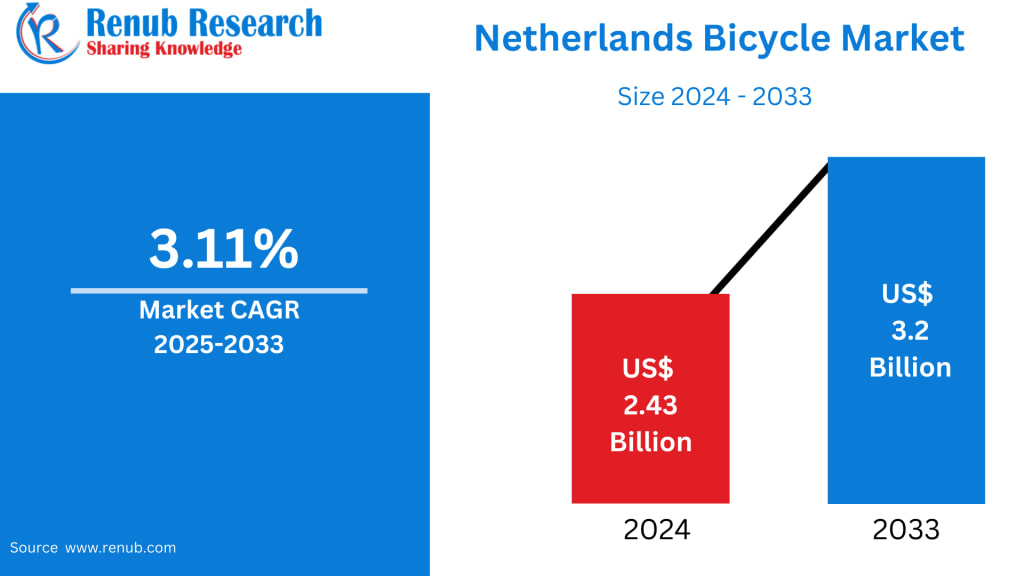
According to Renub Research, the Netherlands Bicycle Market is poised for steady expansion, growing from US$ 2.43 billion in 2024 to US$ 3.20 billion by 2033, registering a Compound Annual Growth Rate (CAGR) of 3.11% from 2025 to 2033. This growth is supported by strong government backing, widespread infrastructure, rising adoption of electric bicycles, and continued innovation in bicycle design and technology.
Netherlands Bicycle Market Outlook
A bicycle is a two-wheeled, human-powered or electric-assisted vehicle used for transportation, recreation, and sport. In the Netherlands, bicycles are not limited to leisure use—they form the backbone of daily commuting for millions of residents. From schoolchildren and working professionals to senior citizens, cycling spans all age groups and income categories.
The country boasts an extensive and well-maintained cycling infrastructure, including segregated bike lanes, priority intersections, and large-scale bicycle parking facilities. This environment makes cycling one of the safest, most convenient, and cost-effective mobility options available. With rising fuel prices, traffic congestion, and climate awareness, bicycles remain a preferred alternative to cars, especially in urban areas.
Additionally, cycling tourism contributes to bicycle demand. The Netherlands’ flat landscape, scenic countryside, and well-marked cycling routes attract both domestic and international tourists, further strengthening market fundamentals.
Market Size and Forecast: Renub Research Perspective
Renub Research projects consistent and resilient growth for the Netherlands bicycle market over the forecast period.
Market Size (2024): US$ 2.43 Billion
Projected Market Size (2033): US$ 3.20 Billion
CAGR (2025–2033): 3.11%
Unlike emerging markets driven by first-time adoption, the Dutch bicycle market is primarily propelled by replacement demand, premium upgrades, and electric bicycle penetration. Consumers increasingly invest in higher-value bicycles equipped with smart features, durable materials, and enhanced comfort.
Key Growth Drivers in the Netherlands Bicycle Market
Strong Cycling Culture and Government Encouragement
The Netherlands has one of the highest bicycle-to-population ratios globally, with more bicycles than residents. Government policies actively promote cycling through infrastructure investments, tax incentives, and urban mobility planning that prioritizes non-motorized transport.
Recent fiscal measures supporting bicycle commuting and employer-provided cycle benefits continue to reinforce bicycles as the primary mode of short-distance travel. These policies ensure long-term demand stability across both traditional and electric bicycles.
Growing Popularity of E-Bicycles and Technological Innovation
Electric bicycles represent the fastest-growing segment in the Dutch market. Advances in battery efficiency, lightweight motors, digital connectivity, and ergonomic design have made e-bikes attractive to a broader demographic, including seniors, professionals, and delivery workers.
In August 2024, a German e-bike subscription platform expanded operations into Amsterdam, highlighting the growing commercialization of e-bikes for professional and last-mile delivery use. Smart e-bikes equipped with GPS tracking, app-based diagnostics, and anti-theft features are further accelerating adoption.
Health, Fitness, and Sustainable Living Trends
Dutch consumers are increasingly aligning lifestyle choices with sustainability and health goals. Cycling supports cardiovascular fitness, reduces stress, and lowers carbon emissions, making it a preferred daily habit.
As awareness of climate change intensifies, bicycles are viewed not merely as transport tools but as symbols of responsible living. This shift ensures continued demand even in a mature market environment.
Challenges Facing the Netherlands Bicycle Market
Market Saturation and Intense Competition
With bicycle ownership already near saturation, particularly in urban centers, manufacturers face challenges in driving volume growth. Competition is intense, forcing companies to differentiate through innovation, design, durability, and after-sales services.
Growth increasingly depends on value-based upgrades rather than new user acquisition, placing pressure on brands to continuously innovate.
Rising Costs of Premium Bicycles and E-Bikes
E-bikes and high-end bicycles often carry premium price tags due to advanced components, lithium-ion batteries, and smart features. Inflationary pressures and supply-chain disruptions further increase costs, potentially limiting accessibility for price-sensitive consumers.
Although subsidies help offset costs, affordability remains a concern for widespread adoption of premium models.
Netherlands Hybrid Bicycle Market
Hybrid bicycles remain popular due to their versatility and comfort. Designed to perform well on both urban roads and suburban paths, hybrid bikes appeal to students, professionals, and recreational cyclists.
Their upright seating position, moderate pricing, and low maintenance requirements make them ideal for daily commuting. As cities continue to encourage mixed-use mobility, hybrid bicycles maintain steady demand across demographics.
Netherlands E-Bicycle Market
The e-bicycle segment dominates market growth and revenue expansion. Pedal-assist technology allows users to travel longer distances with minimal effort, making e-bikes ideal for aging populations and longer commutes.
Government incentives, employer-supported cycling programs, and urban emission reduction targets strongly favor e-bike adoption. This segment is expected to remain the primary growth engine through 2033.
Netherlands Online Bicycle Market
E-commerce has reshaped bicycle purchasing behavior in the Netherlands. Consumers increasingly research, compare, and purchase bicycles online, particularly mid-range bikes, accessories, and electric models.
Online platforms offer transparent pricing, home delivery, financing options, and extended warranties. While physical bike shops remain essential for servicing and fittings, online channels continue to gain market share.
City-Wise Bicycle Market Insights
Amsterdam Bicycle Market
Often called the world’s cycling capital, Amsterdam sees bicycles dominate daily commutes. Extensive bike lanes, limited car access, and strong environmental policies sustain high bicycle usage.
Despite challenges such as congestion and theft, demand for e-bikes, cargo bikes, and rental bicycles remains strong among residents and tourists.
Eindhoven Bicycle Market
Eindhoven’s technology-driven ecosystem supports innovation in smart mobility. The city is emerging as a hub for connected e-bikes and sustainable transport solutions, supported by a young, tech-savvy population.
Almere Bicycle Market
As a planned city with modern infrastructure, Almere promotes cycling through wide roads and integrated urban planning. E-bikes are particularly popular due to longer commuting distances between residential and commercial zones.
Market Segmentation
By Type
Road Bicycle
Hybrid Bicycle
All-Terrain Bicycle
E-Bicycle
Others
By Distribution Channel
Online Stores
Offline Stores
Top 10 Cities
Amsterdam, Rotterdam, The Hague, Utrecht, Eindhoven, Groningen, Tilburg, Almere, Breda, Nijmegen
Competitive Landscape and Key Players
The Netherlands bicycle market features a mix of domestic leaders and global manufacturers. Major players include:
Accell Group NV
Trek Bicycle Corporation
Pon Holdings BV
Giant Manufacturing Co. Ltd
Bulls Bikes
Pedego Inc.
Benno Bikes LLC
Hero Cycles Limited
Ribble Cycles
Riese & Müller GmbH
Each company is evaluated across five viewpoints: overview, key leadership, recent developments, SWOT analysis, and revenue performance.
Final Thoughts
The Netherlands Bicycle Market represents a rare combination of cultural tradition, government support, and technological evolution. While the market is mature and competitive, steady growth is ensured through premiumization, e-bike adoption, and sustainability-driven policies.
With Renub Research forecasting growth to US$ 3.20 billion by 2033, bicycles will remain a cornerstone of Dutch mobility and a benchmark for sustainable transport globally. Innovation, affordability, and smart urban planning will determine which players lead the next phase of this iconic market.
About the Creator
Keep reading
More stories from Aaina Oberoi and writers in The Swamp and other communities.
Maintenance, Repair and Operations Market Size and Forecast 2025–2033
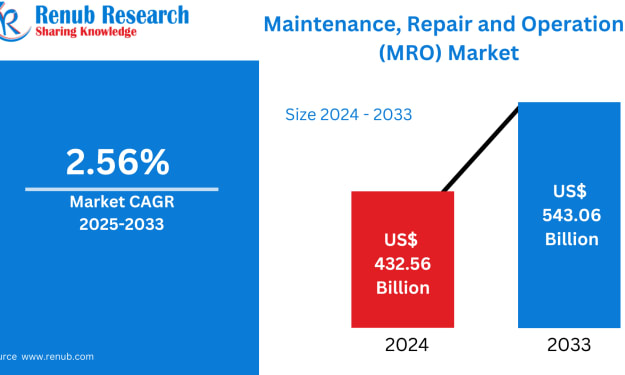
Maintenance, Repair and Operations (MRO) Market Overview The global Maintenance, Repair and Operations (MRO) market plays a critical role in ensuring the smooth functioning, safety, and longevity of industrial, commercial, and infrastructure assets across sectors. According to Renub Research, the Maintenance, Repair and Operations Market is expected to grow from US$ 432.56 billion in 2024 to US$ 543.06 billion by 2033, registering a compound annual growth rate (CAGR) of 2.56% from 2025 to 2033.
By Aaina Oberoi10 days ago in The Swamp
Stocks, Bonds and Oil Steady as Investors Downplay Venezuela Upheaval
Global markets showed remarkable composure this week as investors largely shrugged off the recent political upheaval in Venezuela. While Latin America’s largest oil producer continues to grapple with internal turmoil, key financial indicators—including stocks, bonds, and oil prices—remained largely stable, suggesting that market participants are weighing broader economic fundamentals over short-term geopolitical risks. Markets Stay Grounded Amid Venezuelan Turmoil Despite news of widespread protests and political uncertainty in Caracas, major stock indices in the United States and Europe showed little volatility. The S&P 500 hovered near record highs, while European benchmarks, including Germany’s DAX and the UK’s FTSE 100, experienced minor fluctuations. Analysts suggest that investors are prioritizing macroeconomic trends, such as interest rate expectations and corporate earnings, over regional disruptions. “This isn’t the first time Venezuela has faced political instability,” said Laura Chen, a senior strategist at Horizon Capital. “Markets have learned to isolate localized events from global investment strategies. While the situation is concerning on a humanitarian level, it has limited immediate impact on diversified portfolios.” Bonds Hold Firm as Credit Concerns Linger U.S. Treasury yields remained largely unchanged, reflecting continued demand for safe-haven assets even as geopolitical risks simmer. Venezuelan debt, meanwhile, continues to trade at distressed levels, but investors appear to have largely priced in the country’s political volatility. Emerging market bonds in neighboring regions also showed resilience. Brazil, Colombia, and Mexico saw minor yield fluctuations, indicating that investors are confident in these economies’ relative stability compared to Venezuela. Financial analysts note that, in times of regional instability, capital tends to flow toward more diversified or insulated markets rather than retreating globally. Oil Prices Exhibit Surprising Stability Given Venezuela’s status as a major crude exporter, one might expect that domestic unrest could trigger spikes in global oil prices. Yet, Brent and West Texas Intermediate (WTI) crude futures have remained within a narrow range over the past week. Traders cite ample global supply and the strategic reserves maintained by countries like the U.S. and Saudi Arabia as factors mitigating sudden price swings. “Oil markets have adapted to political shocks in Venezuela before,” said Javier Morales, an energy commodities analyst. “Unless there is a sudden disruption to exports, which is unlikely in the short term, prices are expected to stay relatively stable.” Investor Sentiment: Risk vs. Reality The calm in financial markets reflects a broader trend in investor behavior: a growing ability to compartmentalize political crises. Institutional investors, in particular, appear to be weighing the risks of Venezuela’s turmoil against broader portfolio strategies, opting to maintain positions in equities and bonds. Retail investors have also demonstrated cautious optimism. Trading volumes on U.S. exchanges have been steady, with no major sell-offs attributed to Venezuelan unrest. Online forums and social media sentiment analysis indicate that while geopolitical news captures attention, it has not yet influenced significant shifts in asset allocation. Historical Context: Venezuela’s Chronic Volatility Venezuela’s political and economic instability is not new. Over the past two decades, the nation has experienced hyperinflation, currency devaluations, and multiple government crises. Each time, markets have initially reacted with concern, only to stabilize once investors assessed the broader global context. This historical perspective may explain why current market reactions are muted. Unlike sudden shocks in major economies, Venezuela’s challenges are seen as somewhat contained, with limited spillover effects on international trade and finance. Analysts’ Takeaways Market observers are emphasizing that stability in stocks, bonds, and oil does not imply that Venezuela’s situation is irrelevant. Instead, it highlights the sophistication of global investors in distinguishing between headline risk and systemic risk. “Investors are learning to differentiate between local political drama and global financial exposure,” said Chen. “While it’s critical to monitor developments in Venezuela, the markets’ steadiness reflects confidence in the resilience of the global economy.” Looking Ahead Experts caution that this equilibrium could shift if political unrest escalates to a point that disrupts Venezuela’s oil production or triggers broader regional instability. For now, however, financial markets appear unshaken, with investors showing a remarkable capacity to prioritize long-term fundamentals over short-term geopolitical noise. The Venezuelan situation will remain under close watch, especially by energy traders and emerging-market investors. Any substantial changes could influence oil prices, bond yields, and regional equity markets. But as of now, the global financial ecosystem demonstrates that not every political upheaval automatically translates into economic turbulence.
By Muhammad Hassan5 days ago in The Swamp



Comments
There are no comments for this story
Be the first to respond and start the conversation.