
Morocco: Street and politicians' movement in dealing with price hikes
Morocco’s luck this year is not good, as three major crises have converged upon it: the continuation of the repercussions of the Corona pandemic
Morocco’s luck this year is not good, as three major crises have converged upon it: the continuation of the repercussions of the Corona pandemic, its great impact on raw materials, its causing successive waves of price hikes, the crisis of rising fuel prices in global markets, and the accompanying hike in transport prices, and the consequent From raising the prices of all materials, foremost of which are foodstuffs, then a drought crisis that Morocco has not known since 1981. Difficult effects on the rural world, which lives on agriculture and livestock.
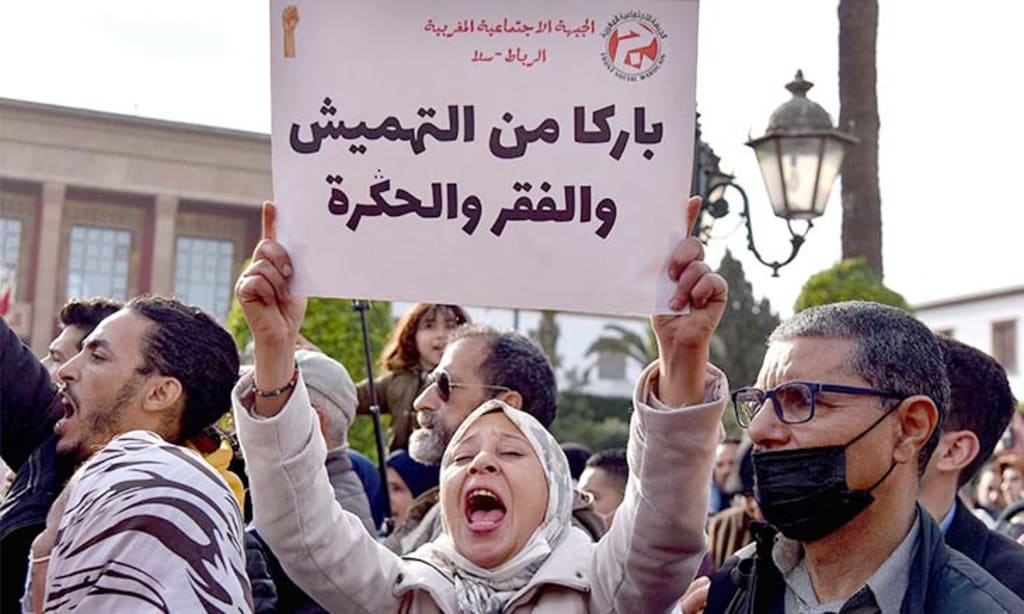
The government coalition parties were very slow in coming out to public opinion, until a number of protest expressions came out on the street (about 57 protests in different cities) on the occasion of the February 20 anniversary, and social media platforms turned into a wave of anger at the government’s silence and indifference to popular suffering, and waited for the initiative The property, by allocating 10 billion to alleviate the suffering of the rural world (bringing water to its districts, and supporting farmers by providing feed materials to their livestock so that they do not have to sell it at the lowest price) to then introduce its elements.
The observation that was recorded in the street movement and its expressions, that very quickly, he turned his slogans into a political protest against the Akhannouch government (demanding its overthrow) focusing on the issue of the relationship between wealth and power, which was the focus of the popular movement of the February 20 movement, but, this time, it was the image of men Business and money from the National Rally of Independents, and in particular, the leader of the party, Mr. Aziz Akhannouch, in the crater of artillery, and the discussion was restored about the illegal margins for profit of the hydrocarbon companies, mainly his “Africa” and how these companies managed to reap about 38 billion dirhams from As a result of benefiting from the liberalization of prices and its control over the price of fuel, it also revived the discussion about the role of the Competition Council and its inability to confront the “big fish.” Rather, the Green Scheme project (the scheme for the development of agriculture in Morocco), which Mr. Aziz Akhannouch was responsible for, was questioned, and how the drought demonstrated its fragility. He turned only to the big peasants, and did not put the small peasants at the center of his concerns.
The Justice and Development Party, according to its new Secretary-General, Abdelilah Benkirane, had a media appearance in the regular session of the National Council of his party, which received wide interaction. Although he provided some kind of political support to the government of Aziz Akhannouch, rejecting calls for its overthrow, arguing that it was not more than five months old, and that its overthrow would be a political message that would harm Morocco’s stability and image abroad, but on the other hand, he invested the moment of popular anger over the government’s waiting behavior , to emphasize the need to correct the confusion that the democratic process was exposed to in Morocco in the September 8 elections, and that the result of that appeared quickly, as the government of businessmen and businessmen, which enjoyed the support of the administration according to the leader of the Justice and Development, has become unable to confront the street, and even incapable of carrying out any mediation To calm the tension, and that defending political stability, at this political moment, does not mean endorsing the fragile democratic situation, and thus not capturing the popular reaction.
Ibn Kiran, took advantage of the political moment, and sent two messages, the first to society, by being patient with this government for an additional seven months, that is, until it completes a year, until its complete impotence becomes clear, and so as not to harm Morocco’s political stability and image abroad. The second is to the state, by calling for premature parliamentary elections a year later, in the event that Aziz Akhannouch is proven incapable of running the government, and until the policy of confusing the democratic process in the country in the September 8 elections is corrected.
The message of progress and socialism, the former ally of the Justice and Development Party, was not different. The communiqué of his political office was rational in reading the causes of the phenomenon of high prices, and it adopted almost the same reading mentioned by Ibn Kiran in his speech. However, on the other hand, there is a government failure, and an inability to take important measures that could have alleviated the suffering of the people, including measures related to the hydrocarbon sector, and how the government recommends the reality of the continued illegal profit margins for fuel companies, which cause high transportation prices. And there is a rise in the prices of all materials, especially foodstuffs.
The communiqué of progress and socialism did not neglect to direct sharp criticism of water security policies and strategies, accusing the government of slowing down in carrying out structural strategic projects, which could have secured a large share of water needs, whether for drinking or for irrigation.
The government majority woke up late, and its intervention came after the street movement, after the royal initiative, and after the intervention of the leader of Justice and Development. However, its answer and its political and media communication method received new ridicule on social media, as it did not add anything new to what the royal initiative brought, and preferred To attribute the congestion to what it called the legacy of the years of management of the government of justice and development, referring to the past ten years, and raising the slogan “God is the winner” in reference to its inability to face these difficult challenges, or its lack of help in the face of the huge potential it requires to meet the needs of society in This compound distress.
The irony that was recorded is that at a time when the leader of Justice and Development provided partial political support to Akhannouch’s government, by calling on the people not to respond to calls for its overthrow and to wait for a year, and to make the change within an institutional constitutional framework (the king’s initiative to conduct premature elections), the answer of the coalition parties came The government did not respond by itself or better than it. Rather, it came to attach the crisis to the legacy of the previous government, in which Aziz Akhannouch was responsible for the agricultural sector and for the development of the rural world.
What is interesting about the dynamics of political parties is that the position of Abd al-Rahim Bouabid (Socialist Union) party came far from the movement and aspirations of the street, and was closer to being the answer of a government party, proposing measures to confront the crisis, as if it is still hoping for a position in the government and being convinced of the necessity of its presence in it. And he sends a message to the state that his absence from the government is costly, and that if he had been in it, he would have anticipated the situation and provided solutions that alleviate popular suffering, and cut short the deadly waiting state that the government knows in dealing with social tension.
The National Rally of Independents, in this difficult circumstance, announced, in preparation for its upcoming conference, the opening of the nomination for the General Secretariat, amid leaks about the possibility of Aziz Akhannouch leaving the leadership, and replacing him with Moulay Hafid Elalamy, in preparation for a scenario similar to the dismissal of Ibn Kiran and the appointment of Said El Din El Othmani from the same party. as head of government.
These opposite dynamics, in essence, reveal dissatisfaction with the government of Aziz Akhannouch, but rather reveal annoyance about the weakness of its political mediation. Their illegal profit, even at the expense of the suffering of the people and the poor classes, especially the rural worker.
It is estimated that the popular movement in Morocco will not reach long ranges. The king in the political system, the popular imagination, and the constitutional framework remains the center of gravity, the reference in the case of disagreement, the one who guarantees security and stability, and secures the functioning of institutions, and above that, he has the wide options to carry out reforms. What is necessary, whether in the form of constitutional reform, a change of government, a call for premature elections, or a broad social solidarity initiative, obliges the rich to alleviate the suffering of the poor as he did in the face of the repercussions of the Corona pandemic.
About the Creator
The Forsyth House Fire
Since 1851, Forsyth House has stood on the corner of Union Street and Gordon Street in the heart of Glasgow. Its iconic, or was... because on Sunday 8th of March, 2026, a fire broke out in a small, seemingly un-named shop in the building and tore all that history down. As I write, the rubble is still unsettled and the street is still blocked off. Central Station is quiet on the upper level, and around 30 small businesses have quite literally gone up in smoke.
By S. A. Crawford3 days ago in The Swamp
Iranian Soccer Team Exits Women’s Asian Cup and Faces Tricky Prospect of Return Home
The Iranian women’s national football team’s campaign at the 2026 AFC Women’s Asian Cup came to a somber end on Sunday with a 2–0 defeat to the Philippines on the Gold Coast in Queensland, Australia, condemning them to an early exit from the tournament. The loss, following earlier defeats to South Korea and Australia, leaves the squad reflecting not only on their performance on the pitch but also on the profound uncertainty that awaits them as they prepare for the journey back to their homeland — where political tensions, war and allegations of persecution now loom large. The team had arrived in Australia last month ahead of the tournament, mere days before a significant escalation of conflict in the region triggered by U.S. and Israeli air strikes on Iran on February 28. That conflict has only heightened anxieties about what players — especially those visible on the international stage — might face on their return. Silence, Anthem Controversy, and the Backlash Iran’s campaign became politically charged from the outset. Before their opening match against South Korea, the team stood in silence during the national anthem, a gesture interpreted by many international commentators and human rights activists as a possible act of protest, mourning, or dissent given the wartime backdrop. That moment reverberated back home: Iranian state media branded the players “wartime traitors”, a designation with serious implications in a legal system where charges of treason can carry grave penalties. In subsequent matches — including the final group game against the Philippines — the players did sing and salute the anthem. But the damage in the eyes of state media and hardline commentators had already been done, and the controversy continued to cast a long shadow. Protesters, Petitions, and Concerns on the Gold Coast As the Iranian squad prepared to depart Australia following their exit from the tournament, dramatic scenes unfolded outside Gold Coast Stadium. Supporters and activists surrounded the team bus, chanting slogans such as “let them go” and “save our girls,” and briefly impeding its movement. Police intervened to disperse crowds of up to around 200 people in what was described as chaotic scenes. Locally based Iranian community organisations and human rights advocates have called on Australian authorities to ensure the team’s safety and to provide the players with the opportunity to seek protection if they fear persecution when returning home. One widely circulated online petition, supported by tens of thousands of people, urges Australian officials to guarantee independent legal counsel, interpreter support, and safe, private interviews for any player who expresses fear about going back to Iran. Government Response and Asylum Debate The emotional and political complexities of the situation have prompted responses at the highest levels of Australia’s government. Foreign Minister Penny Wong expressed public solidarity with the Iranian players and acknowledged the broader oppression faced by women in Iran, but stopped short of detailing any specific protection plans or whether government officials had communicated directly with the players. Advocates for the team argue that Iran’s current wartime environment — and the punitive rhetoric broadcast by state-controlled media — create credible risks of persecution, imprisonment, or worse for players labelled “disloyal” upon their return. Several former athletes and civil society groups have called on football’s governing bodies, including FIFA and the Asian Football Confederation (AFC), to intervene and uphold their obligations to protect athletes’ safety during and after competition. Some Australian lawmakers — including opposition figures — have gone further by urging the government to offer temporary protection or even asylum to team members, arguing that humanitarian commitments should take precedence in such an extraordinary case. Yet officials have reiterated that any such actions would need to adhere to standard immigration and visa processes unless players themselves formally request protection. The Road Ahead: Homecoming in Limbo For the players themselves, emotions are mixed. Iran’s coach Marziyeh Jafari has publicly stated that the squad wants to return home and be reunited with family and compatriots, emphasizing their eagerness to go back despite the tumultuous backdrop. Others within the team have voiced concern for their loved ones still in Iran, where widespread social unrest and wartime tensions persist. As arrangements for their departure from Australia are finalised, many questions remain unanswered: Will they return to a warm welcome, or face suspicion and reprisals? Does international sport carry a responsibility to protect athletes beyond the pitch? And what does this saga mean for the future of women’s sport in Iran amid a deeply polarized political climate? The answers — and the fate of these players — are still very much to be determined.
By Fiaz Ahmed 7 days ago in The Swamp


Comments
There are no comments for this story
Be the first to respond and start the conversation.