
Missile strikes reported across Russia as Belgorod faces blackouts, major oil pipeline hub in Tatarstan damaged
Explosions and infrastructure damage ripple far beyond the border regions as energy facilities and civilian utilities come under pressure.
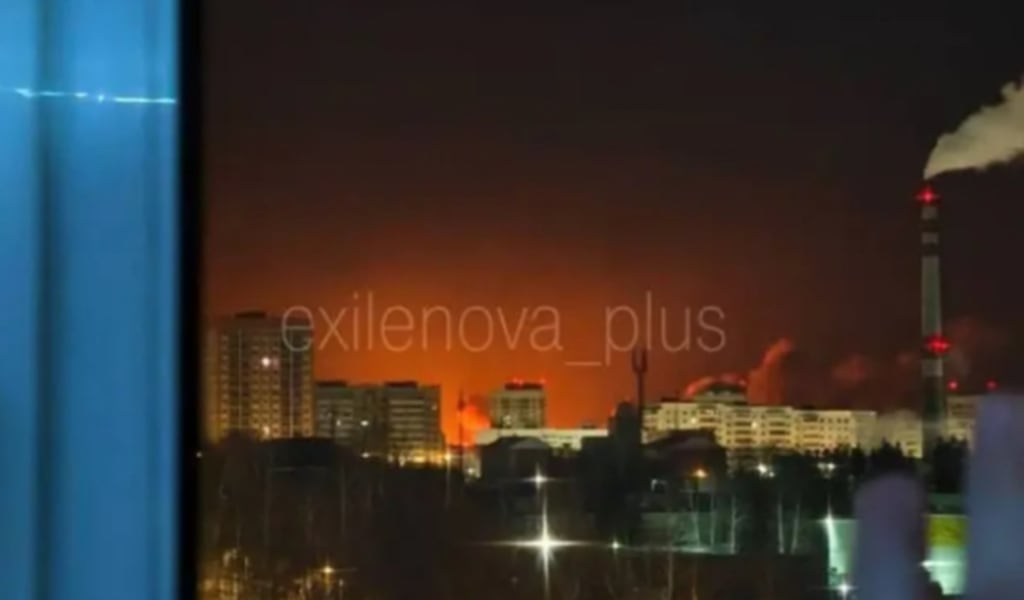
Russia awoke to another wave of reported missile and drone strikes stretching from its western borderlands deep into the Volga region, underscoring how the conflict’s reach now extends well beyond the immediate front lines. Regional officials and local media channels described overnight explosions, power outages, and damage to critical infrastructure in multiple oblasts, with the border city of Belgorod and a major oil pipeline hub in Tatarstan among the most affected.
While independent verification of battlefield claims remains difficult, the geographic spread of the reported incidents signals a widening arc of vulnerability across the country’s energy and transport networks.
Blackouts in Belgorod
The city of Belgorod, just north of the Ukrainian border, has endured repeated cross-border shelling and drone incursions since the early stages of the war. In the latest wave, residents reported loud detonations followed by widespread power outages in several districts. Social media footage showed darkened residential blocks and emergency vehicles navigating streets lit only by headlights and portable lamps.
Regional authorities acknowledged disruptions to the electricity grid, citing damage to substations and transmission lines. Utility crews were deployed overnight, but officials warned that full restoration could take time, especially if follow-up strikes target repair operations.
Belgorod’s strategic significance lies not only in its proximity to the border but also in its role as a logistics and staging area. Rail lines and highways linking the region to central Russia make it a key transit corridor. Repeated attacks have heightened local anxiety, prompting the construction of additional air defenses and reinforced shelters.
For civilians, however, the immediate concern is more basic: heat, light, and water. In winter months, blackouts can quickly become life-threatening, particularly for the elderly and families with young children. Even short disruptions strain hospitals, telecommunications networks, and municipal services.
Oil pipeline hub hit in Tatarstan
Farther east, in the Republic of Tatarstan along the Volga River, regional officials confirmed damage to a major oil pipeline control and distribution facility. The site serves as a hub for crude transported from western Siberia toward refineries and export terminals. Photographs circulating online appeared to show smoke rising from industrial structures, though the extent of the damage has not been fully disclosed.
Energy analysts note that Tatarstan is home to significant refining and petrochemical assets, including facilities linked to the state pipeline operator Transneft. Any sustained disruption at a central node could complicate internal fuel distribution and export scheduling, even if only temporarily.
Authorities described the strike as an attempt to undermine Russia’s economic backbone. Emergency crews reportedly contained secondary fires, and engineers began assessing whether pipeline pressure and flow rates could be safely restored. No immediate casualty figures were released.
The targeting of oil infrastructure reflects a broader pattern seen over the past year, with refineries, storage depots, and pumping stations increasingly vulnerable to long-range drones and missiles. Such attacks aim not only to degrade military fuel supplies but also to dent state revenues derived from hydrocarbon exports.
Expanding reach of long-range systems
The reported incidents highlight how advances in drone technology and missile range have altered the conflict’s geography. Early in the war, strikes were concentrated along the front lines and in major cities near the border. Now, installations hundreds of kilometers from active combat zones have come under threat.
Russian air defense systems have intercepted numerous projectiles in recent months, according to official statements. Yet the sheer volume and frequency of attacks create gaps that adversaries can exploit. Even limited damage can have outsized effects when aimed at chokepoints such as substations, rail junctions, or pipeline valves.
Military analysts argue that the psychological impact is also significant. Repeated air raid sirens and sporadic explosions in regions once considered relatively secure erode the sense of distance from the conflict. Businesses face higher insurance costs and operational uncertainty, while regional governments divert funds toward fortifications and rapid-response capabilities.
Civilian toll and infrastructure strain
Though oil depots and power substations are strategic targets, their destruction reverberates through civilian life. Electricity outages disrupt heating systems, water pumps, and internet connectivity. Fuel facility damage can trigger localized shortages or price spikes, particularly if transport routes must be rerouted.
In Belgorod, schools have periodically shifted to remote learning during heightened security alerts. In Tatarstan, officials sought to reassure residents that gasoline supplies remain stable, emphasizing contingency plans and reserve stocks.
Still, infrastructure repair is costly and time-consuming. Specialized components for high-voltage transformers or pipeline control systems are not always readily available, especially under sanctions that restrict access to Western technology. Repeated damage to the same facilities can compound delays, leaving networks more fragile over time.
Strategic messaging and escalation risks
Neither side has consistently provided detailed evidence for every reported strike, and information warfare plays a central role in shaping public perception. Statements emphasizing resilience and rapid recovery aim to project control, while highlighting damage to high-value targets serves to demonstrate reach and capability.
The targeting of deep infrastructure nodes carries escalation risks. Energy facilities, in particular, sit at the intersection of civilian and military use. Strikes that cause environmental contamination or prolonged blackouts could provoke retaliatory measures, widening the cycle of attack and response.
International observers are watching closely for signs that critical export flows might be significantly curtailed. So far, global oil markets have reacted cautiously, suggesting traders believe disruptions remain localized or temporary. But the cumulative effect of repeated hits could shift that calculus.
A conflict without clear geographic limits
The latest wave of reported missile and drone strikes reinforces a stark reality: the war’s footprint is no longer confined to trench lines and border towns. From the darkened streets of Belgorod to the industrial complexes of Tatarstan, infrastructure far from the battlefield is increasingly entangled in the conflict.
For residents, the distinction between frontline and rear area grows blurrier with each siren and blackout. For policymakers and military planners, the challenge is equally complex — defending vast territories and critical assets against relatively inexpensive, hard-to-detect weapons.
As repairs continue and investigations assess the scale of damage, the broader trajectory remains uncertain. What is clear, however, is that energy grids, oil pipelines, and civilian utilities have become central arenas in a war defined not only by territorial control but by the resilience — and vulnerability — of modern infrastructure.
About the Creator
A Gathering of Evil Bosses
“I’m the queen of chin jutting while I smooth my hair, attacking, insulting, and deflecting to protect my appointer.” “Oh, please, Blondi, my hair is curled, highlighted, and longer than yours. I feature television commercials telling immigrants that we will give them a free plane ride home, and if they voluntarily turn themselves in, they will be allowed to legally apply for re-entry. It runs everywhere, and I look good in it! You can’t compete because of your blond hair. Mine is nicer, and my lips are prettier than yours.”
By Andrea Corwin 5 days ago in The Swamp




Comments
There are no comments for this story
Be the first to respond and start the conversation.