
Micron Joins the 3GB GDDR7 Party, Introduces 36 Gbps Modules for GPUs
New Memory Modules Boost Capacity, But Speed Race Still Favors Samsung and SK Hynix
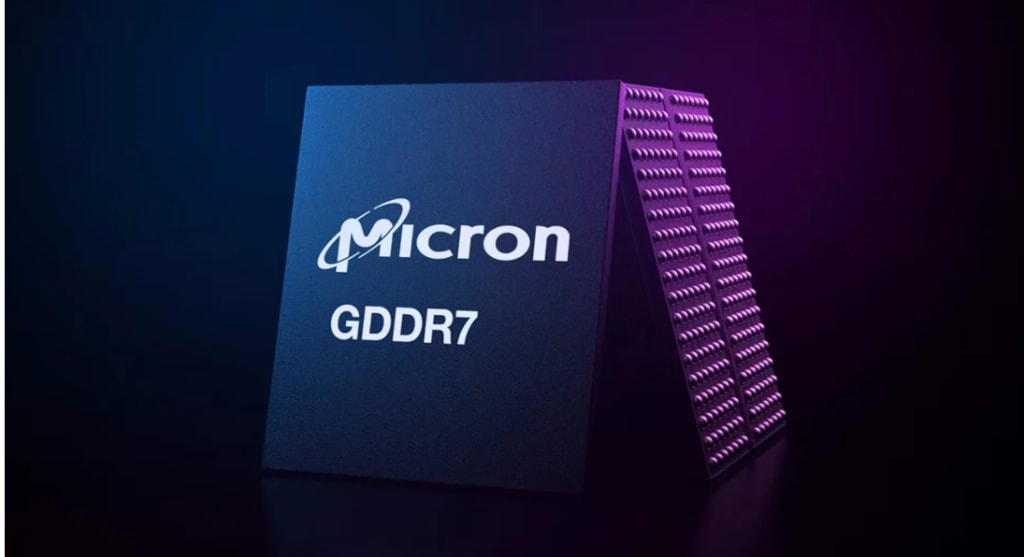
The graphics memory race is heating up again. Micron has officially joined the emerging 3GB GDDR7 memory segment, unveiling new 36 Gbps modules designed for next-generation GPUs. While the announcement marks a significant milestone for the company, Micron still trails behind rivals Samsung and SK Hynix in raw speed performance.
As GPU manufacturers push toward higher resolutions, advanced AI workloads, and faster gaming experiences, memory bandwidth and capacity have become just as critical as the graphics processors themselves. Micron’s entry into the 3GB GDDR7 space signals both opportunity and intense competition in the memory industry.
What Is GDDR7 and Why It Matters?
GDDR7 (Graphics Double Data Rate 7) is the latest generation of high-speed memory designed specifically for graphics cards. It succeeds GDDR6 and GDDR6X, offering improved bandwidth, power efficiency, and data integrity.
Modern GPUs rely heavily on memory bandwidth to handle:
4K and 8K gaming
Real-time ray tracing
AI acceleration
Large-scale data processing
Professional creative workloads
As GPU cores become more powerful, they require faster memory systems to avoid bottlenecks. That’s where GDDR7 comes into play.
Micron’s new modules operate at 36 gigabits per second (Gbps), delivering substantial bandwidth improvements over previous generations.
The 3GB Module Shift
One of the most notable aspects of Micron’s announcement is the move to 3GB memory modules.
Traditionally, GDDR memory chips have been available in 1GB or 2GB densities. The introduction of 3GB modules allows GPU manufacturers to design graphics cards with higher total memory capacity without increasing the number of memory chips on the board.
For example:
A 12-chip GPU configuration using 3GB modules could achieve 36GB of VRAM.
This opens new possibilities for AI training cards and high-end gaming GPUs.
Higher memory capacity is especially important for artificial intelligence workloads, where large models require significant VRAM to function efficiently.
Micron’s Position in the Speed Race
Although 36 Gbps is impressive, Micron is not currently leading the speed race.
Competitors like Samsung Electronics and SK Hynix have already demonstrated faster GDDR7 modules, reportedly reaching speeds beyond 36 Gbps in testing phases.
This means Micron’s strength may lie more in capacity innovation and production readiness rather than absolute speed leadership — at least for now.
However, in semiconductor manufacturing, speed differences can narrow quickly as processes mature.
Why Capacity Matters as Much as Speed
In today’s computing landscape, raw bandwidth is not the only performance factor. Memory capacity is becoming equally critical.
Gaming titles are growing larger and more complex. Professional applications like 3D rendering, video editing, and simulation modeling demand substantial VRAM. Meanwhile, AI accelerators require enormous memory pools to process large datasets and neural networks.
By introducing 3GB modules, Micron provides GPU manufacturers greater flexibility in balancing performance and capacity.
For companies designing next-generation GPUs, this could be especially appealing.
Impact on GPU Manufacturers
Major GPU makers such as Nvidia and AMD constantly evaluate memory suppliers when designing new graphics cards.
Memory availability, cost, speed, efficiency, and production scale all influence these decisions.
If Micron can deliver strong yields and competitive pricing, its 36 Gbps 3GB modules may find their way into upcoming gaming GPUs, workstation cards, and AI accelerators.
The introduction of 3GB modules could also enable more balanced product tiers. Instead of odd memory configurations (like 10GB or 20GB), manufacturers might adopt more symmetrical memory designs.
Efficiency and Power Considerations
Power efficiency remains a major concern in high-performance computing. GPUs already consume significant amounts of electricity, particularly in data centers and AI clusters.
GDDR7 is designed to improve power efficiency compared to earlier memory standards. Micron claims that its modules provide optimized energy performance, which could reduce thermal output and improve overall system stability.
In large-scale deployments — such as AI data centers — even small efficiency improvements can translate into significant energy savings.
The Broader Semiconductor Competition
Micron’s move highlights the intense competition in the global semiconductor industry. Memory technology is a key battleground, particularly as AI demand surges.
Companies like Samsung and SK Hynix have historically dominated the high-end memory space. Micron’s latest announcement signals its determination to remain competitive.
The race is not only about speed, but also:
Manufacturing scalability
Production cost
Reliability
Supply chain resilience
With geopolitical factors influencing chip production and global supply chains, diversification among memory suppliers may also benefit GPU manufacturers.
What This Means for Gamers and AI Users
For gamers, faster and larger VRAM means smoother performance at ultra-high resolutions and better handling of texture-heavy environments.
For AI researchers and developers, higher memory density enables larger models to run locally on fewer GPUs, improving efficiency.
While 36 Gbps may not be the absolute fastest currently announced speed, it still represents a significant upgrade over GDDR6 and GDDR6X memory found in many existing GPUs.
The real-world performance impact will depend on how GPU manufacturers integrate these modules into final products.
Looking Ahead
Micron’s entry into the 3GB GDDR7 market is an important step, even if it trails slightly in peak speed compared to Samsung and SK Hynix.
Technology cycles move quickly. As manufacturing processes improve, Micron may push speeds higher in future revisions. At the same time, the company’s emphasis on memory density positions it well for AI-driven demand.
The GPU market is evolving rapidly, fueled by gaming, professional workloads, and artificial intelligence. Memory technology will remain a central component of that evolution.
With 3GB GDDR7 modules now officially in play, the next generation of graphics cards could offer both higher capacity and stronger bandwidth — giving users more power than ever before.
The memory race continues, and Micron has firmly stepped onto the track.
About the Creator
Why Black History Matters in America?
The United States of America is celebrating their 250th anniversary in 2026. I'm proud to be an American and as someone who was born here, I wouldn't imagine myself living anywhere else. This is a country where opportunities are possible. Where anyone can be successful in anything they desire to do. Equality, community, and togetherness are the backbones of what America is and should be about. However, we have an administration who wants to erase and disregard those who have made positive, meaningful impacts in our country, specifically Black figures, such as Martin Luther King, Jr., Rosa Parks, and Maya Angelou. President Trump and his administration have been constantly complaining and fighting against what they call the "Woke agenda". They use this excuse as a distraction from other issues they refuse to address, such as the high cost of living, climate change, and inflation. That equality is dividing America, when in reality, it's bringing us together. Being woke is not tied to a specific political party. No matter where you stand on the political spectrum, you can still care about other people and their plights. Compassion and empathy for others isn't tied to a political party, either. We were taught as children to treat others the way we want to be treated and not judge others because they're different from us. Caring about others isn't a personal attack on your beliefs. It doesn't make you any less of a person. People who are easily offended over African American figures, past or present, or anything related to it, are grasping at straws. Current and future generations need to know who people like Harriet Tubman and Shirley Chisholm were, especially in the classroom. Black History is part of American History. It should be recognized, not hidden or forgotten. Besides, you can't shield children from everything, just because your feelings are easily hurt.
By Mark Wesley Pritchard 26 days ago in The Swamp



Comments
There are no comments for this story
Be the first to respond and start the conversation.