
"Merchant of Menace": Why Is Pakistani Scientist Dr. Abdul Qadeer Khan’s Name Linked to Iran’s Nuclear Program?
How Dr. Abdul Qadeer Khan's Alleged Nuclear Proliferation Network Shaped Global Concerns — The Inside Story of Accusations, Denials, and the Iran-Pakistan Nuclear Link
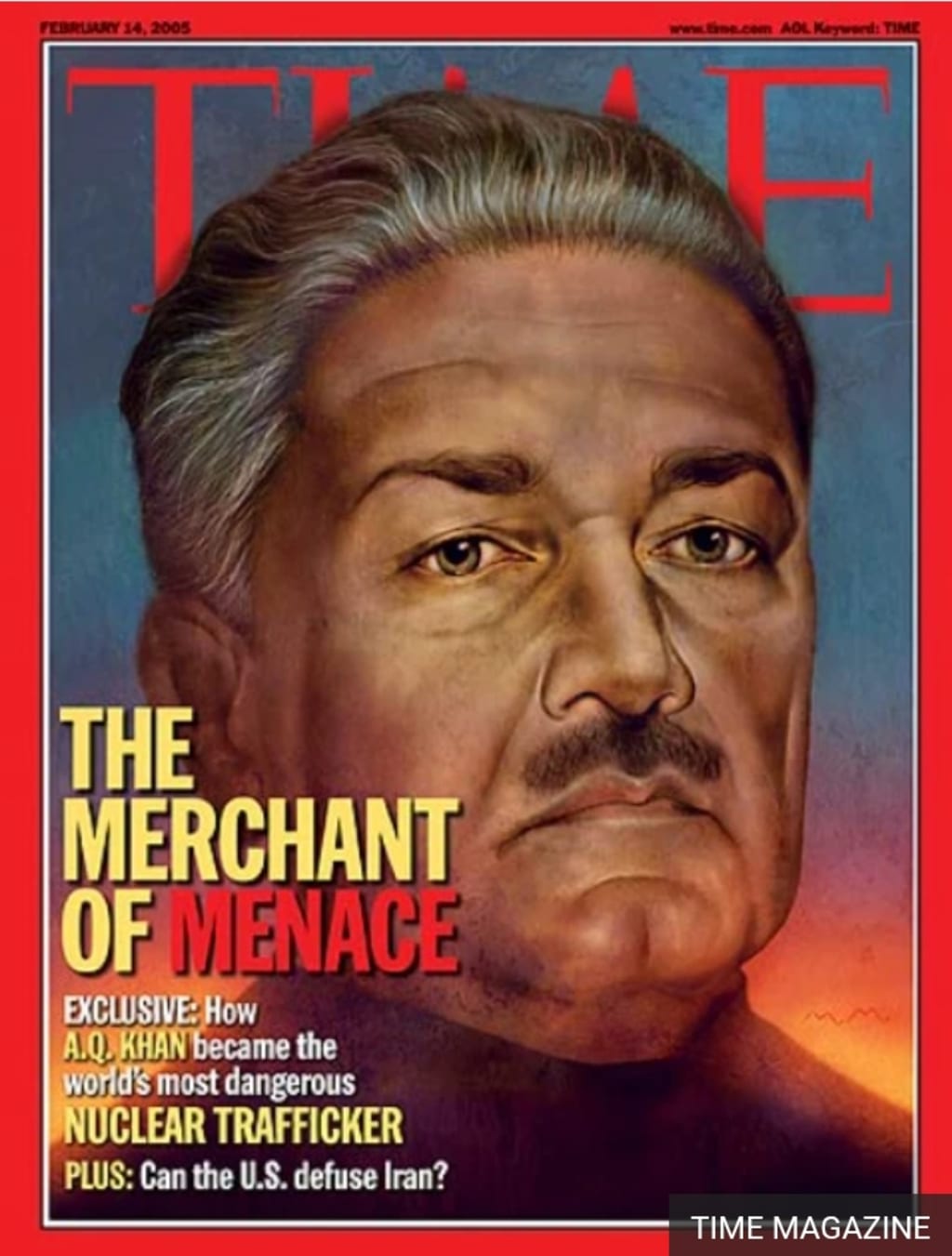
"Merchant of Menace": Why Is Pakistani Scientist Dr. Abdul Qadeer Khan’s Name Linked to Iran’s Nuclear Program?
On February 4, 2004, the people of Pakistan witnessed a scene on their television screens that was nothing short of an explosion — and its echoes were heard around the world.
This explosion was metaphorical — when Dr. Abdul Qadeer Khan, the leading figure of Pakistan's nuclear program, admitted on state television that he had illegally sold nuclear secrets to other countries without the knowledge of the Pakistani government.
Wearing a suit and tie, Dr. Abdul Qadeer Khan, in simple English, stated in his confession:
“Investigations have established that many reported activities did take place and were initiated at my behest.”
He added, “In my interviews with the concerned government officials, I had to confront evidence and outcomes, and I voluntarily acknowledged that most of them are true and accurate.”
“My dear brothers and sisters, I have chosen to appear before you to express my deep remorse and offer an unconditional apology. I also want to clarify that these activities were never authorized by the government.”
At the time, then-President General Pervez Musharraf placed Dr. Abdul Qadeer Khan under house arrest, cutting off his contact with the outside world. Yet, Pakistan and Dr. Khan remained in the global spotlight.
On February 14, 2004, Time Magazine featured Dr. Khan on its cover with the headline: “Merchant of Menace.”
Similar headlines were published around the world.
However, in Pakistan, questions arose about his statement. A recurring question was: How could such an important scientist sell nuclear secrets and technology for so long without anyone knowing — especially the military and intelligence agencies?
Four years later, Dr. Abdul Qadeer Khan told The Guardian in an interview that he had read his confession from a piece of paper that had been handed to him.
It should be noted that Dr. Khan was accused of selling nuclear secrets through a clandestine network to Iran, North Korea, and Libya, assisting in the development of their nuclear programs.
Iran, North Korea, and Libya
This story actually began in the 1990s. According to a BBC report published in December 2004, British intelligence agencies and the U.S. CIA managed to penetrate Dr. Khan’s secret network in the late 1990s. These agencies conducted several operations and even placed one of their officers inside the network.
According to the same report and sources from the British Intelligence Headquarters, they uncovered Dr. Abdul Qadeer Khan’s buyers, fake companies, financial networks, and a web of laboratories.
As more information revealed that Dr. Khan had established an international network supplying nuclear weapons-related equipment, the UK’s Joint Intelligence Committee began expressing concern as early as 2000.
But the most crucial evidence came in December 2003, when CIA and MI6 officers received documents from Libyan authorities as Libya agreed to abandon its nuclear program. Inside brown envelopes were nuclear weapon designs.
According to the information, these designs and related components for the nuclear program were supplied by Pakistani nuclear scientist Dr. Abdul Qadeer Khan, giving the U.S. strong grounds to pressure Pakistan to take action against him.
Pakistani Government’s “Admission”
In March 2005, then-Pakistani Information Minister Sheikh Rashid also admitted that Dr. Khan had provided nuclear technology to Iran, though the government was unaware of the transaction. This was the first time a Pakistani government representative made such a confession.
Sheikh Rashid Ahmed told the Associated Press in a phone interview: “Dr. Abdul Qadeer gave some centrifuges to Iran,” and “he helped Iran in his personal capacity, and the Government of Pakistan had nothing to do with it.”
According to a BBC report published in October 2021, Iran’s Natanz facility’s centrifuge program appears to be largely based on the designs and materials initially supplied by Dr. Khan’s network.
That same report mentions that in one meeting, Dr. Khan’s representatives gave Iran a list of materials and components used in developing a nuclear program — complete with pricing — allowing Iranian officials to place orders accordingly.
In response to these allegations, according to an Al Jazeera report published in December 2004, Iran’s foreign ministry admitted to purchasing materials from certain dealers but said, “We don’t know where those materials originated from.” The statement also emphasized that Iran’s nuclear program was peaceful and that the country had no interest in developing atomic bombs.
It is important to note that Natanz is a significant uranium enrichment facility in Iran, located about 250 kilometers south of Tehran. It began operations in February 2007, in violation of United Nations Security Council resolutions, and was recently targeted in Israeli attacks.
Its current status is unclear, but both former U.S. President Trump and Israel have claimed that Iran’s nuclear weapon development capability has been neutralized.
Before the attacks, the facility reportedly consisted of three large underground buildings, capable of running 50,000 centrifuges. However, by the time of recent U.S. and Israeli strikes, about 14,000 centrifuges were installed — with nearly 11,000 in operation.
Natanz has previously also been targeted by cyberattacks and sabotage, believed to be joint operations by the U.S. and Israel.
ElBaradei’s Interview and Allegations Against Abdul Qadeer Khan
Mohamed ElBaradei, then-head of the International Atomic Energy Agency (IAEA) — the global body monitoring nuclear programs — pointed a direct finger at Dr. Abdul Qadeer Khan, stating in a public statement that he was aware of at least 30 companies across 30 countries involved in illegal nuclear trafficking, with Dr. Khan acting as the CEO of this clandestine network.
This was a serious allegation, one that Dr. Khan continued to deny until the end of his life. However, he never explicitly clarified what had truly happened.
In a September 2004 interview on the BBC program HardTalk, ElBaradei answered several tough questions from host Tim Sebastian:
Tim: Thirty countries, including many you weren’t even aware of before?
ElBaradei: No, not all companies knew they were involved in illegal trafficking. If you’re exporting steel, or if you’re exporting magnets, those materials often have dual use. So they didn’t know that these items would ultimately end up in Iran or Libya.
Tim: But what about their clients — Abdul Qadeer Khan’s clients? The countries he sold to?
ElBaradei: We’re still working on it. We and several intelligence agencies are trying to identify whether there are other clients. We haven’t reached that point yet.
Tim: Why didn’t you personally speak with this man (Dr. Khan)?
ElBaradei: Pakistan didn’t allow us to speak with him.
Tim: What do you mean by “not allowed”? General Musharraf is on record saying no one ever asked for permission to question him.
ElBaradei: I think we would’ve been happy to question him...
Tim: Did you actually request to question him?
ElBaradei: I believe we did.
Tim: But they say you didn’t — which is quite strange, isn’t it?
ElBaradei: I can’t say for certain. I believe we kept requesting access to him.
Tim: Can you not clearly tell me whether the IAEA officially requested an interview?
ElBaradei: As far as I know, our people asked.
Tim: If you didn’t, that would be a major gap, wouldn’t it?
ElBaradei: I can tell my Pakistani friends today that if they allow it, I’ll gladly send a team tomorrow. Yes, it’s a huge gap, but...
Tim: Isn’t it time you made such a request?
ElBaradei: As far as I know, Dr. Abdul Qadeer Khan has never spoken to any non-Pakistani, which is obviously not ideal. It would be extremely useful for us to speak to him directly.
Tim: What about Syria, Saudi Arabia — were they clients?
ElBaradei: We’ve seen no indications of that. I mean, no signs that Syria or Saudi Arabia were clients. In fact, we sent a team to Syria to discuss all of their nuclear activities. We found no indication. We act on every piece of information we receive. We didn’t find anything concrete in this regard.
Tim: But in this case, it doesn’t seem you were proactive enough.
ElBaradei: Oh, we are very active. But I can’t go to every country and ask, “Did you buy something from Dr. Khan?” I need information — a lead. We don’t have even a single piece of credible information indicating that any other country bought something from Dr. Khan. If we had such evidence, I assure you we’d act on it immediately.
---
Dr. Abdul Qadeer Khan Denies Helping Iran
Dr. Khan remained under house arrest for only a short period. In 2012, he launched a political party — Tehreek-e-Tahaffuz-e-Pakistan (Movement for the Protection of Pakistan) — which failed badly in elections and did not win a single seat.
Around that time, he gave interviews to a few journalists after many years, where he denied his televised confession and any involvement in illegal nuclear activity.
In an interview with an international journal, he clearly stated that he had no connection with any nuclear program outside of Pakistan — particularly Iran’s. Regarding Iran, he said:
“How is it possible that Iran, a signatory to the NPT (Non-Proliferation Treaty), which has always claimed it doesn't want to build a bomb, could build one with someone’s help?”
He called the allegations propaganda — similar to what was done in Iraq.
"Since Iran is a signatory to the NPT, the IAEA can inspect its nuclear program at any time," he said. “So claiming it’s building a bomb is completely incorrect.”
Regarding North Korea’s nuclear capability, he said that the country had long been part of the Chinese and Russian camp:
“They don’t need to go to another country to build a bomb.”
As for the allegation that Libya attempted to build a nuclear bomb using technology sold by him, Dr. Khan’s response was:
“How can a country that can’t even make a bicycle build a nuclear bomb?”
---
“An Irresponsible Act Beyond State Policy”
Syed Muhammad Ali, a specialist in defense and nuclear affairs, told the BBC:
“The Pakistani state and government have consistently maintained that Dr. Abdul Qadeer Khan tried to assist Iran at an individual level — a highly irresponsible act that had nothing to do with Pakistan’s official policy.”
“For nearly 25 years, Pakistan has consistently stated that its nuclear and missile technology is solely for its own defense, deterrence, and regional security — and will not be shared with any other country.”
He added:
“There’s a concern and desire to downplay proliferation accusations because such claims are not in Pakistan’s interest.”
---
What’s the Difference Between Pakistan and Iran’s Nuclear Programs?
Dr. Mansoor, an expert on nuclear and defense matters affiliated with the Australian National University in Canberra, has extensively studied the nuclear programs of Pakistan, India, and Iran.
Explaining the difference between Pakistan and Iran’s nuclear programs, he said:
“Pakistan never signed the NPT, while Iran did — and that’s the big difference. Since Iran signed it, it is scrutinized. The question arises: if your program is peaceful, why are you enriching so much uranium?”
“Because Pakistan developed its nuclear fuel cycle capability outside IAEA safeguards, no one can accuse it of violating the
About the Creator
Keep reading
More stories from Ikram Ullah and writers in The Swamp and other communities.
The Forsyth House Fire
Since 1851, Forsyth House has stood on the corner of Union Street and Gordon Street in the heart of Glasgow. Its iconic, or was... because on Sunday 8th of March, 2026, a fire broke out in a small, seemingly un-named shop in the building and tore all that history down. As I write, the rubble is still unsettled and the street is still blocked off. Central Station is quiet on the upper level, and around 30 small businesses have quite literally gone up in smoke.
By S. A. Crawford3 days ago in The Swamp
France Is Sending a Large Naval Force to the Middle East
France has announced the deployment of a large naval force to the Middle East, signaling a heightened commitment to security and stability in a region facing escalating conflicts and maritime challenges. The move comes amid rising tensions involving Iran, Israel, and other Gulf states, with global powers closely monitoring developments in the region. The French naval task force will include a combination of frigates, destroyers, supply vessels, and advanced submarines capable of extended operations. Officials emphasize that the deployment is designed to support maritime security, safeguard shipping lanes, and participate in joint exercises with allied forces. The presence of these vessels in the strategic waters of the Persian Gulf and the Gulf of Oman reflects France’s broader strategic interests in the region. Defense analysts note that this deployment marks one of the most significant French naval operations in the Middle East in recent years. France has maintained a steady maritime presence in international waters to protect global trade routes, particularly through the Strait of Hormuz, a critical chokepoint for oil and gas shipments. The new task force demonstrates Paris’ ability to project power and respond rapidly to crises in distant regions. French officials have framed the mission as a stabilizing measure rather than a provocative move. “Our objective is to ensure the safety of international waters and support our allies while avoiding escalation,” said Admiral Pierre Vandier, who oversees France’s maritime operations. “We remain committed to dialogue and cooperation, but we will protect freedom of navigation and the security of critical maritime routes.” The deployment is expected to include collaborative operations with the United States, the United Kingdom, and other NATO partners already operating in the region. Exercises will focus on surveillance, anti-piracy measures, and coordinated maritime security operations. Analysts highlight that such multinational coordination enhances situational awareness and reinforces deterrence against potential adversaries. The decision to deploy a large force comes amid increasing incidents of drone and missile attacks in the region. Recent months have seen repeated strikes on shipping vessels, oil facilities, and military infrastructure, raising concerns about the safety of commercial shipping and regional security. French officials cite these developments as part of the rationale for strengthening their naval presence. In addition to security operations, France intends to use the deployment to provide humanitarian assistance and logistical support where necessary. Naval vessels in the region are equipped to deliver emergency aid, medical assistance, and disaster relief, reflecting a multifaceted approach to crisis response. Such operations are particularly relevant in the Gulf, where conflict and environmental hazards can threaten both civilian populations and vital infrastructure. The deployment also carries symbolic weight, signaling France’s ongoing engagement in Middle Eastern affairs. French leaders have consistently emphasized the importance of balancing diplomatic efforts with credible defense capabilities. By sending a substantial naval force, Paris underscores its role as a global power willing to act independently while coordinating with allies. International reactions to the announcement have been mixed. Some regional actors view the deployment as reassurance that key maritime routes will remain secure, while others perceive it as a potential escalation of military presence in an already tense environment. Analysts caution that maintaining transparency, communication, and coordination with regional partners will be essential to prevent misunderstandings and inadvertent clashes. French naval officials have stressed that the force will operate under international law, respecting territorial waters while ensuring the protection of commercial and civilian vessels. They also indicate that missions will be flexible, allowing the task force to respond quickly to emerging threats or humanitarian needs. Observers note that France’s decision reflects a broader trend of European powers taking a more active role in global security. With rising tensions in the Middle East, European nations are increasingly deploying military assets to protect strategic interests, support allies, and demonstrate the capability to act independently of U.S. forces when necessary. As the French task force sails toward the Middle East, defense and diplomatic communities are closely monitoring its movements. The deployment represents a combination of deterrence, humanitarian readiness, and strategic signaling, emphasizing France’s commitment to regional security and its capability to project power in distant theaters of operation.
By Fiaz Ahmed 7 days ago in The Swamp


Comments
There are no comments for this story
Be the first to respond and start the conversation.