
Macron Hosts Ukraine and Allies to Try to Cement Security Guarantees
France Leads a Diplomatic Push to Strengthen Long-Term Support for Kyiv Amid Ongoing War
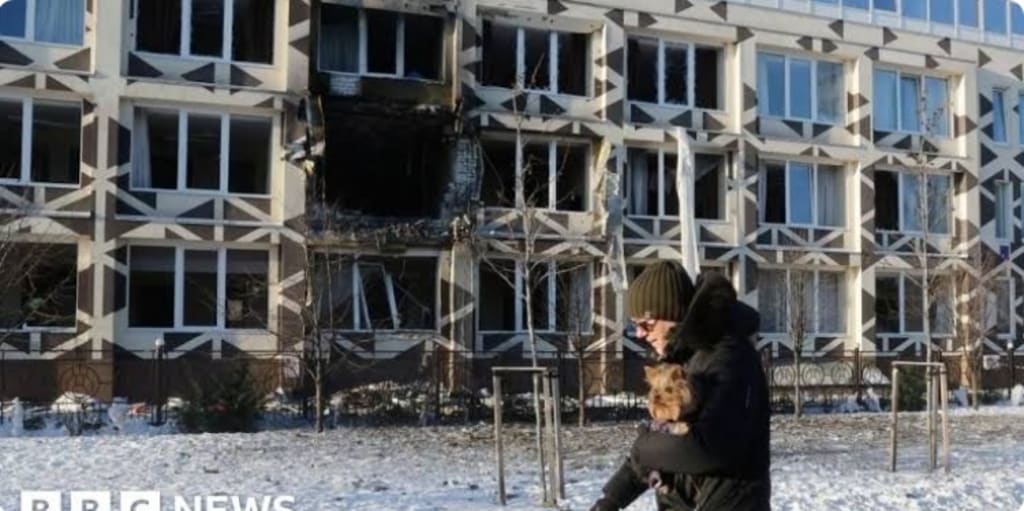
French President Emmanuel Macron has once again placed France at the center of European diplomacy by hosting Ukraine and key allied nations in Paris, aiming to cement long-term security guarantees for Kyiv. As the war in Ukraine continues with no clear end in sight, the meeting reflects growing urgency among European leaders to move beyond temporary military aid and toward more durable commitments that can deter future aggression.
The gathering brought together representatives from Ukraine, major European powers, and NATO-aligned partners, underscoring France’s ambition to act as a bridge between European security interests and broader transatlantic goals. For President Macron, the summit was not only about immediate battlefield needs, but about shaping the post-war security architecture of Europe.
A Shift From Short-Term Aid to Long-Term Guarantees
Since Russia’s full-scale invasion of Ukraine in 2022, Western support has largely focused on weapons deliveries, financial assistance, and sanctions on Moscow. While these measures have been critical in helping Ukraine defend itself, Ukrainian leaders have repeatedly stressed that long-term security guarantees are essential to prevent future attacks.
President Volodymyr Zelensky has argued that without clear and enforceable commitments, any ceasefire or peace agreement risks becoming only a temporary pause before renewed conflict. The Paris talks echoed this concern, with Macron emphasizing that Europe must think “strategically and sustainably” about Ukraine’s security.
Rather than immediate NATO membership—still a sensitive and divisive topic—the discussions reportedly focused on alternative frameworks. These include bilateral and multilateral defense agreements, long-term military training programs, intelligence sharing, and guaranteed arms supplies in the event of renewed aggression.
France’s Strategic Calculus
Macron’s decision to host the talks is consistent with his broader vision of European strategic autonomy. He has long argued that Europe must be capable of defending itself and shaping its own security policies, even while remaining closely aligned with the United States and NATO.
By convening Ukraine and its allies, Macron positioned France as a diplomatic leader capable of balancing firmness toward Russia with long-term stability in Europe. The summit also allowed Paris to reinforce its role as a key military supporter of Ukraine, following increased French deliveries of artillery systems, air defense equipment, and training for Ukrainian troops.
Domestically, Macron faces political pressure over foreign spending and defense commitments. Internationally, however, the summit signals that France is willing to take political risks to shape Europe’s future security landscape.
Unity Amid Differences
While the meeting highlighted broad agreement on the need to support Ukraine, it also exposed underlying differences among allies. Some countries favor stronger, more explicit guarantees, while others remain cautious, wary of commitments that could draw them directly into conflict with Russia.
Eastern European nations, particularly those closer to Russia’s borders, have been among the strongest advocates for robust guarantees. Western European states, meanwhile, tend to emphasize flexibility and diplomatic channels alongside military deterrence.
Macron sought to bridge these perspectives by framing security guarantees not as a provocation, but as a stabilizing force. According to French officials, the goal is to make any future aggression against Ukraine “predictably costly,” thereby strengthening deterrence without escalating tensions unnecessarily.
Ukraine’s Perspective
For Ukraine, the Paris talks represent a critical step toward international recognition of its long-term security needs. Ukrainian officials have repeatedly stated that security guarantees are not a luxury but a necessity for rebuilding the country and encouraging the return of displaced citizens and foreign investment.
Without credible guarantees, Ukraine risks remaining in a state of permanent vulnerability. Infrastructure reconstruction, economic recovery, and democratic consolidation all depend on a sense of lasting security. The summit offered Kyiv reassurance that its concerns remain high on the European agenda, even as global attention is pulled in multiple directions.
Broader Implications for Europe
The discussions in Paris extend beyond Ukraine itself. They raise fundamental questions about Europe’s role in a changing global order, the future of NATO, and the balance between deterrence and diplomacy.
If successful, the security guarantees under discussion could serve as a model for how Europe responds to future crises—combining collective defense principles with flexible, country-specific arrangements. Failure, on the other hand, could embolden authoritarian actors and weaken confidence in Europe’s ability to protect its partners.
Looking Ahead
While no final agreement emerged from the Paris meeting, Macron’s initiative marked an important moment in the evolution of Western support for Ukraine. The talks shifted the conversation from “how long can we help” to “how do we ensure lasting security.”
As negotiations continue, the challenge will be translating political intent into concrete, enforceable commitments. For Ukraine, Europe, and the broader international community, the stakes could hardly be higher. Macron’s diplomatic push may not deliver immediate answers, but it reinforces a critical message: Ukraine’s security is inseparable from Europe’s own future.
About the Creator
Keep reading
More stories from Aqib Hussain and writers in The Swamp and other communities.
Donald Trump’s Greenland Claim Leaves Europe Struggling for an Answer
Donald Trump’s renewed interest in Greenland has once again unsettled Europe, reviving a geopolitical controversy many hoped had been laid to rest. What once sounded like a bizarre aside during his earlier presidency has returned with sharper edges, forcing European leaders to confront uncomfortable questions about sovereignty, security, and their relationship with the United States. As Trump frames Greenland as a strategic necessity for American interests, Europe finds itself struggling to respond with unity, clarity, or confidence.
By Aqib Hussain2 months ago in The Swamp
A Gathering of Evil Bosses
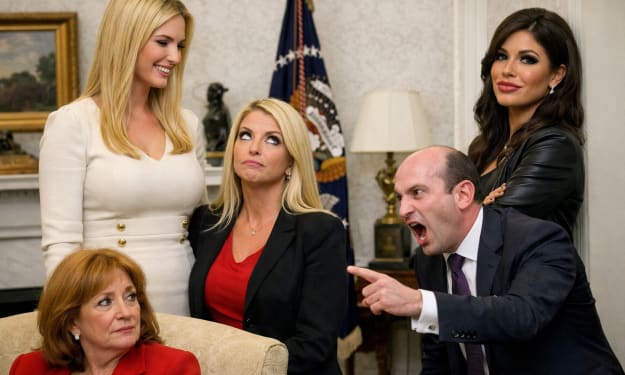
“I’m the queen of chin jutting while I smooth my hair, attacking, insulting, and deflecting to protect my appointer.” “Oh, please, Blondi, my hair is curled, highlighted, and longer than yours. I feature television commercials telling immigrants that we will give them a free plane ride home, and if they voluntarily turn themselves in, they will be allowed to legally apply for re-entry. It runs everywhere, and I look good in it! You can’t compete because of your blond hair. Mine is nicer, and my lips are prettier than yours.”
By Andrea Corwin 23 days ago in The Swamp
‘It’s a Huge Mess’: How Starmer Is Failing Britain’s Armed Forces
Britain’s armed forces are facing mounting criticism from defence analysts, former military leaders, and political opponents who argue that the government of Keir Starmer has failed to address serious problems affecting the country’s military readiness. From equipment shortages and recruitment challenges to strategic uncertainty in a rapidly changing global security environment, critics say the United Kingdom’s defence structure is struggling to keep pace with modern threats. Several senior defence commentators have described the situation bluntly. One former officer recently summarized the state of affairs as “a huge mess,” pointing to a combination of delayed procurement programs, overstretched personnel, and uncertainty over long-term military strategy. The criticism comes at a time when geopolitical tensions across Europe and the Middle East have increased pressure on NATO members to strengthen their military capabilities. Britain’s armed forces, long considered among the most capable in Europe, have been undergoing a period of restructuring in recent years. Government officials argue that modernization and technological innovation require difficult decisions, including reductions in some traditional force structures. However, critics say these reforms have been poorly managed and have weakened operational readiness. The most visible challenge has been recruitment and retention. The British Army has struggled to meet its target troop numbers, and experienced personnel have reportedly left service due to concerns about career prospects, workloads, and the pace of reforms. Defence experts warn that losing trained soldiers and officers creates gaps that cannot easily be filled. Equipment modernization has also been a point of contention. Delays in acquiring new vehicles, aircraft, and naval systems have frustrated military planners who argue that the armed forces must adapt quickly to emerging threats. While the government has announced investments in advanced technology—including cyber capabilities and drone systems—critics say the transition has been uneven. Opposition politicians and defence specialists have raised concerns that the United Kingdom may not be meeting the expectations of its allies within the North Atlantic Treaty Organization. NATO has increasingly emphasized the importance of readiness, particularly as tensions with rival powers continue to influence global security calculations. Maintaining credible military capability, analysts argue, is essential not only for national defence but also for the credibility of international alliances. The government, however, disputes the claim that the armed forces are being neglected. Officials say Britain continues to invest billions of pounds in defence and remains committed to strengthening its role within NATO. They point to ongoing modernization programs, including upgrades to the navy’s aircraft carriers and investments in next-generation fighter aircraft. Supporters of the government also argue that the nature of warfare is evolving rapidly. Modern conflicts increasingly involve cyber attacks, space-based surveillance, and unmanned systems rather than large conventional forces alone. From this perspective, shifting resources toward new technologies is necessary to ensure that the military remains effective in the decades ahead. Nevertheless, critics insist that modernization should not come at the expense of basic readiness. Some analysts say that while technological development is important, the armed forces still require sufficient personnel, equipment maintenance, and training to respond to immediate crises. Without these fundamentals, they warn, advanced technology alone cannot guarantee security. The debate has intensified amid a broader discussion about Britain’s role in the world. As global competition grows and new conflicts emerge, the United Kingdom faces difficult choices about how much to invest in defence and what type of military force it wants to maintain. Some experts believe the country must significantly increase spending to keep pace with other major powers. Others argue that the focus should be on improving efficiency and strategic planning rather than simply allocating more funds. According to these analysts, clearer long-term objectives are needed to ensure that investments in defence produce meaningful results. Public opinion on the issue is mixed. While many citizens support maintaining a strong military, there are also competing demands for government spending in areas such as healthcare, education, and economic development. Balancing these priorities has become one of the most challenging tasks for policymakers. For members of the armed forces themselves, the debate is more personal. Service personnel rely on stable leadership, reliable equipment, and clear strategic direction to perform their duties effectively. When those elements appear uncertain, morale can suffer. Whether the criticism directed at Starmer’s government leads to significant policy changes remains to be seen. What is clear, however, is that the discussion about the future of Britain’s military is becoming increasingly urgent. In an era marked by geopolitical instability and technological transformation, the decisions made today will shape the country’s defence capabilities for decades to come.
By Fiaz Ahmed 5 days ago in The Swamp
Becca
"Everything is so... flat." Denille said stupidly as she looked around her new neighborhood. She looked around at the muted desert where even the smallest sign of life seemed to have given up. The plant life was shrubs that were half cooked by the heat and where there should have been a lawn, a mess of white rocks laid glistening in the sun. Even the sky looked stretched thin, like the sun had ironed it smooth. She’d moved from Riverside, where at least there were hills, but here in Barstow, everything felt baked and brittle.
By Sara Wilson7 days ago in Fiction



Comments
There are no comments for this story
Be the first to respond and start the conversation.