
Kamala Harris and the Great Vibe Nudge
In this election year’s model of America, an idea has exploded on three tracks of our attention span — politics, popular culture, and e-commerce: We can do better


Whoever invented that enduring maxim of two-party American politics — Democrats fall in love, Republicans fall in line — never saw Kamala Devi Harris coming. The vice president of the United States has, in record time, deftly navigated that murky netherworld where politics and popular mythology are connected, blind loyalty and emotional commitment are intertwined.
Since she first assumed the national spotlight as a senator in 2017, Harris has occupied a symbolic space in the culture, punching bag and pugilist, piñata for conservatives and stand-in for Rosie the Riveter to progressives. Now, with her second foray into presidential politics, Harris has a better, surer grasp of both the voters and herself. And voters have a better grasp of the need to prevent Donald Trump from ever assuming the White House again. It’s no wonder that the Kamala campaign has caught fire: the timing couldn’t be better.
Beyoncé gifted the song “Freedom” to the Harris 2024 presidential campaign. As Queen Bey’s track gets used for the candidate’s walk-ins from now until Election Eve, it may be the most visible overture to reaching voters with something that isn’t strictly political. In the eight days since President Biden announced his intention not to seek re-election and endorsing Harris to succeed him, the worlds of social media, pop culture and e-commerce have exploded with expressions of fascination and support many have likened to how they felt about another relentlessly appealing politician: Barack Obama in 2008.
◊ ◊ ◊
Example: In one instance last year, Harris used her avuncular talents, and the advice of her South Asian mother, to lay the groundwork for a meme that announces her now without a word. The vice president regaled her audience in a May 2023 speech on growing Hispanic economic opportunity, Harris (adopting her mother’s POV) recounted:
“She would say to us, ‘I don’t know what’s wrong with you young people. You think you just fell out of a coconut tree?’” Then Harris drops the subtext: “You exist in the context of all in which you live and what came before you.” Voila: What had been just a quaint anecdote found new life in social media this month, with coconut tree and palm tree emojis spreading virally in the eight days since Biden quit the race on July 21.
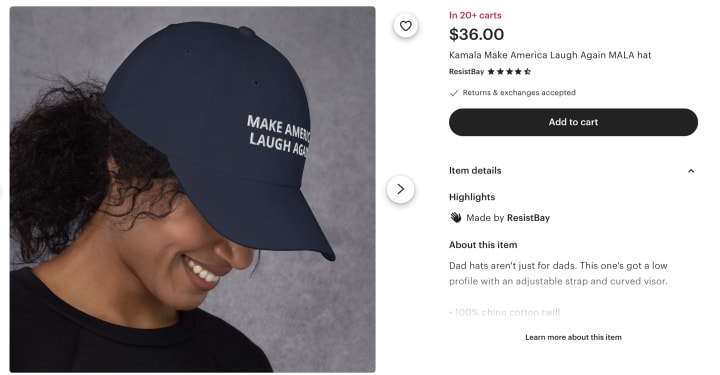
ResistBay, an enterprising Georgia company, quickly introduced a line of on-point Kamala baseball caps, a smart MALA (yep, Make America Laugh Again) rejoinder to the redcaps of the MAGA movement, headwear whose logo pushes back on the conservatives’ denigration of one of Harris’ more visible public traits. Another company, Grishko, based in Hammond, Ind., sells its own line of MALA caps and Harris ’24 hoodies.
The memeification of Kamala Harris came complete when her first name was shorthanded in a way a professional image consultant couldn’t improve on. You’ve seen it, her name in three short characters: “,la”. That’s it. A comma and the letters “la.” [Elbow jab to the ribs] Comma-la — get it? Yes it’s goofy, but it’s endearingly goofy, it’s self-deprecating in a typographical way, and it works for the moment. The power of that meme shorthand provides Harris a vector into the culture that money can’t buy.
◊ ◊ ◊
These were this campaign’s early bursts of Kamalamania. Then there’s the KHive, a revival of an online fan base first started in 2017, and which exploded in 2019, when Harris first ran for the presidency. The KHive (whose name respectfully cribs the BeyHive, Beyoncé’s online tribe) has been simmering during Harris’ time in the Biden administration, but has come roaring back in a 2024 edition, fueled by Harris’ latest run for the White House. A grassroots base of support certainly in the thousands, maybe by now the hundreds of thousands.
On television: Viewership of the first season of Veep, the hit HBO/Max comedy series starring Julia Louis-Dreyfus, was up 353 percent on July 22, with 2.2 million total minutes watched, according to data from Luminate’s Streaming Viewership service, as reported on July 24 by Deadline, the industry trade website. Compare that to 486,000 total minutes of the show watched on July 21.
Charli XCX, a British singer with a huge social-media following, has just praised Harris as an exemplar of the “brat” lifestyle — the word both the title of her new album and an endorsement of Harris, one that invokes the new benchmark of Gen Z cred. In the spirit of pop-cultural bipartisanship, the Kamala campaign feed on X (Twitter) was later tweaked to imitate the “brat” album cover and font, right down to the lime-green color that The New York Times hailed as “the color of the summer.”
◊ ◊ ◊
Others in the entertainment world have weighed in, including Janelle Monae, Lance Bass, Katy Perry, George Clooney and John Legend, lending their voices to the Harris amen chorus. They are the tip of the tip of the iceberg; TheWrap reported on Harris’ extensive relationships with Hollywood power players from JJ Abrams to Reginald Hudlin, from David Geffen to Reed Hastings, the Netflix co-founder who ponied up $7 million for her campaign.
But in some ways, when a movement or event takes on an almost tidal force in society and the culture, celebrities are low-hanging fruit. Given the transactional forces always at work in and between Hollywood and Washington, their attachments to big events outside their own is a given, and frankly expected. What’s less certain and less consistently predictable is how that passion trickles down into the lives of everyday people. The ones who vote.
Harris’ current grassroots appeal has done just that. Setting aside the power broker tie-ins and the KHive and Charli XCX’s imprimatur: the relationship that really matters is the one Harris has convincingly cultivated with the voters. Within days of Biden’s endorsement of Harris, black Harris supporters of both sexes took to the new drum — the Zoom call — to announce their support and assist campaign fundraising.
◊ ◊ ◊
That was eye-opening enough. Then came the waves of voters expected to vote Republican (or not so presumptively expected to vote for a Democrat) … suddenly making a civic virtue of going in the other direction. That’s what happened since July 26, when White Women Answer the Call, a livestream special event with P!nk, Megan Rapinoe, Rep. Elissa Slotkin and others, raised more than $8 million for the Harris campaign, with more than 164,000 women logged on.
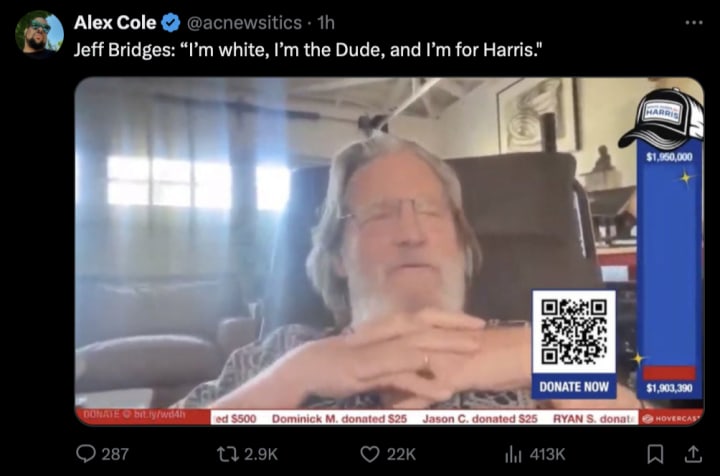
Not to be outdone, the White Dudes for Harris livestream went off on July 29, with Kamala backers like Mark Hamill, Bradley Whitford, Jeff Bridges, Joseph Gordon-Levitt and others. More than 190,000 people attended the virtual meeting on Zoom, raising more than $4 million. In less than three hours.
With tweets by the hundreds and thousands, unreported ordinary Americans — including those whose demographic profiles scream “MAGA Republican” — have signed onto Team Kamala with startling passion and frankness.
◊ ◊ ◊
In the Kamala Harris phenomenon, social media has been the movie. Conventional survey techniques embraced by the legacy pollsters have been the snapshot. Social media gives us, in real time, a more immediate assessment of the mood and temperature of voters than legacy survey organizations. Thanks to social, we’re gravitating toward the movie instead of the snapshot.
Read these scenes from the movie of American social media:
Posting on X(Twitter) on July 22, Wesley Clark said: “I'm a straight, white, male, Christian, veteran, and I’m voting for Kamala Harris because I know she’ll protect my civil rights and those of my kin, friends, neighbors and fellow citizens by preventing our country from turning into a hellscape controlled by plutocratic dipshits.”

Posting on Bluesky on July 23, Jenny Staff Johnson said: “Y’all wanna hear something wholesome? My husband’s Dungeons and Dragons group is organizing to write letters for the Harris campaign.”
Posting on X (Twitter) on July 24, Cheri Jacobus, “64-year-old, college-educated, former Republican, cancer survivor, white, childless cat lady supports @KamalaHarris for President!”
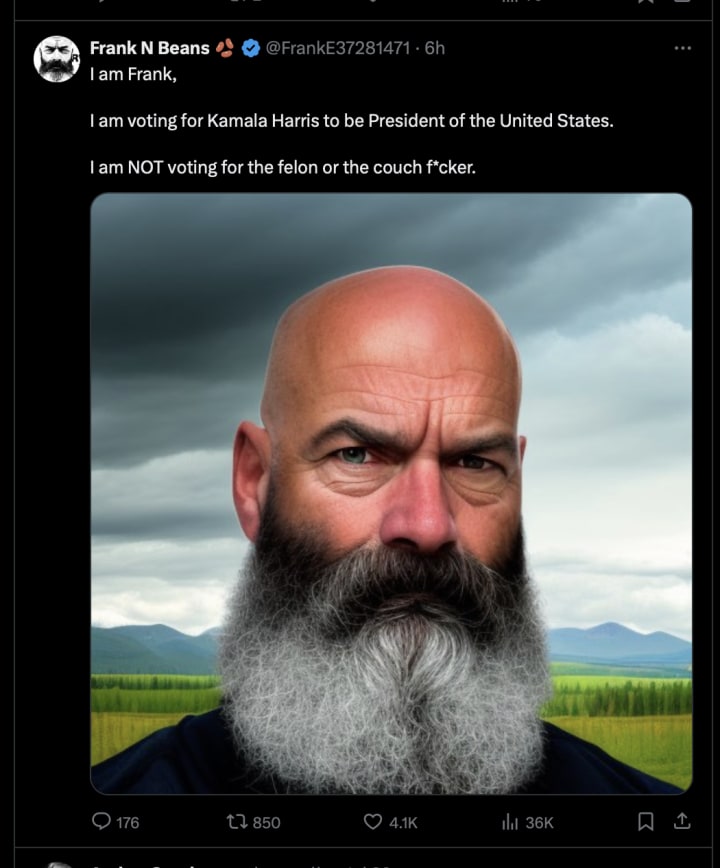
Posting on X (Twitter) on July 25, CurtisW wrote: “I'm SFC Curtis W. A 75 year old Vietnam War combat veteran and if need be ill low crawl through broken glas and punji pits to vote for our Vice President and all blue up and down ballot!”
◊ ◊ ◊
Such statements of Harris support are a serious hurdle for Team Trump, spanning as they do every sweet spot of the Trump target demographic. But unscripted blasts of support like these may (now as before, only more so) also be a challenge for the pollsters relying on conventional polling techniques to gauge what people are thinking in the runup to the vote.
Regardless of what the classic polls say about Harris’ difficulty in winning certain states historically or legislatively predisposed to go Republican, the Twittersphere (or X-o-sphere or whatever it’s called now) is instructive both for what it says about voters — and how fast it says it. That’s a delivery system that ignores the usual spatial categories, one that gives regular voters the chance to speak their minds and hearts — at length, in detail, in their preferred environment, on their terms — with context, nuance and perspective that regular opinion polls can’t touch.
These tweeting American citizens, and more besides, are breaking up with their expectations. A candidate who breaks the mold of identity (someone running for the presidency who’s not another white male) can similarly change the course of the electorate’s expectation. Enthusiasm like that expressed in these tweets isn’t a slave to the shopworn descriptors of “swing states” and “battleground states.” And it doesn’t obey the reflexes of professionals in the business of recognizing and transmitting their ideas of who’s leading and who’s trailing.
◊ ◊ ◊
No one ginned up the phenomenon of Kamala Harris. Nobody engineered this explosion of grassroots support for a Harris candidacy. This isn’t the result of political pros war-gaming an outcome. It’s not a “Wag the Dog” exercise. This was organic to the electorate. It’s yet to be seen if the Harris campaign morphs into a full-bore vibe shift, with all the relentlessness suggested in the phrase. For now, it’s certainly a true vibe nudge in our politics and our culture.
That’s largely why it’s surprised so many people on either side of the aisle, and it helps to explain why voter registrations nationally briefly surged by 700 percent in the two days after Harris got into the race. People like to believe in a candidate when they think a candidate believes in them. That fact has buoyed candidates for generations on journeys from the VFW hall to the White House, from the folding chair at the state fairgrounds to a leather chair behind the Resolute Desk.
Which makes the next step really pretty easy to understand: People like voting when they believe they’re going to make history by the ACT of voting. When that happens, a civic obligation becomes a joy of citizenship, a drudge turns into a badge. When that happens, something that people tolerate becomes something that people look forward to. That’s what’s taking place around Kamala Harris right now. And the legacy polls (and the news orgs and networks and punditry that depend on them) shouldn’t overlook the non-negotiable effervescence — the frisson factor, if you will — of a capable, tested, capitalized candidate whose appeal invokes the shock of the new. They’ll do so at their peril.
That pent-up desire among Democrats and others for someone to break through the torpor and stasis of the presidential campaign thus far has found that someone and it’s just exploded on three tracks of our attention span — politics, popular culture, and e-commerce: the idea that we can do better. In this election year’s model of America, we can improve. Maybe we can elect better. Maybe our president can laugh again. [Nudge] And hey — if that can happen, maybe we can too [Shift]
About the Creator
Michael Eric Ross
Michael Eric Ross writes from Los Angeles on politics, race, pop culture, and other subjects. His writing has also appeared in TheWrap, Medium, PopMatters, The New York Times, Entertainment Weekly, msnbc.com, Salon, and other publications.
Keep reading
More stories from Michael Eric Ross and writers in The Swamp and other communities.
GOP déjà vu: Minority outreach goes down, again
Keep both hands inside the ride, folks: The Republican party is whiplashing the country once again with respect to its never-evolving efforts at minority outreach. The Daily Beast and The New York Times have both reported that the Republican National Committee has been closing community centers created for the purpose of reaching minority voters, as well as laying off staff.
By Michael Eric Ross2 years ago in The Swamp
A Gathering of Evil Bosses
“I’m the queen of chin jutting while I smooth my hair, attacking, insulting, and deflecting to protect my appointer.” “Oh, please, Blondi, my hair is curled, highlighted, and longer than yours. I feature television commercials telling immigrants that we will give them a free plane ride home, and if they voluntarily turn themselves in, they will be allowed to legally apply for re-entry. It runs everywhere, and I look good in it! You can’t compete because of your blond hair. Mine is nicer, and my lips are prettier than yours.”
By Andrea Corwin 22 days ago in The Swamp
Key Factors Behind the U.S.–Iran Tensions: The Role of Oil and Geopolitics
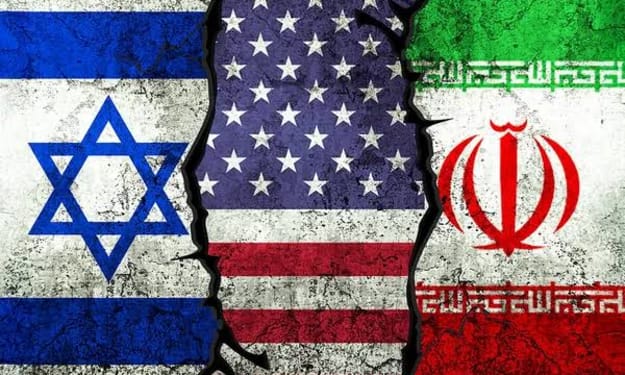
The relationship between the United States and Iran has been tense for decades, shaped by political rivalry, economic sanctions, and regional power struggles. In recent years, these tensions have intensified, raising fears of military conflict and global instability. While oil is often seen as the main reason behind the rivalry, the reality is more complex. The conflict involves a combination of geopolitical competition, energy security, and strategic interests in the Middle East.
By shaoor afridi16 minutes ago in The Swamp
TUS NUA - ch 53
TUS NUA – ch 53 New Beginnings – Mia and Midnight (*)(*)(*) Finola knew Ali’s brother-in-law needed to put his mind at rest. She fed her arm through his and led him outside. “We’ll sit here. If you like, I can put a block around us so our conversation will be private.”
By Margaret Brennan4 days ago in Fiction


Comments (1)
Awesome treatise