
Images Show Huge New British Warship Ahead of Sea Trials
Britain’s largest and most advanced frigate prepares for sea trials, marking a major step in Royal Navy modernization.

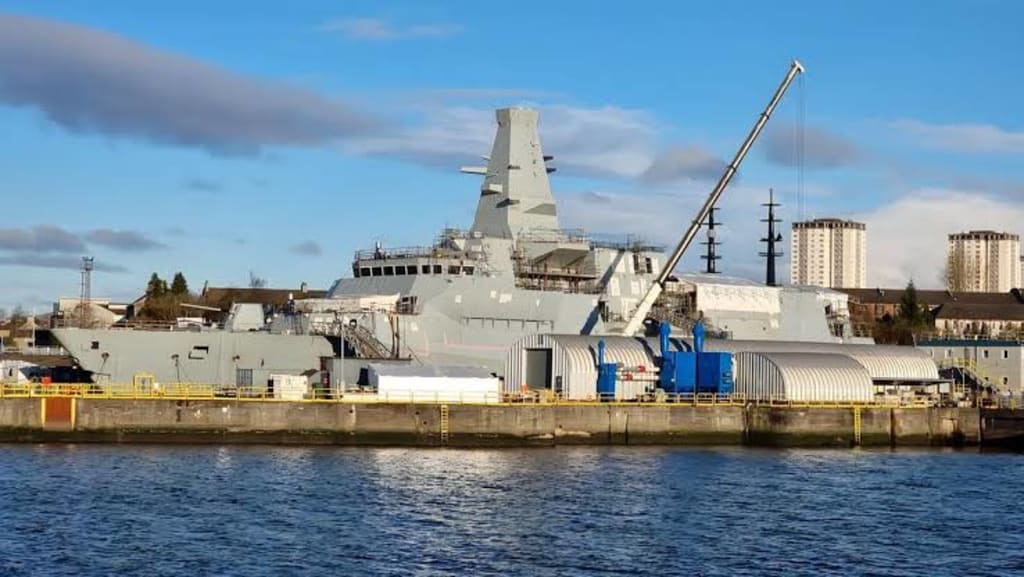
Newly released images of the Royal Navy’s next-generation warship have revealed the immense scale and advanced design of Britain’s most modern surface combatant as it prepares for its first sea trials. The vessel, HMS Glasgow, represents a major milestone in the United Kingdom’s naval modernization program and signals a new era of maritime capability for the Royal Navy.
The images, taken at the shipyard where the vessel has been undergoing final fitting-out work, show the warship towering above surrounding infrastructure. With its angular stealth profile, integrated mast, and advanced weapons systems, HMS Glasgow is designed to operate in some of the world’s most demanding naval environments.
A New Generation of Warship
HMS Glasgow is the first of the Type 26 City-class frigates, a class intended to replace the aging Type 23 fleet. Measuring approximately 149 meters in length and displacing more than 8,000 tonnes when fully loaded, the ship is among the largest and most capable frigates ever built for the Royal Navy.
The vessel has been engineered primarily for anti-submarine warfare but is also capable of air defense, surface combat, and humanitarian missions. Its quiet propulsion system, advanced sonar arrays, and mission bay give it the flexibility to perform a wide range of roles, from escorting aircraft carriers to conducting intelligence operations.
Naval officials say the design reflects lessons learned from modern conflicts and evolving threats at sea, including the increased use of submarines and unmanned systems by potential adversaries.
Sea Trials: A Crucial Phase
Sea trials will mark the first time HMS Glasgow operates under its own power in open water. These trials involve rigorous testing of propulsion systems, navigation equipment, radar, weapons integration, and crew readiness. Engineers and naval specialists will examine how the ship performs under different conditions, including high speeds and complex maneuvering.
A Royal Navy spokesperson described the upcoming trials as “a decisive step toward full operational service,” adding that every system must meet strict safety and performance standards before the ship can be formally commissioned.
Sea trials are expected to last several months, during which data will be gathered to refine onboard software and mechanical systems. Any faults discovered during this phase will be corrected before the vessel enters frontline duty.
Strategic Importance
The introduction of HMS Glasgow comes at a time of heightened geopolitical tension and renewed emphasis on maritime security. The United Kingdom has committed to expanding its naval presence in the North Atlantic, the Arctic, and the Indo-Pacific region. Type 26 frigates will play a central role in protecting carrier strike groups and safeguarding undersea infrastructure such as communication cables and energy pipelines.
Defense analysts note that the ship’s advanced sensors and stealth features give the Royal Navy a significant advantage in tracking hostile submarines while remaining difficult to detect itself.
“This class of frigate is designed for the next 30 to 40 years of naval warfare,” said defense analyst Richard Moore. “It’s not just a ship; it’s a floating network of sensors, weapons, and data systems.”
Economic and Industrial Impact
Construction of HMS Glasgow has supported thousands of jobs across the UK shipbuilding industry, particularly in Scotland. The program has also driven innovation in digital ship design and modular construction techniques, allowing faster assembly and easier future upgrades.
The Type 26 program has attracted international attention, with similar versions selected by allied navies, reinforcing Britain’s position as a leader in advanced warship design.
Looking Ahead
Once sea trials are completed, HMS Glasgow will undergo further training and weapons certification before entering full operational service. Additional ships in the Type 26 class are already under construction, ensuring a steady expansion of the Royal Navy’s surface fleet over the next decade.
The newly released images provide a glimpse into the future of British naval power—one defined by size, stealth, and technological sophistication. As HMS Glasgow prepares to leave the dock for the open sea, it symbolizes both national engineering achievement and the UK’s renewed focus on maritime security in an uncertain world.
About the Creator
Fiaz Ahmed
I am Fiaz Ahmed. I am a passionate writer. I love covering trending topics and breaking news. With a sharp eye for what’s happening around the world, and crafts timely and engaging stories that keep readers informed and updated.
Keep reading
More stories from Fiaz Ahmed and writers in The Swamp and other communities.
Denmark Rejects Trump’s Plan to Send Hospital Boat to Greenland
Denmark and its Arctic territory Greenland have publicly rejected a surprising proposal by Donald Trump to send a U.S. hospital ship to the island, dismissing the idea as unnecessary and poorly communicated. The response highlights diplomatic tensions in a region where strategic interests, healthcare realities, and international relations intersect. On 22 February 2026, Trump declared in a post on Truth Social that he was dispatching a “great hospital boat” to Greenland “to take care of the many people who are sick, and not being taken care of there.” He indicated the initiative was being coordinated with Jeff Landry, the Louisiana governor appointed as the U.S. special envoy to Greenland. Trump’s announcement also included an AI‑generated image of a U.S. Navy hospital ship, further fueling intrigue. Immediate Rejection from Greenlandic and Danish Officials Greenland’s prime minister, Jens‑Frederik Nielsen, swiftly responded with a firm “no thanks” in a Facebook post. He made clear that Greenland has a publicly funded healthcare system offering free treatment to citizens — a point underscored as a defining societal value. Nielsen emphasised that Greenland already has access to necessary medical care and does not require external assistance from a foreign military vessel. Danish Defense Minister Troels Lund Poulsen echoed the sentiment in remarks to Danish broadcaster DR, stressing that Greenlanders receive healthcare either locally or, if needed, through Denmark’s system. Poulsen added that there was no indication that a hospital ship was actually en route, noting that Danish authorities had not been informed about any such deployment. Danish Prime Minister Mette Frederiksen also affirmed confidence in Denmark’s universal healthcare model, stressing on social media that in her country — and in Greenland — access to care is free and equitable, contrary to systems where insurance and wealth determine quality of treatment. Healthcare Reality in Greenland Despite Trump’s claims, Greenland has five regional hospitals serving its population of around 57,000. The main facility in the capital, Nuuk, provides care for patients from across the vast Arctic island. For more complex treatments, Greenlanders can access Danish hospitals under existing agreements — arrangements Nordic officials say are sufficient. The New Indian Express In fact, on the same day as Trump’s social media post, the Danish military evacuated a U.S. submariner from waters near Nuuk for urgent medical treatment, underscoring that medical evacuations and care already occur through established channels rather than ad‑hoc foreign deployments. Diplomatic Miscommunication and Strategic Context Officials in Copenhagen and Nuuk expressed astonishment at the way the proposal was communicated — via social media rather than through diplomatic discussion. Nielsen urged Washington to engage through formal channels and avoid what he described as random “outbursts” that complicate international dialogue. The broader diplomatic backdrop includes longstanding strategic interest in Greenland’s Arctic position. Trump has previously made controversial remarks about acquiring Greenland, citing its strategic importance — rhetoric consistently rebuffed by Danish and Greenlandic leaders who assert sovereignty and self‑determination. While earlier threats of seizure have eased after a “framework deal” with NATO leadership intended to secure U.S. influence in the region, officials in Denmark and Greenland remain wary of U.S. intentions. Critics see the hospital ship announcement as part of a pattern of unconventional diplomacy that risks undermining alliances built on mutual respect and legal norms. Reactions and Message for the Future The rejection of the hospital ship offer has triggered commentary in both Greenland and Denmark about national pride, autonomy, and the value of solidarity in the Nordic welfare model. “We are happy to live in a country where healthcare is a right, not a commodity,” Frederiksen wrote, framing the response in stark contrast with healthcare debates in the United States. Analysts say this episode may strengthen calls for clearer diplomatic engagement mechanisms between allies, especially when public health and security intersect. For many Greenlanders, the message is simple — cooperation can continue, but it must respect existing systems, sovereignty, and formal diplomatic norms rather than surprise announcements on social media.
By Fiaz Ahmed about 9 hours ago in The Swamp
A Gathering of Evil Bosses
“I’m the queen of chin jutting while I smooth my hair, attacking, insulting, and deflecting to protect my appointer.” “Oh, please, Blondi, my hair is curled, highlighted, and longer than yours. I feature television commercials telling immigrants that we will give them a free plane ride home, and if they voluntarily turn themselves in, they will be allowed to legally apply for re-entry. It runs everywhere, and I look good in it! You can’t compete because of your blond hair. Mine is nicer, and my lips are prettier than yours.”
By Andrea Corwin 5 days ago in The Swamp




Comments
There are no comments for this story
Be the first to respond and start the conversation.