
“I Don’t Want to Live in an American Empire”: Greenlanders Bristle at U.S. Threats
Why Greenlanders are resisting U.S. pressure and refusing to become another chapter in modern imperial ambition.
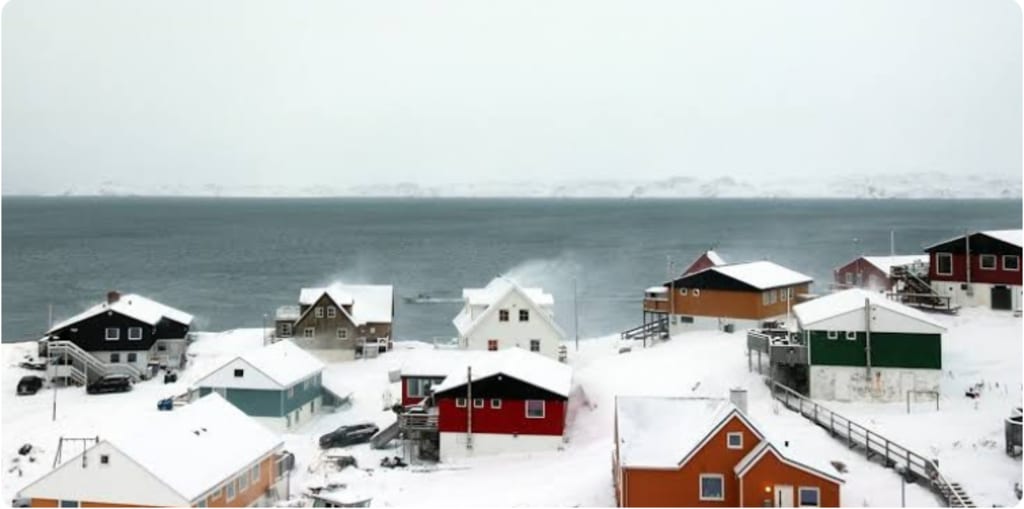
When people think of Greenland, they imagine glaciers, polar bears, and endless white landscapes. What they don’t imagine is a small population suddenly thrust into the center of global power politics. Yet that is exactly what has happened — and Greenlanders are not happy about it.
Recent statements from U.S. leadership suggesting stronger American control over Greenland have sparked outrage, fear, and resistance across the island. To many locals, the rhetoric feels less like diplomacy and more like a warning shot from a modern empire.
“I don’t want to live in an American empire,” one Greenlander said — a sentiment now echoed across towns, fishing villages, and political chambers alike.
Why Is the U.S. So Interested in Greenland?
From Washington’s perspective, Greenland is strategically invaluable. Its location in the Arctic makes it a key military outpost, especially as tensions rise with Russia and China. The island also sits atop rare earth minerals and other natural resources that are becoming increasingly important in a world transitioning to renewable energy.
The U.S. already maintains a military presence at Pituffik Space Base (formerly Thule Air Base), a crucial component of America’s missile defense system. But in recent years, U.S. interest has shifted from cooperation to something more aggressive — at least in tone.
Comments suggesting that the United States could “acquire” Greenland, or act regardless of local opposition, crossed a line for many Greenlanders. What sounded like strategic planning in Washington sounded like imperial ambition in Nuuk.
A History That Makes Threats Feel Personal
To understand Greenland’s reaction, you have to understand its past.
Greenland was a Danish colony for centuries. Decisions about land, culture, and resources were made by outsiders, often with devastating consequences for Indigenous Inuit communities. While Greenland gained home rule in 1979 and expanded self-government in 2009, the scars of colonialism remain fresh.
That history makes Greenlanders especially sensitive to outside powers speaking about their homeland as an asset rather than a society.
To many, U.S. rhetoric feels eerily familiar — another powerful nation discussing Greenland’s future without Greenlanders at the table.
“We Are Not for Sale”
Across the political spectrum, Greenland’s leaders have spoken with rare unity.
They have rejected the idea of becoming American, reaffirmed their desire for self-determination, and emphasized that Greenland’s future belongs to Greenlanders alone. Even political parties that disagree on how fast independence from Denmark should move are aligned on one thing: foreign coercion is unacceptable.
Ordinary citizens share that view. Fishermen, teachers, students, and elders have voiced concern that U.S. interest reduces their homeland to a military outpost or mining zone.
“We don’t want to trade one colonial power for another,” has become a common refrain.
Fear of Becoming a Pawn in a Bigger Game
What worries Greenlanders most is not cooperation — it’s control.
There is broad support for international partnerships, including with the U.S., when those relationships are based on respect and consent. But threats and dismissive language undermine trust and fuel suspicion.
Many fear that escalating geopolitical tensions could turn Greenland into a bargaining chip between global superpowers. In that scenario, local voices risk being drowned out by military priorities and economic interests.
For a population of just 60,000, the imbalance of power feels overwhelming.
Denmark Caught in the Middle
As Greenland’s governing authority in foreign affairs, Denmark has found itself walking a diplomatic tightrope.
Danish leaders have strongly rejected any suggestion that Greenland could be taken or pressured by force, calling such rhetoric dangerous and destabilizing — especially between NATO allies. At the same time, Denmark must respect Greenland’s autonomy and growing push toward full independence.
The situation highlights a broader question: how do small nations and territories protect themselves when global powers decide they matter?
A Wake-Up Call for Greenlandic Independence
Ironically, U.S. pressure may have accelerated something Washington didn’t intend — Greenland’s independence movement.
While full independence has long been debated, recent events have reignited public discussion about reducing reliance on both Denmark and foreign powers. Many Greenlanders now see self-determination not just as an aspiration, but as a necessity for survival in an increasingly aggressive world order.
The message is clear: Greenland does not want to belong to anyone else’s empire.
More Than a Strategic Map Point
For outsiders, Greenland often appears as empty space on a map — ice, minerals, and military potential.
For Greenlanders, it is home.
It is language, culture, ancestry, and identity. It is a society still healing from colonial rule and determined not to repeat that history under a different flag.
When Greenlanders say, “I don’t want to live in an American empire,” they are not rejecting cooperation. They are rejecting domination.
In a world where power often speaks louder than people, Greenland’s resistance is a reminder that sovereignty is not measured by size — but by the will of those who live on the land.
About the Creator
Keep reading
More stories from Aqib Hussain and writers in The Swamp and other communities.
Iran Edges Closer to a Revolution That Would Reshape the World
For decades, Iran has existed in a state of controlled tension — balancing public dissent, economic pressure, and rigid political authority. Today, that balance appears more fragile than ever. From widespread protests and economic collapse to generational defiance and geopolitical strain, Iran is edging closer to a revolutionary moment that could dramatically reshape not only the Middle East, but the world.
By Aqib Hussain2 months ago in The Swamp
The Forsyth House Fire
Since 1851, Forsyth House has stood on the corner of Union Street and Gordon Street in the heart of Glasgow. Its iconic, or was... because on Sunday 8th of March, 2026, a fire broke out in a small, seemingly un-named shop in the building and tore all that history down. As I write, the rubble is still unsettled and the street is still blocked off. Central Station is quiet on the upper level, and around 30 small businesses have quite literally gone up in smoke.
By S. A. Crawford3 days ago in The Swamp
U.S. Navy to increase production of anti-submarine mines
Washington, D.C. — The United States Navy has confirmed plans to expand the production of advanced anti‑submarine mine systems as part of an intensified effort to bolster its undersea warfare capabilities amid growing global competition below the waves. Officials say the move reflects mounting concerns about the expanding submarine fleets of peer competitors and the need to strengthen maritime deterrence and denial strategies. According to a recent presolicitation notice issued by the Naval Sea Systems Command, the Navy intends to modify an existing contract with General Dynamics Mission Systems that increases the number of units of the Hammerhead anti‑submarine mine to be procured over the next several fiscal cycles. The contract adjustment is designed to rapidly accelerate deliveries while ensuring operational demands are met beginning in fiscal year 2027. Senior Navy officials said that expanding Hammerhead production is a priority because the system provides a mobile, autonomous capability to detect, classify and engage hostile submarines — a capability that is increasingly vital in contested littoral and open‑ocean environments. The mines are designed to be deployed from unmanned underwater vehicles, surface vessels or aircraft, and operate in waters where traditional anti‑submarine warfare (ASW) assets may be vulnerable or limited. “We are rapidly adjusting our undersea capabilities to address the realities of great‑power competition,” a senior defense official involved in the procurement process told reporters on condition of anonymity. “The expansion of anti‑submarine mine production — particularly systems like Hammerhead — provides us with a crucial asymmetric advantage in waters where adversary submarine activity is increasing.” Why Mines Again? Naval mines have a long history as cost‑effective tools of maritime control and denial. During the Cold War, systems such as the Mark 60 CAPTOR mine were designed to disrupt Soviet submarine operations in critical chokepoints and served as part of layered ASW strategies. These weapons combined a torpedo killer with a stationary mine casing to detect and destroy submarines autonomously. Despite periods of diminished emphasis in the post‑Cold War era, mine warfare has regained attention within U.S. naval strategy as peer competitors modernize their undersea forces. The marked growth of adversary submarine fleets — particularly the rapid expansion of the People’s Liberation Army Navy nuclear and diesel‑electric submarine fleets — has renewed emphasis on tools that can impose area denial or complicate hostile maneuvers in strategic waters. Mine systems like Hammerhead are seen as force multipliers: they can extend ASW reach into denied areas, channel adversary submarines into predictable paths, and serve as persistent sensors and shooters long after initial deployment. Their autonomy also reduces risk to manned ASW platforms, which are vulnerable to advanced anti‑access systems and modern torpedoes. Industrial and Strategic Challenges Increasing production of advanced mines presents both industrial and strategic challenges. In its notice, the Navy acknowledged that General Dynamics Mission Systems is currently the only vendor capable of meeting the accelerated timeline for additional Hammerhead units, which is why the contract modification will proceed without full and open competition. This approach, while expedient, highlights broader constraints in the defense industrial base for undersea systems, where capable producers are limited and highly specialized. Supporters of the expanded program argue that concentrating production with an experienced contractor will avoid delays and preserve continuity, but some defense analysts have raised concerns about dependence on single suppliers for niche yet critical capabilities. Diversifying the industrial base, they say, could hedge against supply chain disruptions and reduce bottlenecks for future undersea programs. The increased production mandate comes at a time when the Navy is simultaneously stretched across a wide range of modernization and recapitalization efforts, including submarine construction, unmanned undersea systems and expanded mine countermeasure capabilities. Last year’s push for expanded procurement reflected similar pressures on the submarine industrial base, where funding boosts are being applied to sustain construction rates and address workforce constraints. Operational Context The strategic rationale for accelerating anti‑submarine mine production stems from the evolving global maritime environment. Analysts note that Russia’s modernization of its submarine fleet — as well as China’s rapid deployment of new nuclear and conventionally powered submarines — has placed increased pressure on U.S. undersea dominance. Submarines are a central element of both offensive and deterrent naval operations, making investments in tools that can detect and counter them a priority for defense planners. Complicating matters further, developments in autonomous underwater vehicles (UUVs) and unmanned surface vehicles (USVs) have reshaped mine warfare. Modern mines can be integrated with these platforms to achieve quicker, more precise deployment in contested or denied waters while complicating an adversary’s ability to detect and neutralize them. These advances signal a renewed era of undersea competition where traditional concepts are being blended with emerging technologies. Looking Ahead As the Navy prepares to issue and implement the contract modification for expanded Hammerhead supplies, officials emphasize that the program is just one part of a broader, multi‑domain approach to undersea warfare. Investments in detection systems, advanced torpedoes, and layered ASW networks — including manned and unmanned platforms — are moving forward in parallel to ensure that U.S. forces maintain a competitive edge beneath the surface. In an era defined by competition with near‑peer naval powers, the resurgence of mine warfare — once considered a legacy capability — underscores the complexity and adaptability of modern maritime strategy. The expanded anti‑submarine mine production effort reflects not only tactical considerations, but the Navy’s long‑term commitment to securing undersea superiority across critical sea lanes and contested regions.
By Fiaz Ahmed 2 days ago in The Swamp



Comments
There are no comments for this story
Be the first to respond and start the conversation.