
Half a Million Evacuated on Thai-Cambodia Border as Trump Makes Diplomatic Push to End Fighting
Escalating Clashes Force Mass Evacuation While Global Powers Scramble for a Ceasefire

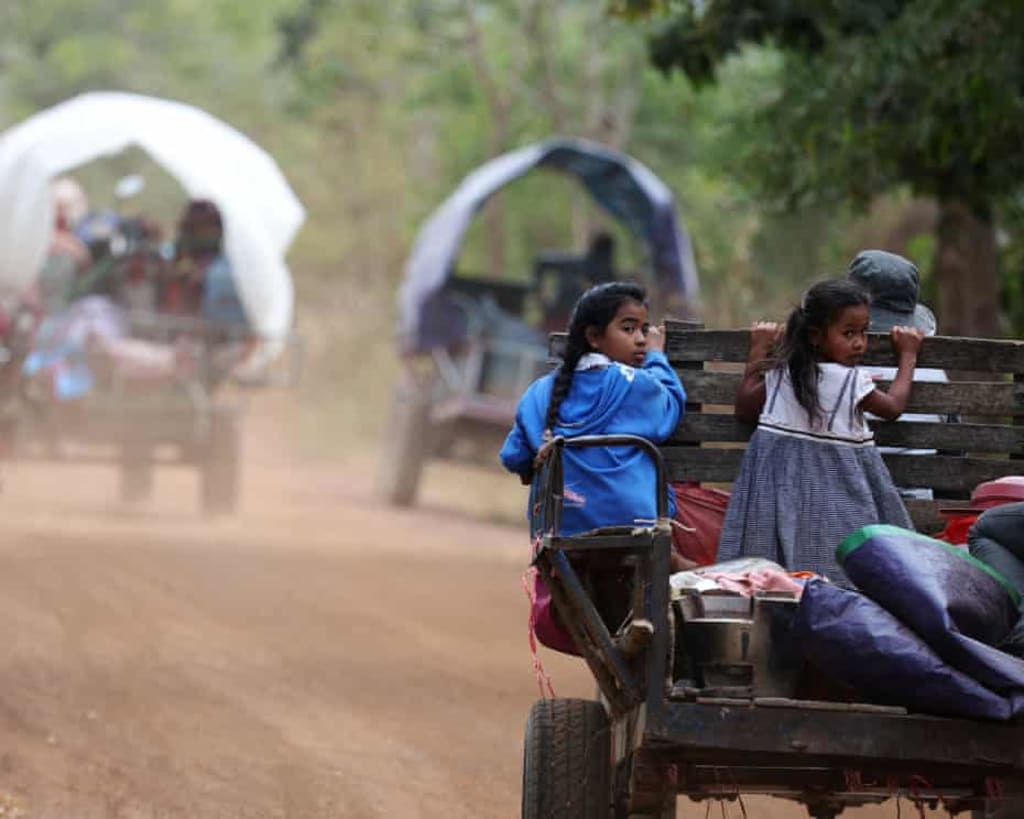
A humanitarian crisis is unfolding along the Thai-Cambodia border as intensifying clashes between the two neighboring countries have forced more than half a million civilians to flee their homes. What began as localized skirmishes has now escalated into one of the most significant regional conflicts Southeast Asia has seen in years. As the violence spreads, former U.S. President Donald Trump has launched a diplomatic initiative aimed at de-escalating tensions and preventing an even more catastrophic conflict.
The sudden eruption of hostilities has overwhelmed local authorities, strained emergency facilities, and reshaped geopolitical discussions across Asia. With artillery exchanges and airstrikes reported near populated areas, families rushed toward evacuation zones, leaving behind homes, farmlands, and livelihoods. For many, this is not the first time conflict has disrupted their lives—but it may be the largest displacement in decades.
A Rapidly Spiraling Border Crisis
Fighting between Thai and Cambodian forces erupted overnight along disputed stretches of the frontier. Each side accuses the other of firing first, but independent observers say the situation deteriorated quickly once both militaries mobilized.
Explosions echoed across border towns, prompting Thai authorities to order mass evacuations. Cambodian villagers followed soon after, scrambling across fields and forest routes to escape the fighting. Makeshift shelters filled rapidly, with evacuees describing scenes of panic as families struggled to stay together amid the chaos.
By mid-week, government rescue teams confirmed that more than 500,000 people had been moved from high-risk zones—one of the largest emergency evacuations in the region’s recent history.
Local hospitals in Thailand’s Sa Kaeo and Surin provinces reported overflowing wards, while Cambodian clinics struggled to treat injuries stemming from explosions and collapsing structures. Relief agencies warned that food, water, and medical supplies were running dangerously low.
International Tension Deepens
The border clash has raised alarms among Southeast Asian nations, many of whom fear that the violence could spill over and destabilize the region. ASEAN called an urgent meeting to coordinate response efforts and evaluate diplomatic strategies.
Meanwhile, global powers have taken notice. China, which has influence in Cambodia, urged “restraint and constructive dialogue,” while Japan expressed concern for civilian safety. The European Union called for an immediate ceasefire and announced emergency humanitarian funding.
But the most surprising diplomatic move came from former U.S. President Donald Trump, who re-entered the international spotlight by offering to mediate peace negotiations.
Trump’s Diplomatic Push: A High-Stakes Attempt
Trump announced that he had spoken with officials from both sides, emphasizing the need to avoid further bloodshed. His involvement comes at a delicate moment—politically charged, yet welcomed by some leaders who believe international mediation is essential for a sustainable resolution.
According to U.S. aides familiar with his outreach, Trump aims to bring Thai and Cambodian negotiators together for preliminary talks. He framed the conflict as “a tragedy for innocent families” and called for “urgent peace efforts before the situation spirals out of control.”
While reactions to Trump’s initiative are mixed, his entry into the diplomatic arena has undeniably increased global attention and pressure on both nations to find a solution.
Humanitarian Concerns Take Center Stage
Evacuation centers are struggling to accommodate the influx of displaced families. Many evacuees have been living in hastily constructed tents or school buildings converted into emergency shelters. Access to clean water, sanitation, and medical care remains uneven, creating concerns about possible disease outbreaks.
Children, in particular, face heightened risk. Aid workers report high levels of trauma among young evacuees, many of whom witnessed explosions or were separated temporarily from their families during the rush to safety.
Authorities are also racing against time to reinforce border defenses and prevent civilians from returning prematurely to dangerous areas.
The Historical Context Behind the Clashes
The border between Thailand and Cambodia has long been contested, with past disputes over historic temple sites and territory occasionally sparking violence. While previous clashes were contained quickly, the current escalation appears far more severe—fueled by political tensions, military posturing, and deep-rooted mistrust.
Experts warn that if the conflict is not brought under control soon, it could undermine regional stability and trigger broader security concerns for Southeast Asia.
A Call for Calm Amid Uncertainty
As international diplomatic efforts intensify, the priority remains clear: protecting civilians and achieving an immediate ceasefire. Trump’s involvement adds an unexpected twist to the unfolding crisis, but many observers believe that any mediator capable of bringing both sides to the table should be welcomed.
For now, families displaced by the violence wait anxiously in crowded shelters, hoping for news that the fighting will stop and they can return home safely. The coming days will determine whether Southeast Asia faces a prolonged conflict or a fragile path toward peace.
About the Creator
Asad Ali
I'm Asad Ali, a passionate blogger with 3 years of experience creating engaging and informative content across various niches. I specialize in crafting SEO-friendly articles that drive traffic and deliver value to readers.
The Forsyth House Fire
Since 1851, Forsyth House has stood on the corner of Union Street and Gordon Street in the heart of Glasgow. Its iconic, or was... because on Sunday 8th of March, 2026, a fire broke out in a small, seemingly un-named shop in the building and tore all that history down. As I write, the rubble is still unsettled and the street is still blocked off. Central Station is quiet on the upper level, and around 30 small businesses have quite literally gone up in smoke.
By S. A. Crawford3 days ago in The Swamp
RAF Typhoon Jets in Action Over Bahrain
Royal Air Force fighter jets roared across the skies above the Gulf kingdom this week as part of a high-profile training and security mission involving the advanced Eurofighter Typhoon aircraft. The deployment highlights the United Kingdom’s continuing military partnership with Bahrain, a strategic ally that hosts a key British naval facility in the region. The operation involved several RAF Typhoon jets flying out of RAF Akrotiri and staging exercises in cooperation with Bahraini defence forces. The sorties, conducted over international waters and Bahraini airspace, focused on air combat manoeuvres, rapid response drills and coordination with ground-based radar units. Officials from the Royal Air Force described the exercise as part of a broader effort to maintain readiness in the Middle East while strengthening defence ties with regional partners. According to defence sources, the drills simulated real-world scenarios including interception of unidentified aircraft and protection of maritime routes in the Persian Gulf. “These missions allow our crews to practice complex operations in a realistic environment,” a British defence spokesperson said. “Working alongside Bahrain’s forces improves coordination and ensures we are prepared to respond to potential threats to regional security.” The Typhoon jets involved in the operation represent one of the most sophisticated fighter aircraft in the RAF fleet. Equipped with advanced radar systems, precision-guided weapons and supersonic speed capabilities, the aircraft are designed to perform air superiority, reconnaissance and strike missions. The fighter is jointly developed by European aerospace companies including BAE Systems, Airbus and Leonardo. Military analysts say the presence of RAF jets in Bahrain reflects the United Kingdom’s long-standing strategic interest in maintaining stability in the Gulf. The region remains critical for global energy supplies and international shipping routes, and Western powers have continued to conduct patrols and exercises there amid ongoing geopolitical tensions. Bahrain hosts the Naval Support Facility Bahrain, which opened in 2018 as the Royal Navy’s first permanent base east of the Suez Canal in more than four decades. The facility allows British warships to operate more easily across the Gulf and Indian Ocean, while also supporting air and maritime missions involving British forces. During the latest exercise, Bahraini air controllers worked closely with RAF pilots to track simulated targets. Local fighter units also participated in some training segments, allowing both sides to exchange operational experience and refine joint tactics. A Bahraini defence official said the drills demonstrated the strength of cooperation between the two countries. “Our partnership with the United Kingdom is built on decades of military collaboration,” the official noted. “These exercises ensure our forces can operate effectively together when regional stability is challenged.” Residents in parts of Bahrain reported seeing the fighter jets streaking across the sky in tight formation. Defence authorities confirmed that the flights were scheduled training missions and that no civilian air traffic was disrupted during the operation. The deployment also provides valuable flying hours for RAF pilots stationed in the Middle East, many of whom regularly support coalition missions across the region. Training in the Gulf’s unique climate conditions—characterised by high temperatures and desert winds—helps crews prepare for potential operational deployments. Security experts say exercises like these are increasingly important as military powers adapt to evolving threats such as unmanned aerial vehicles and long-range missile systems. Practicing rapid interception and coordinated defence responses allows allied forces to maintain a technological and tactical edge. For the United Kingdom, the mission underscores its continued commitment to defence partnerships beyond Europe. While the RAF maintains a strong presence at home bases across Britain, overseas operations remain central to its global strategy. As the Typhoon jets completed their final sorties over Bahrain, defence officials from both countries described the exercise as a success. Plans are already under discussion for future joint drills, reinforcing a partnership that has long been a cornerstone of security cooperation in the Gulf region.
By Fiaz Ahmed 3 days ago in The Swamp
A Transparent Look at Vocal Challenges and Top Stories
Almost three years ago, we shared a resource article that served as a place for people to suggest new challenge prompts. We thought it would be a good idea to refresh that thread, and take the opportunity to answer a few common questions about top stories, how challenges are judged and how submissions are reviewed.
By Vocal Curation Team4 days ago in Resources


Comments
There are no comments for this story
Be the first to respond and start the conversation.