
Global LED Lighting Market Trends & Summary
How Sustainability, Smart Cities, and Government Policies Are Accelerating the LED Revolution

Introduction
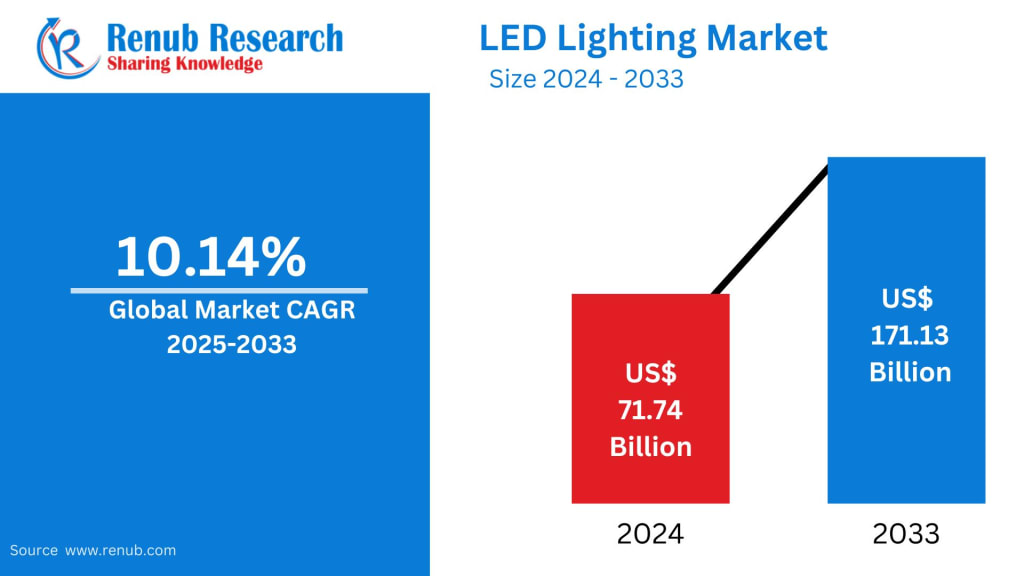
The Global LED Lighting Market is undergoing a dramatic transformation driven by sustainability, energy efficiency, and rapid adoption across residential, commercial, and industrial sectors. According to Renub Research, the market—valued at US$ 71.74 billion in 2024—is projected to reach an impressive US$ 171.13 billion by 2033, expanding at a CAGR of 10.14% from 2025 to 2033.
The growth is powered by widespread environmental awareness, government-led energy transition programs, and the universal shift toward smart, connected lighting systems. As LEDs continue to replace traditional incandescent, halogen, and fluorescent lamps, the global lighting landscape is being reshaped faster than ever before.
This report explores the key trends, growth drivers, challenges, regional insights, and major company developments shaping the global LED lighting industry through 2033.
Global LED Lighting Market Overview
Light-emitting diodes (LEDs) are semiconductor devices that emit light when an electric current passes through them. Their efficiency, durability, and environmental advantages make them superior to conventional lighting technologies.
LEDs offer:
Up to 70–90% less energy consumption
Long operational life of up to 25,000–50,000 hours
Zero mercury content, making them eco-friendly
Better brightness, clarity, and performance in varied environments
Because they consume less power and require less maintenance, LEDs have become the default choice in homes, corporate spaces, public infrastructure, and industrial applications.
Industry Example
In March 2023, Syska Group launched a new range of LED track lights designed for high-quality ambient lighting. This reflects the growing shift toward customizable, aesthetic, and efficient lighting solutions.
As industries, governments, and consumers prioritize energy savings, LED adoption continues to surge across the world.
Key Growth Drivers for the LED Lighting Market
1. Rising Environmental Concerns Fueling LED Adoption
Global concerns regarding energy use, carbon emissions, and climate change are pushing individuals and institutions toward sustainable lighting. LED technology significantly reduces energy consumption, helping countries meet climate targets.
Several manufacturers are actively developing eco-friendly product lines:
Example: Signify Malaysia (2023)
Launched ultra-efficient, mercury-free LED solutions such as:
Philips Ultra Efficient LED tubes & bulbs
Solar-powered outdoor lighting systems
These products consume 60% less energy and provide 3.5x longer shelf life than conventional LED offerings.
Governments too are investing heavily in sustainable infrastructure. In June 2023, U.S. agencies along with the Department of Energy allocated US$178 million for LED upgrades in K–12 schools, targeting reduced emissions and operational cost savings.
2. Increasing Demand for Affordable & Energy-Efficient Lighting
Consumers and organizations globally are prioritizing low-cost, energy-efficient lighting solutions. LED lights convert most electrical energy into light, minimizing waste and maximizing performance.
Smart Lighting & IoT Integration
LEDs are at the heart of the smart home revolution.
GSMA reported that China may host 4.1 billion IoT connections by 2025, boosting the demand for IoT-enabled lighting.
In February 2023, Signify deployed a smart street lighting system in Germany’s Eichenzell municipality using Interact City System, enabling real-time monitoring and energy optimization.
Consumer-Level Innovation
In January 2023, GE Lighting (Savant) expanded its Cync ecosystem with:
16 million color presets
Dynamic Effects technology
Personalized lighting scenes
Device-level music syncing
These advancements are pushing LED adoption into every home and commercial building.
3. Government Policies, Incentives & Regulations Boosting Adoption
Strict global regulations are phasing out inefficient lighting systems and promoting LED alternatives. Many countries offer:
Tax rebates
Subsidies
Government-backed distribution schemes
Mandatory energy-compliance standards
Example: India’s UJALA Program
Distributed 360 million LED bulbs by January 2022
Saved 47 billion kWh annually
Reduced yearly CO₂ emissions by 37 million tonnes
Such programs significantly accelerate LED adoption, lower upfront costs, and improve market penetration.
Challenges in the LED Lighting Market
Despite its massive potential, the LED lighting industry faces several hurdles.
1. High Initial Installation Costs
While LEDs offer long-term savings, their upfront costs (including semiconductors, drivers, and associated components) remain higher than traditional lighting technologies.
For rural and suburban consumers, initial expenses often discourage adoption. For many small businesses and households, LED retrofitting remains financially challenging.
2. Compatibility Issues with Existing Infrastructure
Older buildings using conventional wiring systems often require:
Special adapters
LED drivers
Dimming controllers
Electrical upgrades
This increases installation complexity and costs. Many legacy systems cannot support smart or dimmable LED functionality without significant redesign.
Infrastructure incompatibility remains a significant barrier in developing markets.
Regional Market Insights
North America & Europe: Mature Markets with Strong Growth Potential
Both regions exhibit high adoption rates due to:
Stringent energy-efficiency regulations
Greater environmental consciousness
Rapid smart-home and smart-city expansion
United States
The U.S. LED market is growing due to regulatory policies like the Energy Policy Act, combined with higher consumer demand for cost-efficient lighting.
In May 2023, Cyclone Lighting introduced advanced outdoor LED luminaires with modern optic designs—showcasing ongoing innovation in public lighting.
Germany
Germany’s LED market is expanding rapidly due to sustainability mandates and rising electricity costs.
Key developments include:
Signify’s WiZ Smart Lighting upgrades featuring SpaceSense motion detection
Introduction of Philips Smart LED lamps under the Wiz Connected brand
Germany remains one of Europe’s biggest adopters of smart and integrated LED systems.
Asia-Pacific: The Fastest Growing LED Market
Asia-Pacific—led by China, India, Japan, and South Korea—dominates global LED production and consumption.
India
India’s LED market is booming due to:
Large-scale government programs (UJALA)
Urbanization and housing development
Rising electricity costs
Increased public awareness
India is positioning itself as a major global LED hub.
China
As the world’s largest LED manufacturer, China drives global production, pricing, and technology innovation.
Middle East & Africa
Saudi Arabia
Driven by Vision 2030, Saudi Arabia is rapidly upgrading to LED lighting across commercial, residential, and public infrastructure. Smart city projects and sustainability goals are adding momentum.
LED Lighting Market Segments
By Product Type
Lamps
Luminaires
By Application
Indoor
Outdoor
By End User
Commercial
Residential
Industrial
Others
By Sales Channel
Retail/Warehouse
E-Commerce
Direct Sales
Countries Covered
North America
Europe
Asia-Pacific
Latin America
Middle East & Africa
Rest of World
Key Players Covered (Overview, Key Persons, Revenue & Strategies)
Acuity Brands Inc.
Koninklijke Philips N.V.
Emerson Electric Co.
Hubbell Inc.
Daktronics Inc.
Dialight Plc.
LSI Industries Inc.
Samsung Electronics Co. Ltd.
These companies are leading innovation, expanding smart lighting portfolios, and investing in R&D to reduce costs and increase efficiency.
Final Thoughts
The Global LED Lighting Market is on a robust growth trajectory, supported by climate initiatives, smart-city development, and rising consumer preference for sustainable products. With governments pushing energy transitions and companies investing in smart, connected lighting ecosystems, LEDs will dominate global lighting by 2033.
Challenges such as upfront costs and infrastructure compatibility persist, but technological advances and policy initiatives continue to bridge these gaps. As LED innovation accelerates, the future of lighting will be smarter, greener, and significantly more efficient.
About the Creator
Renub Research
Renub Research is a Market Research and Consulting Company. We have more than 15 years of experience especially in international Business-to-Business Researches, Surveys and Consulting. Call Us : +1-478-202-3244
Keep reading
More stories from Renub Research and writers in The Swamp and other communities.
Transformers Market Size and Forecast 2025–2033: Powering the Future of Global Energy Distribution
As the world accelerates toward a future powered by renewable energy, digital infrastructure, and rapid electrification, the global transformers market is gaining unprecedented momentum. According to Renub Research, the global transformers market—valued at USD 66.28 billion in 2024—is set to reach USD 116.53 billion by 2033, growing at a steady CAGR of 6.47% from 2025 to 2033.
By Renub Research2 months ago in The Swamp
Iran Edges Closer to a Revolution That Would Reshape the World
For decades, Iran has existed in a state of controlled tension — balancing public dissent, economic pressure, and rigid political authority. Today, that balance appears more fragile than ever. From widespread protests and economic collapse to generational defiance and geopolitical strain, Iran is edging closer to a revolutionary moment that could dramatically reshape not only the Middle East, but the world.
By Aqib Hussain2 days ago in The Swamp




Comments
There are no comments for this story
Be the first to respond and start the conversation.