
Global Airlines Scramble as Airbus Issues Major A320 Recall
Thousands of aircraft grounded as software and safety concerns hit airlines worldwide.


Air travel faces turbulence this week as Airbus has issued a major recall affecting its A320-family aircraft, a workhorse of airlines around the globe. The recall involves a critical software issue in the flight-control system, prompting airlines to ground thousands of planes for urgent maintenance. The move comes after a serious flight-control incident raised alarms among regulators, leaving both passengers and airlines navigating uncertainty.
The Recall That Shook the Skies
The A320-family, one of the most widely used aircraft in commercial aviation, is at the center of a sweeping recall that impacts over 6,000 jets worldwide. Airbus identified a software vulnerability in the ELAC (Elevator and Aileron Computer) system, which controls the aircraft’s pitch and roll.
The malfunction, potentially triggered by environmental factors like intense solar radiation, could interfere with critical flight-control operations. While no crash has been linked to the issue so far, regulators have acted decisively to prevent any future incidents. (Al Jazeera)
Airlines are required to either roll back the software to a previous stable version or perform further inspections, meaning temporary grounding of affected planes. The update itself takes only a few hours, but given the sheer scale, the logistical challenge is enormous.
Which Airlines Are Most Affected?
Several major carriers have been forced to ground portions of their fleets. Notable affected airlines include:
American Airlines — Approximately 340 of its 480 A320 jets need the software update. Delays and rescheduled flights are unavoidable.
Avianca (Colombia) — Over 70% of its fleet requires inspection, leading the airline to suspend some bookings until aircraft are deemed safe.
Lufthansa (Germany) — Several aircraft in its A320 fleet require updates, with potential ripple effects across European routes.
easyJet & Wizz Air (Europe) — Low-cost carriers with substantial A320 fleets are adjusting schedules to accommodate grounded planes.
Air New Zealand — All A320neo jets are undergoing maintenance, causing disruptions in Oceania.
IndiGo & Air India (India) — The recall impacts domestic and international schedules, forcing airlines to adjust flights and capacity.
Other regional carriers operating A320s are also affected, though in varying degrees depending on fleet composition. (Investing.com)
Impact on Passengers and Travel
For travelers, the consequences are immediate: flight delays, cancellations, and last-minute rebookings. Some airlines have temporarily suspended new ticket sales to manage scheduling chaos. Passengers are advised to check flight status frequently and prepare for possible adjustments.
The recall also coincides with high-demand travel periods, exacerbating inconvenience. Families and business travelers alike face the challenge of rescheduling flights, while airlines work around-the-clock to restore as many planes to service as quickly as possible. (Bloomberg)
Why the Recall Is Serious
The A320 recall is unusual for several reasons:
1. Scale — Thousands of planes worldwide are affected.
2. Critical Systems — ELAC manages pitch and roll; any software flaw poses potential risk to safe flight.
3. Complex Fix — While most jets require only a software rollback, some may need hardware adjustments.
This recall highlights how even widely trusted aircraft designs must remain under constant scrutiny. Aviation safety depends not only on manufacturing standards but also on timely software updates and rigorous inspections.
Airlines Responding
Airlines are acting swiftly to minimize disruption:
Rescheduling flights and notifying passengers.
Grounding affected planes only as long as necessary for maintenance.
Coordination with regulators to ensure compliance with safety directives.
Passenger support services for refunds, rebookings, and accommodations where needed.
Despite the disruption, industry experts note that the prompt recall demonstrates the effectiveness of aviation safety protocols, ensuring potential risks are mitigated before any accidents occur.
Looking Ahead
For the aviation industry, the Airbus A320 recall serves as a reminder of how modern aircraft, while reliable, are increasingly dependent on software. Airlines may need to adopt proactive maintenance strategies and improve fleet monitoring to prevent similar disruptions in the future.
For passengers, flexibility is key. Travelers should check airlines’ notifications regularly and allow extra time when planning trips. While temporary, this recall underscores how interconnected global aviation is: a software issue in a European-built aircraft affects flights across continents, from North America to Asia to Oceania
.
As Airbus works to restore normal operations, airlines and passengers alike are adjusting to the reality that even the skies aren’t immune to software glitches. The industry’s ability to respond effectively, however, demonstrates the resilience and adaptability of modern aviation.
About the Creator
Asad Ali
I'm Asad Ali, a passionate blogger with 3 years of experience creating engaging and informative content across various niches. I specialize in crafting SEO-friendly articles that drive traffic and deliver value to readers.
A Gathering of Evil Bosses
“I’m the queen of chin jutting while I smooth my hair, attacking, insulting, and deflecting to protect my appointer.” “Oh, please, Blondi, my hair is curled, highlighted, and longer than yours. I feature television commercials telling immigrants that we will give them a free plane ride home, and if they voluntarily turn themselves in, they will be allowed to legally apply for re-entry. It runs everywhere, and I look good in it! You can’t compete because of your blond hair. Mine is nicer, and my lips are prettier than yours.”
By Andrea Corwin 21 days ago in The Swamp
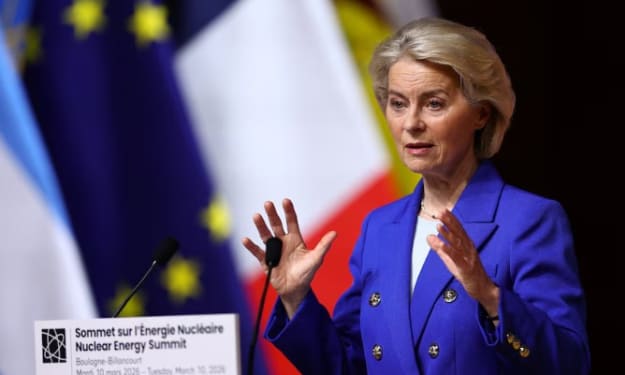
Reducing Europe’s Nuclear Energy Sector Was a “Strategic Mistake,” EU Chief Says
Europe’s energy policy has long been shaped by debates over sustainability, safety, and energy independence. In recent years, those debates have intensified as global energy demands rise and geopolitical tensions disrupt traditional energy supplies. Now, a major voice within the European leadership has publicly acknowledged what many analysts have argued for years: reducing the continent’s nuclear energy sector may have been a strategic mistake.
By Jameel Jamaliabout 13 hours ago in The Swamp
The Politics of Playing Dress-Up
Well, to start off I'd like to say a happy world book day to all who celebrate. I know I haven't really posted anything on my socials about it but I'm not a jubilant kind of person. I lay low most of the time. Let's start off with a popular anecdote from the vaults...
By Annie Kapur6 days ago in Geeks



Comments
There are no comments for this story
Be the first to respond and start the conversation.