


Throughout his father’s reign, George showed his support for his father and King by carrying out public duties. As the Duke of York, George opened the first session of the Australian Parliament upon the creation of the Commonwealth of Australia. As Prince and Princess of Wales, the young couple toured British India, and it is interesting to note that George was ‘disgusted by the racial discrimination’ and he actually campaigned for the greater involvement of Indians in the government of the country. George and Mary proved faultless in supporting King Edward VII and England.
During this time, George was being prepared for his role as the future king of England. His father assigned Sir Arthur Biggs the task of ‘teaching’ his son ‘how’ to be a King. Prince George appreciated the help Sir Arthur gave him: “He taught me how to be a King.” Writing to Sir Arthur, George wrote: “I thank God that I have a friend like you, in whom I have the fullest confidence and from whom I know on all occasions I shall get the best and soundest advice.” Acknowledging how well his son was doing, the King wrote to the Prince saying: “I know I can always count on your support and assistance in the heavy duties and responsible position I now occupy.” Unfortunately, King Edward VII’s reign was troubled by internal dissension and conflict. On 4th May, 1910, Prince George went over to Buckingham Palace to see his father: “his colour was bad and his breathing fast.” The King was ill with bronchitis which led to a series of heart attacks. As his father’s life was slipping away, the Prince of Wales was able to tell his father that his horse ‘Witch of the Air’ had won at Kempton Park. At 11.45pm, that evening, King Edward VII died and not only did the nation mourn a sovereign, Prince George mourned his father saying: “I have lost my best friend and the best of fathers.”

As Halley’s Comet ‘blazed in the night skies,’ Prince George became the King of England and in London, the trumpets ‘rang out’ to proclaim the new sovereign:
“George the Fifth by the Grace of God, King of the United Kingdom of Great Britain and Ireland, and of the British Dominions beyond the Seas, Defender of the Faith, Emperor of India.”
His father was buried at Windsor at a service attended by the Royal family and foreign dignitaries that included the ex-President of the United States, Theodore Roosevelt.
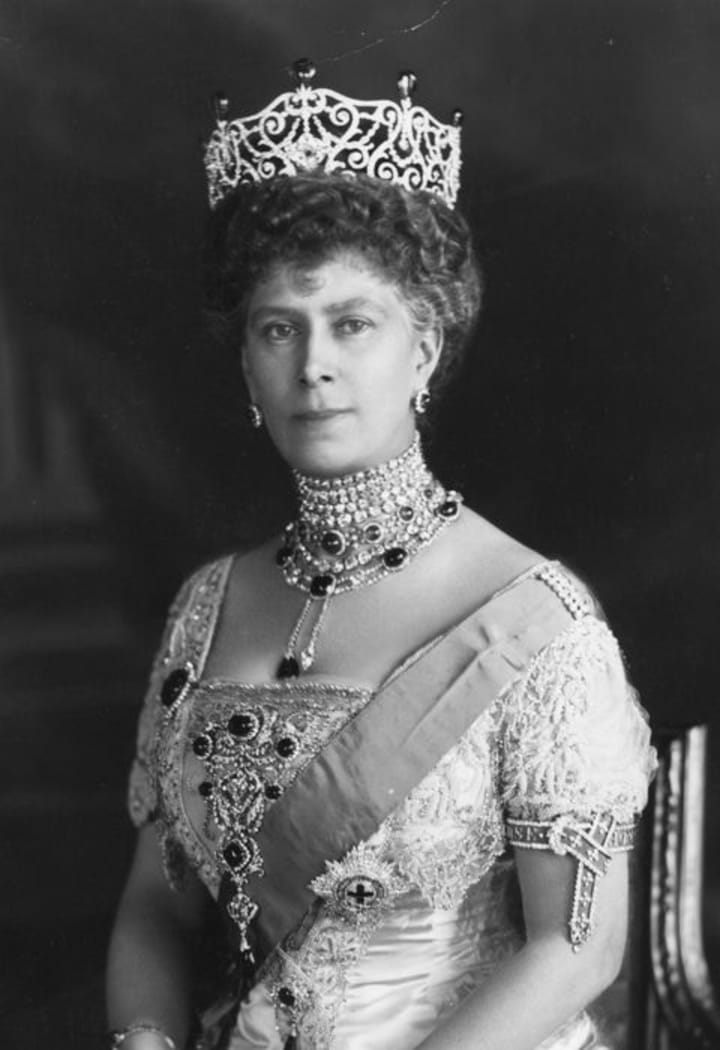
King George and Queen Mary were crowned in a gorgeous ceremony at Westminster Abbey on 22nd June, 1911. The now King George V wrote: “Today was indeed a great & memorable day on our lives & one we can never forget. There were hundreds of thousands of people who gave us a magnificent reception. The service at the Abbey was most beautiful, but it was a terrible ordeal. Beautiful illuminations everywhere.”
Later on in the same year, the new King and Queen travelled to India for the Delhi Durbar, where they were presented to an assembled audience of Indian dignitaries and princes as the Emperor and Empress of India. King George V was the only Emperor of India to be present at his own Delhi Durbar. Thus started the new reign of King George V.
Prince Edward, George’s first son, was sixteen when his father was crowned. Prince Albert was fourteen, Princess Mary was twelve, Prince Henry was ten and Prince John was five. Even though George was devoted to his family, he did not have the same rapport with his own sons that he had had with his own father. Mary took no delight in being pregnant and giving birth, just like the late Queen Victoria: “But with Mama life was less severe,” wrote one of the sons.
George inherited the throne at a politically difficult time. The ‘People’s Budget’ had been rejected (Lloyd George) the year before and Asquith was attempting to curtail the power of the Lords through ‘constitutional reforms.’ Wanting to avoid the prospect of a civil war in Ireland, George called a ‘meeting of all parties at Buckingham Palace’ in July 1914 in an attempt to negotiate a settlement. After four days, there was no agreement and then --- World War One started which brought a halt to everything!
On 4th August, 1914, King George wrote in his diary: “I held a council at10.45 to declare war with Germany. It is a terrible catastrophe but it is not our fault --- Please to God it may soon be over.” As there were family ties within the Royal Court with Germany (The German Kaiser Wilhelm II, so for the British public came to symbolize the horrors of the war, was the King’s first cousin), H.G.Wells wrote about Britain’s “alien and uninspiring court.” George, the King, replied: “I may be uninspiring but I’ll be damned if I’m an alien.” So, on 17th July, 1917, King George V changed the name of the British Royal Family from the German-sounding name “Saxe-Coburg and Gotha” to a much more ‘English-sounding’ name --- the “House of Windsor.”
During The Great War, King George V presented himself to the public as a confident and caring and cheerful King. He continued to advise, encourage and warn his ministers and his public duties assumed a new significance. As the head of state, he was the very essence of patriotism! As King, George paid seven visits to British naval bases, held 450 inspections, conferred 50,000 decorations 'with his own hands’ and visited 300 hospitals --- all during World War One. He also went to visit the armies in France --- five times.
It was in 1917 when George’s cousin, the Tsar Nicholas II of Russia was overthrown by the Russian Revolution and the Russian Royal family were put under house arrest. Whilst George wanted to help his cousin, it was thought that the revolution might come over to Britain if he took his cousin and his family in. The Tsar and his family remained in Russia and were killed, murdered, by the Bolsheviks in 1918. George wrote in his diary: “It was a foul murder. I was devoted to Nicky, who was the kindest of men: (he) loved his country and people.”
The King’s two eldest sons ‘did their duty.’ The Prince of Wales served as side-de-camp on the personal staff of the Commander-in-Chief in France. His second son, “Bertie,” served in the Royal Navy (like his father had done many years before).
Whilst touring the encampments and battlefields in France and Flanders, George wrote constant letters to his Queen, Mary. Mary, naturally, feared for her husband’s safety. In October 1915, the King did fall off his horse but it was an accident. The horse reared in fright as the men cheered their King. He fractured his pelvis and suffered severe bruising. This made George one of the permanent war-wounded.
When Sir Douglas Haiz was able to succeed to the command of the British forces on the Western front, he knew that he could rely on his Sovereign’s support even in the most adverse of conditions, as George was not only his King but also a good friend. In return for the King’s support, Haiz kept his Sovereign supplied ‘with a great deal of information.’
The first units of the United States army gave King George V the opportunity to address the American staff officers and their leader by saying: “It has always been my dream that the two English-speaking nations should someday be united in a great cause, and today my dream is realized.” (June 1917) Talking of this Great War, George wrote to his mother: “we must be courageous & go on to the end, however long it may take, as I shall never submit to those brutal Germans & I am sure the British nation is of the same opinion.” By the middle of July, the British, French and American counter-attacks were pushing back the spent German forces.

On 11th November, the war was over.
Two months after the end of the war, Prince John died at thirteen years of age. He had suffered with epilepsy all of his short life which eventually led to his death. His mother wrote: “The first break in the family circle is hard to bear but people have been so kind & sympathetic & this has helped us much.”
Support for home rule in Ireland was now growing momentum. In 1921, King George V was able to exercise a personal influence on these Irish affairs which was unusual for a ‘constitutional’ monarch, but it was also plainly effective. He made a speech on this which helped to bring substantial improvement in Anlgo-Irish relations.
Even though The Great War had finished, it had affected everybody. In February, 1918, food rationing had been introduced, but also the state itself took fresh responsibilities in the field of social welfare, taking care of the servicemen’s wives and families. Also, nearly everyone felt that they had made some sacrifice in the cause of ‘winning the war.’ The King’s own tireless devotion to the general encouragement of his people’s war efforts had its own reward in his evident popularity within the nation. Even Lloyd George, the elected Prime Minister, (1918) ‘flung’ himself into the massive task of post-war government, especially peace-making and domestic reconstruction. Women over thirty-five years of age now had the vote.
Life had now changed!
The rich may still be rich and the poor may still be poor, but the social habits of dress and leisure activities for both classes had changed. All social classes now smoked cigarettes; the lounge suit became the working-dress of the middle-classes; women’s fashions became “less fussy”; the ‘flapper’ had arrived! In 1924, the King appointed the first Labour Prime Minister, Ramsey MacDonald. Understanding his people so completely, during the General Strike of 1926, George said: “Try living on their wages before you judge them.”
It is interesting to note that King George V was concerned by the rise to power in Germany of Adolf Hitler and the Nazi Party. He seemed to know that there would be another war within the next ten years if Germany did not change their course in history.

On a much happier note, George agreed to deliver the first Royal Christmas Speech “on the radio” in 1932 --- he wanted to do this because “it was what his people wanted.” By his Silver Jubilee in 1935, King George V had become a well-loved King. He said: “I cannot understand it, after all I am only a very ordinary sort of fellow” in response to the crowd’s adulation.
With the Royal Family itself life was changing. George almost despaired at the conduct of his older son but became increasingly fond of his second son, “Bertie.” Bertie had now settled down and married the Lady Elizabeth Bowes-Lyon and now had two children, two Princesses, “Lilibet” and Margaret Rose. George was enchanted with his granddaughters, especially “Lilibet” or Elizabeth (who eventually became our dear Queen, Elizabeth II). He call her “Lilibet” and she called her grandfather “Grandpa England.” Seeing into the future, King George V said of Edward, his eldest son: “After I am dead, the boy will ruin himself within 12 months.” And of his second son, Albert, and his granddaughter, Elizabeth: “I pray to God my eldest son will never marry and have children, and that nothing will come between Bertie and Lilibet and the throne.”

In 1928, the King suffered a serious setback. He developed a dangerous illness as a result of a pleural abscess which was awkwardly situated behind the diaphragm. However, his doctor, Lord Dawson, managed to operate on the King who began to slowly recover. In May 1929, there was a second operation to remove a new abscess and in July, a third operation. All of this weakened the King’s health, his ‘constitution,’ but George still lived for another six years!
During the King’s illnesses, the nation clearly showed how much it loved its King. There was a widespread offering of prayers and £689,597 was subscribed to the Thanksgiving Fund for the King’s recovery.
Early in November, 1935, Prince Henry married the Lady Alice Scott, a celebration for the whole family. However, on 3rd December, King George V’s sister, Prince Victoria, died. George cancelled the state opening of Parliament and never appeared in public again.
On 20th January, 1936, King George V died peacefully surrounded by his wife and children. His wife, Queen Mary, wrote in her diary: “Am heartbroken --- at 5 to 12 my darling husband passed peacefully away. The sunset of his death tinged the whole world’s sky.”
George’s body lay in state at Westminster Hall for four days, while 809,182 mourners filed past. On 28th January, King George V was taken to the Chapel of the Knights of the Garter at Windsor Castle to be buried. Millions throughout the Empire saluted the passing of King George V. He may have had his ‘blind spots’ but he never let them come between him and his duty.

King George V “was the right man in the right place.” In his straightforward manner, George always “spoke the truth” which gave him an enviable rapport with his people!
(My research comes from: Wikipedia, The Royal Family and “The Life and Times of George V” by Dennis Judd)
About the Creator
Ruth Elizabeth Stiff
I love all things Earthy and Self-Help
History is one of my favourite subjects and I love to write short fiction
Research is so interesting for me too
Keep reading
More stories from Ruth Elizabeth Stiff and writers in The Swamp and other communities.
King George V
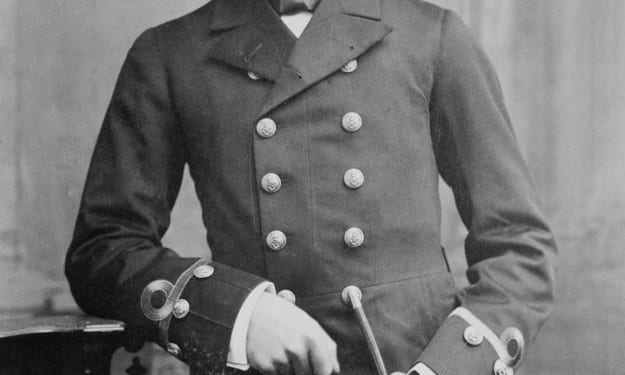
King George V was the grandson of the late Queen Victoria AND the grandfather of our dear Queen today, Queen Elizabeth II. As he was born third in line to the throne, George did not expect to become King and he started to carve out a “career” in the Royal Navy. George was born during the reign of Queen Victoria (his grandmother), with Prince Albert Edward (his father) being next in line to the throne and Prince Albert Victor “Eddy” (his older brother) being second in line. During King George V’s reign, there was the rise of socialism, communism, fascism, the Irish Republicanism and the Indian independence movement --- all of which changed the political landscape of the British Empire. In 1917, King George V became the first monarch of the House of Windsor, which he renamed from the House of Saxe-Coburg and Gotha because of the anti-German public ‘feeling’ during World War One.
By Ruth Elizabeth Stiff5 years ago in The Swamp
Russian War Deaths Are Rising to Unsustainable Levels, Says Ukraine
The war in Ukraine, now stretching into its fourth year, has become one of the deadliest conflicts in recent European history. Recently, Ukrainian officials issued a stark warning: Russian military deaths are climbing to levels they call “unsustainable.” But what does that really mean? And how could this affect the future of the war—and the world beyond Ukraine? Kyiv Sounds the Alarm Ukrainian military sources have been blunt. Russia’s losses on the battlefield, they say, are mounting at a pace Moscow can’t sustain indefinitely. Exact numbers are difficult to verify. The Russian government has not released comprehensive casualty data, and the fog of war makes independent reporting challenging. Yet estimates suggest staggering figures: over 1.1 million Russian casualties—including killed, wounded, and missing—since the invasion began in February 2022. Ukraine’s officials point out that these losses aren’t just numbers on a page. They weaken military capacity, strain morale, and could affect Russia’s ability to maintain a prolonged campaign. Why “Unsustainable” Isn’t Just a Word When Ukrainian officials call Russian losses unsustainable, they’re talking about more than just battlefield deaths. Several factors contribute: 1. Military Capacity Erosion High casualties make it harder for Russia to field trained soldiers. Recruitment struggles, combined with heavy losses, reduce the effectiveness of frontline units. 2. Domestic Pressure Rising deaths may fuel public dissatisfaction in Russia. Casualty fatigue can weaken support for the war and put pressure on political leaders. 3. Economic Burden The human cost translates into an economic one. Wounded soldiers require care, families are affected, and resources are diverted from other priorities—adding financial strain on top of sanctions. 4. Strategic Limitations Despite heavy losses, territorial gains have often been limited. This mismatch underscores Kyiv’s argument: Russia is paying a steep price for little progress. Numbers and Estimates Different organizations provide varying casualty figures: UK Defence Intelligence estimates over 1.1 million Russian casualties, with hundreds of thousands killed or missing. Independent tallies suggest at least 150,000 Russian deaths, excluding irregular forces. Analysts at CSIS estimate around 250,000 fatalities and nearly one million total casualties by 2025. While exact numbers vary, the pattern is clear: Russian losses are extremely high and continue to rise, which is why Kyiv warns they could become unsustainable. The Global Impact Russia’s rising casualties have implications far beyond Ukraine: International Diplomacy Western allies monitor casualty trends closely. Rising losses could justify continued military aid to Ukraine, ensuring Kyiv can hold its ground and push Russia toward negotiation. Negotiation Leverage Weakened Russian forces may give Ukraine more leverage in future ceasefire talks or peace negotiations. Domestic Response in Russia A population confronted with mounting fatalities may pressure the Kremlin to reconsider its strategy, potentially impacting political stability. The Challenge of Verification It’s worth noting that casualty figures in wartime are notoriously hard to verify. Russia has historically underreported losses, while Ukraine may emphasize them to maintain international support. Despite this, multiple intelligence assessments and open-source investigations converge on one point: the human toll of the war is staggering, and losses are rising faster than Russia can comfortably manage. A War Without Easy Answers Even if Russian losses aren’t literally “unsustainable,” the human and political toll is undeniable. The war has already reshaped geopolitics in Eastern Europe, influenced NATO strategy, and forced global powers to rethink security and diplomacy in the region. For now, the conflict drags on. Each casualty has consequences, not just on the battlefield but across societies, governments, and international relations. Key Takeaways: Russia’s casualties are extremely high, with estimates ranging from 150,000 deaths to over 1 million total casualties. Ukraine calls these losses “unsustainable” due to military, social, and economic strain. Rising deaths could influence NATO, global diplomacy, and negotiations. Verification is difficult, but the human toll remains undeniable.
By Muhammad Hassan5 days ago in The Swamp


Comments
There are no comments for this story
Be the first to respond and start the conversation.