
General Atomics Is Turning the MQ-9 Reaper Family of Drones Into “Cruise Missile Trucks”
General Atomics is reworking the MQ-9 Reaper drone family, equipping them to carry long-range cruise missiles and expanding their role from surveillance to potent standoff strike platforms.

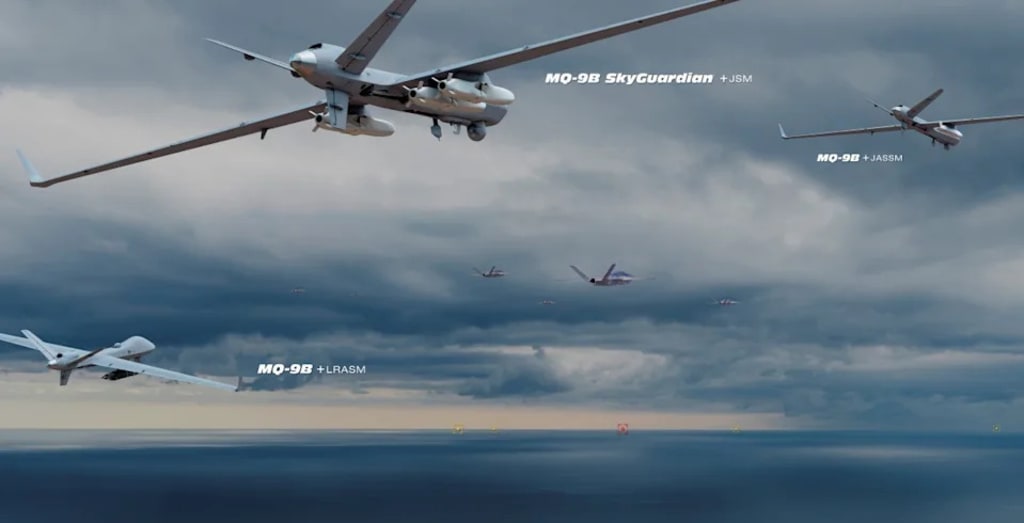
General Atomics Aeronautical Systems, the U.S. defense firm behind the widely used General Atomics MQ-9 Reaper family of remotely piloted aircraft (RPAs), is expanding the mission profile of its drones to include long-range standoff strike capabilities — effectively turning them into what industry insiders are calling “cruise missile trucks.” The initiative marks a significant evolution in how these unmanned systems might be used in future conflict scenarios, particularly in the vast expanses of the Western Pacific.
Traditionally known for surveillance, reconnaissance, and precision strike missions using smaller air-to-ground weapons like the Hellfire missile, the MQ-9 Reaper and its high-end MQ-9B variants — SkyGuardian and SeaGuardian — are now being engineered to carry heavy, long-range cruise missiles such as Lockheed Martin’s AGM-158 Joint Air-to-Surface Standoff Missile (JASSM), its anti-ship variant LRASM, and the Joint Strike Missile (JSM) developed by Kongsberg and Raytheon.
From Hunter-Killer to Long-Range Strike Platforms
The conceptual shift is stark. The MQ-9 family was originally designed for intelligence, surveillance, and reconnaissance (ISR) with the ability to engage targets at tactical ranges. But in recent years, militaries have pushed for these drones to take on broader roles — including maritime strike and deep-strike missions — because of their endurance, persistence, and relatively low cost compared with manned strike aircraft.
General Atomics says integrating long-range weapons will give the MQ-9B family “greater flexibility to hold targets at risk from extended distances while maintaining loiter time” — a combination that could make the drones far more capable in contested environments, particularly in scenarios where traditional aircraft face heightened air-defence threats.
Experts describe this as turning a persistent ISR platform into a form of “standoff strike asset” — essentially a drone that can surveil an area for hours and then, if necessary, launch cruise missiles without exposing manned aircraft to danger.
Why the Western Pacific Matters
The emphasis on cruise missile integration is driven in part by strategic needs in the Western Pacific, where distances between islands and naval task groups are vast, and where potential adversaries possess sophisticated air-defence systems. Traditional assets may struggle to maintain persistent coverage and strike reach simultaneously, which makes a drone that can orbit at range and then deliver precision-guided missiles an attractive option for planners.
Defense analysts say this development responds to demand from allied air and naval forces seeking platforms that can independently surveil, track, and strike targets deep inland or at sea without relying on other aircraft.
“We’re developing the addition of long-range standoff weapons to expand MQ-9B’s mission roles,” said David R. Alexander, president of GA-ASI, highlighting that the drones’ “extraordinary payload capacity” makes such upgrades viable.
True North Strategic Review
Technical and Operational Challenges
Adapting a drone to carry heavy cruise missiles is not as simple as bolting them on. Engineers must consider the aircraft’s aerodynamic stability, range, payload capability, and the impact of heavier stores on flight performance. Integrating systems that can reliably deploy such weapons without compromising control is a significant engineering task.
General Atomics is reportedly already studying payload, stability, and range trade-offs as part of its integration efforts, with plans to flight-test carrying at least one of the long-range missiles as early as 2026.
The Aviationist
The company’s approach reflects a broader trend in modern warfare: maximizing the utility of unmanned platforms not just for surveillance and tactical strikes, but also for precision, long-range firepower traditionally reserved for manned aircraft and surface ships.
Broader Strategic Implications
If successful, these upgrades could make the MQ-9B family more of a multi-domain force multiplier, capable of supporting both air and naval operations. This would broaden its appeal to U.S. allies in Asia, Europe, and the Middle East seeking persistent strike capabilities without the expense of high-end stealth aircraft.
However, critics caution that weaponizing drones to this degree raises questions about escalation dynamics and the risk of miscalculation in high-tension environments, especially where standoff strikes might be interpreted as offensive acts rather than defensive deterrence.
Looking Ahead
As the U.S. military and its partners continue to experiment with ways to meet the demands of future conflicts, the MQ-9 family’s transformation into a “cruise missile truck” — a platform that can carry advanced standoff weapons while loitering for extended periods — signals a shift in doctrine that could redefine how unmanned aircraft contribute to power projection and deterrence.
The MQ-9 may soon be known not just for watching the battlefield, but for shaping it from afar.
About the Creator
Fiaz Ahmed
I am Fiaz Ahmed. I am a passionate writer. I love covering trending topics and breaking news. With a sharp eye for what’s happening around the world, and crafts timely and engaging stories that keep readers informed and updated.
Keep reading
More stories from Fiaz Ahmed and writers in The Swamp and other communities.
Ukraine marks four years since Russia's full invasion as Moscow says its 'goals' not yet achieved"
Four years after Russia launched its full-scale invasion of Ukraine, the war continues with no clear end in sight, as both sides mark the grim anniversary amid frozen front lines, mounting casualties, and deepening geopolitical divisions. Ukrainian leaders commemorated the date with ceremonies honoring soldiers and civilians killed since February 24, 2022, while Moscow reiterated that its military objectives remain unfinished. In Kyiv, President Volodymyr Zelensky addressed the nation in a solemn speech, praising what he called the “unbreakable spirit” of Ukrainians who have resisted one of Europe’s largest military assaults since World War II. Church bells rang across several cities, and moments of silence were observed in schools and government offices. Memorials and mass graves in towns such as Bucha and Irpin served as stark reminders of the early months of the invasion, when Russian forces were pushed back from northern Ukraine after heavy losses. The anniversary comes at a time when the battlefield has largely stabilized into entrenched positions across eastern and southern regions. Russian troops still occupy significant portions of Donetsk, Luhansk, Zaporizhzhia, and Kherson, while Ukrainian forces continue to conduct limited counteroffensives and long-range strikes on logistics hubs and military infrastructure. Both armies are heavily reliant on drones, artillery, and electronic warfare, signaling a shift toward a grinding war of attrition rather than rapid maneuver warfare. Moscow used the occasion to restate its justification for the invasion. Russian officials said their “special military operation” had not yet achieved all of its goals, which include preventing Ukraine from joining NATO and securing what the Kremlin calls Russian-speaking territories. In a statement carried by state media, the defense ministry claimed that Russian forces were “steadily improving their tactical positions,” despite Western intelligence assessments suggesting high casualties and equipment losses. For Ukraine, the war has transformed nearly every aspect of national life. The economy has been reshaped around defense production and foreign assistance, while millions of citizens remain displaced inside the country or abroad. Power stations, ports, and factories have been repeatedly targeted, leaving communities to rebuild under constant threat of missile and drone attacks. Yet Ukraine has also deepened its ties with Western allies, receiving advanced weapons systems and financial aid that have allowed it to sustain resistance far longer than many analysts initially predicted. International reactions on the anniversary reflected both solidarity and fatigue. European leaders reaffirmed support for Kyiv, emphasizing that the conflict is not only about Ukraine’s sovereignty but also about the future of international law. The United States repeated its commitment to military and humanitarian assistance, though debates in Congress and among voters highlight growing concerns over the cost and duration of the war. Meanwhile, some Global South countries have continued to call for negotiations, urging both sides to seek a diplomatic path out of the conflict. Humanitarian agencies warned that the war’s toll on civilians remains severe. Tens of thousands have been killed or wounded, and millions still face shortages of electricity, heating, and medical supplies, particularly in frontline regions. Children have grown up amid air raid sirens and online schooling, and an entire generation has been shaped by conflict. Analysts say the fourth anniversary underscores a strategic stalemate. Neither side appears capable of delivering a decisive blow in the near term. Ukraine depends heavily on sustained Western backing, while Russia has expanded arms production and strengthened economic ties with countries outside the Western alliance system. Prospects for peace talks remain slim, as trust between the two governments is virtually nonexistent. As Ukraine marks four years since Russia’s invasion, the country stands as both a symbol of resistance and a warning of prolonged war in the modern era. For many Ukrainians, the anniversary is not only about remembering the past but also about enduring an uncertain future. And as Moscow insists its objectives remain unmet, the conflict continues to shape global politics, energy markets, and security calculations far beyond Eastern Europe.
By Fiaz Ahmed about 12 hours ago in The Swamp
A Gathering of Evil Bosses
“I’m the queen of chin jutting while I smooth my hair, attacking, insulting, and deflecting to protect my appointer.” “Oh, please, Blondi, my hair is curled, highlighted, and longer than yours. I feature television commercials telling immigrants that we will give them a free plane ride home, and if they voluntarily turn themselves in, they will be allowed to legally apply for re-entry. It runs everywhere, and I look good in it! You can’t compete because of your blond hair. Mine is nicer, and my lips are prettier than yours.”
By Andrea Corwin 7 days ago in The Swamp
At My Wits’ End
Life is about taking out the trash and calling it trash because you have every reason to. It wasn't meant to be linear, they say. But the times you tried to make it straight led to problems, and you didn’t have the tools to put any of it to use. You don't put your right shoes on the right feet; you put the left shoes on the left feet. The grey hardened slab will trip you up anyway.
By Caitlin Charlton6 days ago in Humans



Comments
There are no comments for this story
Be the first to respond and start the conversation.