
First launch of "monster missile"
South Korea crosses over to missile power?

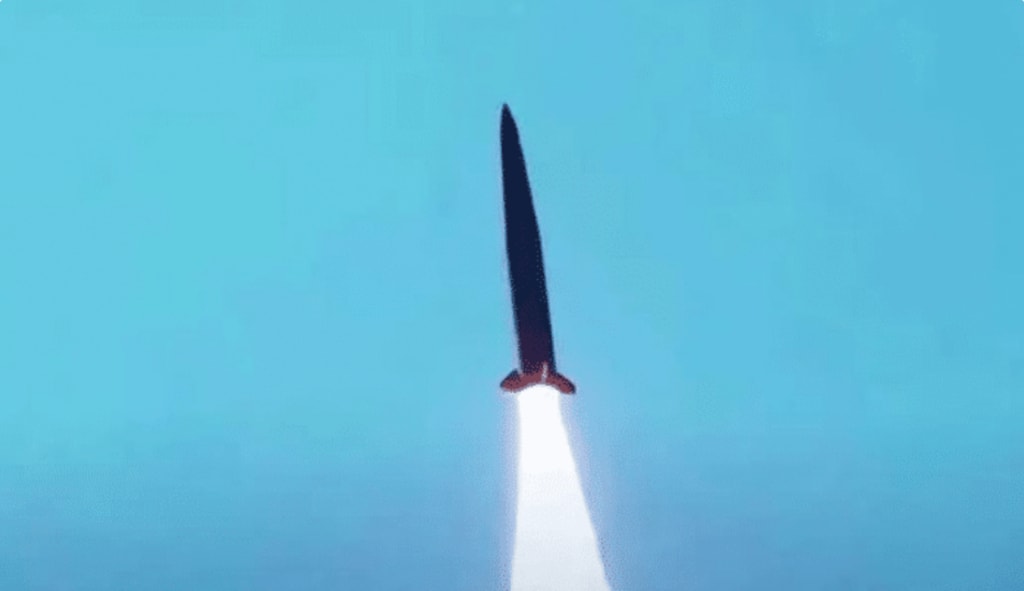
According to reports, at the ceremony of the 74th anniversary of the founding of the Korean army, the South Korean military showed for the first time to the outside world the development state of the "Hyundai-5" ballistic missile data images. The South Korean military claims that the missile has the world's highest level of firepower and is a "monster missile" that can carry up to 9 tons of warheads, even exaggerating that "10 Hyundai-5 ballistic missiles are as powerful as nuclear weapons."
According to the Korean media, the Hyundai-5 ballistic missile is capable of carrying an 8 to 9-tonne warhead, which can strike high-value targets in the north of the peninsula, in addition to being able to develop an intermediate-range ballistic missile based on it, making its maximum range to cover the Chinese hinterland. However, the good times did not last long, as Yon hap News Agency reported on Oct. 5 that a Hyundai-2 ballistic missile fell to the ground and exploded after being launched on the evening of Oct. 4, but fortunately did not affect the people nearby.
Early in the morning of October 4, local time, in response to the recent provocations of the South Korean and U.S. forces, the North of the peninsula in the territory of the Ci gang Province Maepyeong-RI area launched an intermediate-range ballistic missile eastward, after a long flight, and finally fell in the western waters of the Pacific Ocean. The Japanese and South Korean militarize later responded that the bomb had a range of 4,000 to 4,600 kilometres a maximum flight speed of Mach 17 per hour and a maximum altitude of about 970 kilometres.
Interestingly, when the bomb passed over the Japanese archipelago, the Japanese government also sounded an air defense siren in the area concerned, causing panic among the local population. In contrast to the Japanese panic, South Korean President Yuan Seek-yep said he would respond "firmly" to the above move, but he did not expect that the "firm" response later turned into an international joke.
Between midnight and midnight on October 4, South Korean and U.S. forces conducted a joint ground-to-ground strike exercise in the eastern waters, with each of the two Korea firing two ATAXICS missiles, both of which hit targets accurately in a predetermined area. Perhaps wanting to show the north of the peninsula the power of its ballistic missiles, the South Korean military followed up with a Hyundai-2 ballistic missile.
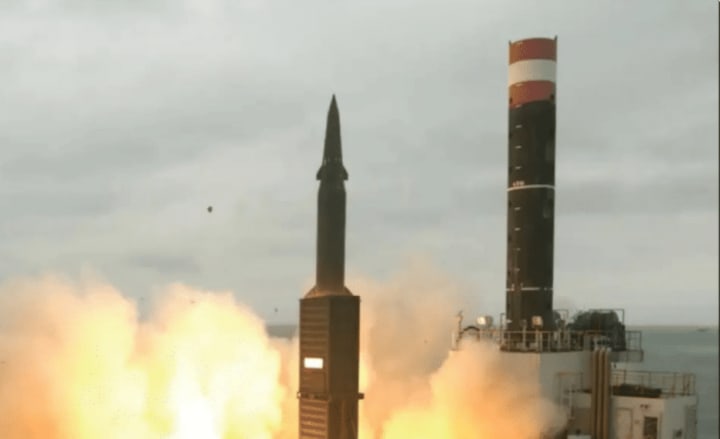
Initially, the missile was launched without any abnormalities, but then it went off course during flight and eventually crashed into the Gangrene Air Base in Gang won Province, where it ignited a fire and caused a series of explosions. After the incident, the South Korean military quickly launched an investigation, according to a preliminary analysis given by South Korean military officials, the incident should be loaded into the body of the propellant and burst into flames, but in a good fight did not explode, so any casualties.
The Hyundai-2 ballistic missile was developed by the South Korean military based on the Hyundai-2/B ballistic missile, which is 7 to 8 meters long and has a diameter of about 1 meter. Given the U.S. government's recent loosening of ties to the South Korean government in the ballistic missile field, this has increased the maximum range of the bomb to about 800 kilometers, and the weight of the combat section has also moved smoothly into the 1-ton mark from the previous 500 kilograms.
From the launch tests conducted in the past, the Xuanwu-2 strike accuracy is high, and speculation says that if inertial guidance + scenery matching guidance system is used, the strike accuracy of the bomb is theoretically less than 2 meters. Judging from its design, the bomb is capable of striking not only conventional targets but also targets located within a few meters underground.
However, it is believed that the ground-drilling performance of the bomb should not be overestimated given South Korea's limited technology in terms of body materials. If the final investigation is indeed related to the propellant, it means that the Hyundai-2 will be put out of service shortly, and the possibility of returning to the factory for maintenance and safety inspection or even solid fuel replacement cannot be ruled out.
On Oct. 1, the South Korean military held a ceremony to commemorate the 74th anniversary of the founding of the army at the Ironmonger drill ground, a joint base for land, sea, and air in Chungcheongnam-do and displayed a large number of Korean army-made equipment to the outside world. At the same time, the Ministry of National Defense released a propaganda video titled "Korean Army Determination", announcing for the first time the Hyundai-5 ballistic missile was in the development stage. From the viewpoint of the picture, the body of the Hyundai-5 ballistic missile is long and slender, the body is cylindrical, and the warhead is slender and conical, the transition between the two is more natural, and no obvious signs of articulation are found. The tail of the projectile is similar to the Xuanwu-2, with four irregular wings installed, the difference being that the former wing is pentagonal and the Xuanwu-5 is quadrilateral.
The changes in the warhead of the Gen bu-5 are more obvious, first of all, the use of a single cone design to reduce flight resistance and increase the strike range, abandoning the double cone configuration of the Gen bu-2. Secondly, the warhead skirt eliminates the four-piece truncated triangular air rudder surface used by the Hyundai-2, which means that South Korea has significantly improved missile terminal guidance and control, but it is not known through what technical path to achieve.
According to the South Korean media, the Hyundai-5 ballistic missile can carry a warhead of 8 to 9 tons and has a maximum range of about 300 kilometres, which can deliver a fatal blow to a target located hundreds of meters underground with its enormous legality. Accordingly, the primary mission of the Gen bu-5 is to strike military targets such as underground command posts, nuclear facilities, and missile silos in the northern part of the peninsula once the war begins.
However, the focus is on the successor model of the Hyundai-5, an anonymous South Korean missile expert claimed that with a reduced warhead load, the maximum range of the Hyundai-5 is expected to increase to about 3,000 to 3,500 kilometres, thus becoming a medium-range ballistic missile. Therefore, the Korean media, which has always been brainless, also made a lot of noise that the Gen bu-5 ballistic missile can effectively respond to the "provocations" launched by China, which is a real "poison needle weapon".
At the same time, the Korean media also disclosed the predicted parameters of the bomb, saying that its full length remains at about 15-16 meters, and the diameter is 1.6 meters, from this point of view, the Hyundai-5 compared to the Hyundai-2, there is indeed a lot of progress in size.
For South Korea, the biggest difficulty in increasing the range of the missile lies in the United States, if the U.S. imperial grace, then the South Korean research institutions will raise high-performance solid rocket motors and use a large charge of solid fuel rods to achieve the above-mentioned technical and tactical indicators.
But the trouble is that the propellant of the Hyundai-2 also seems to have problems, which to some extent will affect the subsequent improvement of the Hyundai-5, so whether it can become a medium-range ballistic missile, is not clear. In addition, is the guidance system, to measure the performance of a missile is excellent or not, in addition to its range, and power, but also inseparable from the accuracy of the strike, in other words, even with a long long-range kill, but the missile, in the end, is not dropped to the intended area, it is a waste.
In this regard, it can be said that South Korea has always been a technical pain point, a closer look at the South Korean military and research institutions can be found in the foreign literature, they seem to "Hyundai" series of ballistic missiles hit accuracy rarely mentioned, even if mentioned is only an understatement, in short, far from the point of confidence. So it remains to be seen what kind of guidance system will be used for the Hyundai-5 missile, and you can be sure that the process will not be smooth.
In the East Asian monster room, South Korea's national pride is the strongest, but also more fragile, so it is not difficult to find, from the top of the military and political hierarchy, down to the general public, South Korea is very easy to go between the two extremes. For example, the Hyundai-5 ballistic missile, which is currently regarded as a "poison weapon" by the Korean media, is one of the best proofs of this.
If South Korea were to limit the maximum range of the Hyundai-5 ballistic missile to less than 1,000 kilometres, the neighboring countries could indeed understand, after all, South Korea's strategic enemies are the northern part of the peninsula, there is no excuse for defending national interests. But rashly increasing the maximum range of about 3,500 kilometres, and named that it is aimed at China, is a bit of bear child nonsense, one does not know what is good and bad.
About the Creator
Parallel Protests
I haven't written for quite some time, but I have A LOT of thoughts about yesterday's protest rally against our government's involvement and complicity in America's war on Iran, on the harbourside of my home city Bristol, and I need to put them somewhere. My gorgeous girlfriend is always a loving and listening ear and sharing it all with her will always be a healthy and happy way of processing the mental and emotional weight, but getting it straight in my brain to share means writing it all down in straight lines, so, here we are and thanks for being here.
By Steph Cole10 days ago in The Swamp



Comments
There are no comments for this story
Be the first to respond and start the conversation.