
Europe Home Appliance Market Trends & Summary
Smart Living, Sustainable Choices, and Premiumization Reshape Europe’s Home Appliance Industry

Europe Home Appliance Market Overview
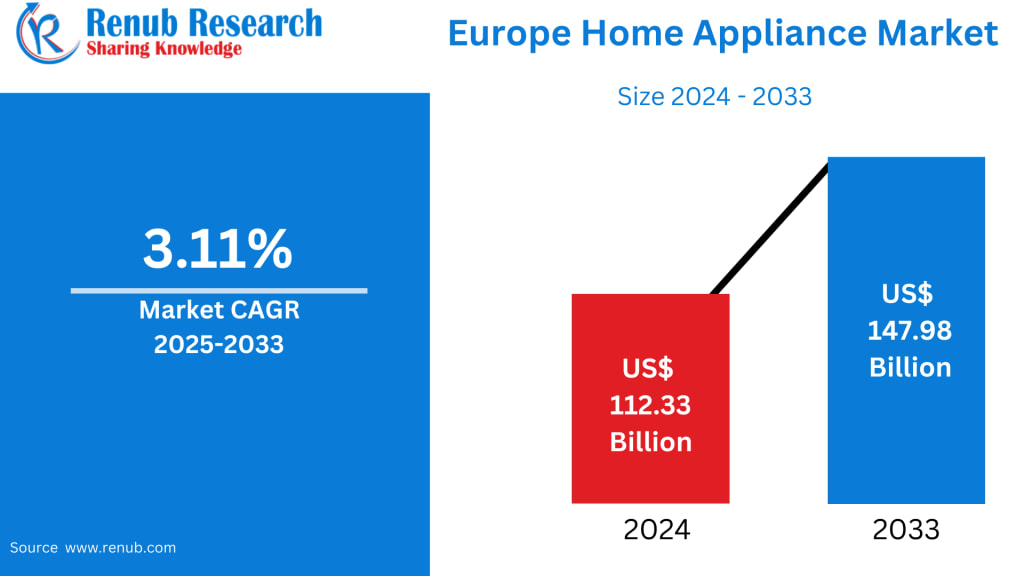
The Europe Home Appliance Market is on a steady growth trajectory, projected to increase from US$ 112.33 billion in 2024 to US$ 147.98 billion by 2033, expanding at a compound annual growth rate (CAGR) of 3.11% during 2025–2033, according to Renub Research.
This growth reflects a broader transformation underway across Europe’s consumer electronics landscape. Changing lifestyles, rising environmental awareness, technological innovation, and premiumization trends are reshaping how European households purchase and use home appliances. Consumers are no longer buying appliances solely for basic functionality; instead, they increasingly demand energy efficiency, smart connectivity, design aesthetics, and long-term sustainability.
Western European countries such as Germany, France, and the United Kingdom are witnessing particularly strong demand for premium household appliances with advanced features, while Southern and Eastern European markets continue to offer growth opportunities driven by urbanization and improving living standards.
Europe Home Appliance Industry Outlook
The European home appliance industry is expanding steadily due to a combination of energy-efficiency mandates, digital innovation, and sustainability-driven consumer behavior. European buyers are increasingly conscious of energy consumption, carbon footprints, and long-term operating costs. As a result, appliances that meet high environmental standards are gaining preference over conventional alternatives.
Smart home integration is another defining trend shaping the industry. Appliances that can be remotely monitored, controlled, and optimized through smartphones or home automation systems are becoming mainstream. Connected washing machines, smart refrigerators, intelligent ovens, and AI-enabled vacuum cleaners are increasingly common in European households.
Urbanization is also influencing product design. With shrinking living spaces in cities, especially across Western Europe, compact, multifunctional, and space-saving appliances are in high demand. Manufacturers are responding by offering modular designs that blend seamlessly into modern homes while maintaining high performance.
Additionally, the rapid expansion of e-commerce platforms has transformed the way consumers discover, compare, and purchase appliances. Online retail channels now complement traditional stores, offering wider product selections, personalized recommendations, and competitive pricing.
Strategic Focus on Innovation and Design
For manufacturers operating in Europe, product innovation and portfolio diversification have become critical competitive strategies. Companies are consistently launching appliances equipped with features such as:
Artificial intelligence (AI)–powered diagnostics
Internet of Things (IoT) connectivity
Voice assistant compatibility
Predictive maintenance alerts
Advanced energy management systems
Beyond functionality, design aesthetics play an increasingly important role. European consumers value appliances that complement contemporary interior styles. Minimalist designs, premium materials, and customizable finishes are becoming standard features, particularly in high-end product segments.
Evolution of Distribution Channels
The European home appliance market is experiencing a major shift toward omnichannel retailing. While brick-and-mortar stores remain important—especially for high-value purchases—online channels are rapidly gaining traction.
Manufacturers and retailers are investing heavily in experience-driven showrooms and flagship stores, allowing customers to interact with products before purchasing. At the same time, digital platforms provide convenience, price transparency, and access to a broader product range.
This hybrid retail approach is transforming consumer buying behavior, enabling seamless transitions between online research and offline purchasing—or vice versa.
Key Growth Drivers of the Europe Home Appliance Market
1. Rising Demand for Smart and Eco-Friendly Appliances
Europe’s home appliance market is being propelled by tech-savvy consumers and increasing internet penetration. Smart appliances that offer energy optimization, automation, and remote control are seeing strong adoption.
Manufacturers are responding with innovative products designed to maximize efficiency while reducing environmental impact. A notable example is Samsung’s Bespoke Infinite Line refrigerator, launched in January 2023, which offers customizable modules for refrigeration, freezing, and wine storage.
The hospitality sector is also contributing to demand, as hotels and restaurants increasingly invest in high-performance appliances that meet stricter hygiene and efficiency standards.
2. Urbanization and Lifestyle Changes
Urban living continues to shape appliance demand across Europe. Smaller homes and faster-paced lifestyles have increased the need for compact, time-saving, and multifunctional appliances.
Modern consumers prefer appliances that simplify daily routines, leading to increased demand for features such as:
Quick wash cycles
Delay-start functions
Flexible cooking modes
Compact integrated designs
Manufacturers are innovating accordingly, aligning product development with evolving lifestyle expectations.
3. Sustainability and Energy Efficiency as Core Priorities
Environmental awareness has become a central purchasing criterion for European consumers. Strict EU regulations on energy and water efficiency are compelling manufacturers to redesign appliances for lower consumption and improved sustainability.
Countries such as Germany, Italy, and Poland are leading innovation in energy-efficient appliance technologies. Smart energy management systems now allow consumers to track usage, reduce waste, and lower utility costs—further strengthening demand for eco-friendly products.
Challenges Facing the Europe Home Appliance Market
Competition from Low-Cost Imports
European manufacturers face growing competition from low-cost imports, particularly from regions with lower production costs. These products attract price-sensitive consumers, putting pressure on established European brands.
While European companies are known for durability, quality, and efficiency, competing solely on price remains challenging. As a result, manufacturers are increasingly differentiating themselves through premium branding, innovation, and sustainability-focused value propositions.
Rising Raw Material and Energy Costs
Fluctuating prices of metals, polymers, and energy have significantly increased manufacturing costs across Europe. These rising expenses strain profit margins and often result in higher retail prices, which may dampen demand.
Energy-intensive manufacturing processes are especially vulnerable, forcing companies to balance cost absorption with price adjustments—an ongoing challenge in a competitive market environment.
Country-Level Insights
France Home Appliance Market
France’s home appliance market is driven by strong consumer interest in energy efficiency, sustainability, and smart technology. Demand for compact, multifunctional appliances is growing, especially in urban areas.
Environmental awareness is particularly high, with consumers favoring durable, repairable, and recyclable products. However, economic pressures such as inflation may influence purchasing decisions, pushing manufacturers to enhance value through innovation and design.
United Kingdom Home Appliance Market
The UK market is undergoing a shift toward smart, connected, and eco-friendly appliances. AI and IoT integration are becoming standard features, enhancing convenience and user experience.
Smaller living spaces are driving demand for compact appliances, while government incentives promoting energy efficiency continue to influence purchasing behavior. Regulatory changes and economic uncertainty remain key factors shaping market dynamics.
Germany Home Appliance Market
Germany represents one of Europe’s most mature home appliance markets. Consumers prioritize energy efficiency, advanced technology, and sustainability, making it a strong market for premium and smart appliances.
AI-enabled and IoT-connected devices are gaining traction, supported by Germany’s robust manufacturing ecosystem and strong regulatory framework encouraging green innovation.
Spain Home Appliance Market
Spain’s home appliance sector is evolving rapidly due to technological advancements and changing consumer preferences. Demand for smart, energy-efficient appliances is increasing, particularly among urban households.
Government initiatives promoting sustainability further support market growth. However, economic challenges and regulatory requirements continue to influence consumer spending and corporate strategies.
Recent Industry Developments
May 26, 2024: Haier partnered with Roland-Garros as an official sponsor, reinforcing its global brand presence and commitment to performance, precision, and innovation.
April 25, 2024: Electrolux Group announced that CEO Jonas Samuelson will step down on January 1, 2025, prompting a leadership transition at one of Europe’s leading appliance manufacturers.
Europe Home Appliance Market Segmentation
By Product
Major Appliances
Refrigerators
Freezers
Dishwashing Machines
Washing Machines
Cookers and Ovens
Other Major Appliances
Small Appliances
Vacuum Cleaners
Food Processors
Coffee Machines
Irons
Toasters
Grills and Roasters
Other Small Appliances
By Distribution Channel
Exclusive Stores
Multi-brand Stores
Online
Other Distribution Channels
By Country
France, Germany, Italy, Spain, United Kingdom, Belgium, Netherlands, Russia, Poland, Greece, Norway, Romania, Portugal, Rest of Europe
Key Companies Covered
Arçelik A.Ş.
Robert Bosch GmbH
Electrolux AB
De’Longhi S.p.A
Liebherr Group
Miele
Koninklijke Philips
Gorenje Group
Each company is analyzed across overview, leadership, recent developments, and revenue performance.
Final Thoughts
The Europe Home Appliance Market is entering a new era defined by smart living, sustainability, and premium consumer experiences. While challenges such as cost pressures and low-cost imports persist, innovation, regulatory alignment, and evolving consumer preferences continue to create long-term growth opportunities.
With steady expansion forecast through 2033, manufacturers that prioritize energy efficiency, digital connectivity, and design excellence will be best positioned to succeed in Europe’s dynamic and increasingly sophisticated home appliance landscape.
About the Creator
Keep reading
More stories from Aaina Oberoi and writers in The Swamp and other communities.
Europe Non-Lethal Weapons Market Trends & Summary (2025–2033)
Europe Non-Lethal Weapons Market Overview The Europe Non-Lethal Weapons Market is witnessing steady expansion as governments, law enforcement agencies, and defense organizations increasingly prioritize public safety, ethical enforcement, and proportional use of force. According to Renub Research, the market is projected to grow from US$ 1,654.31 million in 2024 to US$ 2,571.37 million by 2033, registering a compound annual growth rate (CAGR) of 5.02% from 2025 to 2033.
By Aaina Oberoi24 days ago in The Swamp
Berlin Suspects ‘Leftwing Extremists’ of Causing Huge Power Outage
Berlin authorities are investigating whether leftwing extremist groups were responsible for a major power outage that plunged large parts of the German capital into darkness, disrupting transport networks, businesses, and essential services. The incident has raised serious concerns about the vulnerability of critical infrastructure and has sparked renewed debate over political extremism and domestic security in Germany. The outage, which occurred suddenly and without warning, affected thousands of households and commercial districts, temporarily halting public transport and forcing emergency services to activate contingency plans. While electricity was gradually restored, officials say the scale and nature of the disruption point to possible deliberate sabotage rather than a technical fault. What Happened During the Blackout The power outage struck parts of Berlin during peak hours, cutting electricity to residential areas, offices, traffic systems, and sections of the city’s rail network. Subway lines were suspended, traffic lights went dark at busy intersections, and shops and offices were forced to close early. Hospitals and critical facilities switched to backup generators, preventing major medical emergencies, but authorities acknowledged that the situation could have been far worse if the outage had lasted longer. Residents described scenes of confusion as commuters were stranded and mobile phone networks became overloaded. While power was restored within hours, the disruption left the city shaken and searching for answers. Suspicion of Deliberate Sabotage Berlin police and security agencies quickly ruled out routine equipment failure after initial assessments. Investigators discovered signs suggesting intentional damage to power infrastructure, prompting officials to consider sabotage as a leading possibility. City authorities later confirmed that they suspect leftwing extremist groups may be behind the incident. Germany has a history of radical activist movements targeting infrastructure to protest capitalism, energy policy, housing shortages, and state authority. “These acts go far beyond protest,” a senior security official said. “If confirmed, this would represent a serious criminal attack on public infrastructure with potentially dangerous consequences.” No group has yet claimed responsibility, and the investigation remains ongoing. Why Leftwing Extremists Are Under Scrutiny Germany’s domestic intelligence agency has long monitored leftwing extremist networks, particularly in cities like Berlin, Hamburg, and Leipzig. These groups often oppose private energy companies, large corporations, and government policies, sometimes advocating direct action rather than peaceful protest. In the past, such groups have been linked to: Sabotage of construction projects Attacks on corporate property Disruption of transport and logistics While most leftwing activism in Germany is non-violent, authorities warn that small radical factions are increasingly willing to engage in criminal acts to attract attention to their causes. Officials stress that the investigation does not target lawful protest movements but focuses on individuals or groups suspected of engaging in illegal and dangerous actions. Impact on the City The blackout caused significant economic and social disruption. Businesses reported financial losses due to forced closures, while transport delays rippled across the city for hours. Tourists and residents alike were affected, particularly in central districts. Public trust was also shaken. Berliners are accustomed to protests and political demonstrations, but a citywide power outage triggered fears about security and preparedness. Urban planners and security experts say the incident highlights how modern cities are deeply dependent on fragile infrastructure, where even a single point of failure — intentional or accidental — can have widespread consequences. Political Reactions and Public Debate The suspected sabotage has triggered sharp reactions across Germany’s political spectrum. Government officials condemned any attack on public infrastructure, warning that such actions endanger lives and undermine democratic society. Conservative politicians called for stronger surveillance and tougher penalties for extremist crimes, while left-leaning parties cautioned against broad accusations that could stigmatize peaceful activists. Civil liberties groups emphasized the importance of distinguishing between legitimate protest and criminal extremism, warning that overreach could harm democratic freedoms. Despite differing views, there is broad consensus that sabotaging power systems crosses a clear line and cannot be justified as political expression. Security and Infrastructure Concerns The outage has renewed concerns about the security of Germany’s energy networks. Experts note that while cyberattacks often dominate headlines, physical sabotage remains a serious and sometimes underestimated threat. Energy providers and city authorities are now reviewing security protocols, including: Physical protection of substations Surveillance and monitoring systems Rapid response coordination between police and utility companies Germany, like many European countries, is under pressure to modernize infrastructure while also defending it against both physical and digital threats. A Broader European Context The Berlin incident comes amid growing anxiety across Europe about attacks on critical infrastructure. In recent years, authorities have reported attempted sabotage of rail lines, communication cables, and energy facilities in several countries. Security analysts say rising political polarization, climate activism, and economic pressures have contributed to a more volatile protest landscape. While most activists reject violence, authorities warn that extremist fringes on both the left and right are becoming more confrontational. Berlin’s case is now being closely watched by other European capitals as a test of preparedness and response. Investigation Ongoing Police have launched a wide-ranging investigation involving forensic analysis, surveillance footage, and intelligence cooperation. Officials say arrests are possible but caution that identifying suspects in infrastructure sabotage cases can take time. Authorities have urged the public not to speculate or spread misinformation while the investigation continues. They also reassured residents that there is no immediate threat of further outages, though security remains heightened. Conclusion The massive power outage in Berlin has exposed the vulnerability of urban infrastructure and reignited debate over political extremism and public safety. While investigators have yet to confirm responsibility, the suspicion of leftwing extremist involvement has raised serious questions about how far radical activism may be willing to go. As Berlin returns to normal, the incident serves as a stark reminder: in an interconnected city, attacks on infrastructure are not symbolic acts — they have real consequences for millions of people. The outcome of the investigation will likely shape future security policy and how Germany balances civil protest with the protection of essential public services.
By Muhammad Hassan7 days ago in The Swamp
'20/20'
"Do It Again" the track that would ultimately open the Beach Boys final album on Capitol Records which was released on February 10th 1969 had originally been released as a single in August of 1968. The track was the first of many post-Pet Sounds era throwbacks to the early Beach Boys sound which would become continually more cliched and eventually lead the Beach Boys to the level of self-parody they would eventually succumb to in the 1980s while their closest contemporaries The Beatles nearing the end of their run in 1969 would go on to be viewed as the most influential band of all time. However, the song itself is not bad on its surface, and it opens with a futuristic sounding (for 1969) drumbeat captured by then-Beach Boys engineer Stephen Desper using tape delays on the drums performed by Dennis Wilson and John Guerin. The song has been re-recorded numerous times over the years on various Beach Boys-related projects most notably the 2011 re-recording at Capitol studios featuring the five surviving Beach Boys at the time backed instrumentally by various members of both the Brian Wilson Band and Mike Loves touring "Beach Boys" to promote the then upcoming Beach Boys 50th Anniversary reunion tour in 2012. The hammering and power drill sound at the end of the song was an excerpt from a track called "Workshop" that was to be a part of the uncompleted "SMiLE" album.
By Sean Callaghan6 days ago in Beat


Comments
There are no comments for this story
Be the first to respond and start the conversation.