
Europe Biodiesel Market Trends & Summary
Rising Renewable Momentum: How Europe’s Biodiesel Sector Is Powering the Continent’s Clean Energy Future


The Europe biodiesel market is entering a decisive phase in the continent’s transition toward cleaner energy systems. According to Renub Research, the market is projected to reach US$ 18.72 billion by 2033, rising from US$ 11.44 billion in 2024, expanding at a notable CAGR of 5.62% between 2025 and 2033. This steady growth reflects Europe’s persistent focus on reducing greenhouse gas emissions, boosting renewable energy adoption, and meeting ambitious long-term sustainability targets.
As policymakers, industries, and consumers align more closely with climate goals, biodiesel has become a central element in reshaping Europe’s transportation, power generation, and industrial sectors. Produced through transesterification of vegetable oils, animal fats, and used cooking oils, biodiesel—known chemically as fatty acid methyl esters (FAME)—has become one of Europe’s most trusted renewable fuels. Whether used as pure B100 or blended fuels like B7 and B20, biodiesel helps lower emissions without requiring extensive modifications to existing diesel engines.
This report explores how biodiesel is reshaping Europe’s energy future through technological innovation, policy support, evolving market drivers, and regional developments.
Europe Biodiesel Market Outlook
Biodiesel plays a foundational role in Europe’s clean energy strategy, driven largely by the Renewable Energy Directive (RED II). This directive mandates that at least 14% of transportation energy must come from renewable sources by 2030—a target that significantly enhances biodiesel adoption.
Beyond transportation, biodiesel is also being used across heating systems, industrial machinery, agriculture, and backup power generation. Its ability to integrate seamlessly into existing diesel infrastructure gives it a strong competitive edge over other emerging renewable fuels.
Moreover, Europe’s agricultural sector is deeply connected to biodiesel production. Crops like rapeseed, a leading biodiesel feedstock, help sustain farming communities by creating stable demand. This dynamic strengthens Europe’s broader commitment to energy independence and circular economy principles.
Key Growth Drivers in the Europe Biodiesel Market
1. Renewable Energy Mandates Accelerating Adoption
Europe’s regulatory environment is one of the strongest global catalysts for biodiesel market expansion. Under RED II and related national frameworks, EU member states are compelled to integrate renewable fuels into the transportation mix.
By demanding lower emissions and setting binding targets, these policies:
Stimulate demand for biodiesel in both public and private transport fleets
Encourage investment in large-scale biodiesel refineries
Support advanced waste-based feedstock development
Attract new market entrants and technology innovators
Biodiesel’s role in helping Europe meet its climate-neutral ambition for 2050 cannot be overstated. Its immediate compatibility with diesel engines makes it a practical, fast-deployment solution.
2. Technological Advancements Supporting Efficiency and Sustainability
Europe’s biodiesel industry has made remarkable strides in refining and feedstock technology. Production processes have become more cost-effective and environmentally efficient, expanding biodiesel’s market potential.
A standout example is the October 2024 milestone by Argent Energy, which launched Europe’s largest facility for biobased, technical-grade glycerin at the Port of Amsterdam. By upgrading crude glycerin into 99.7% pure technical-grade material, the plant exemplifies how biodiesel by-products are being transformed into high-value commodities.
Innovation is also happening in:
Enzymatic transesterification
Advanced waste oil collection systems
Multi-feedstock refining technologies
Carbon footprint optimization tools
These advancements help lower production costs while increasing scalability and environmental performance.
3. Growing Sustainability Priorities Across Europe
Europe’s sustainability agenda is intensifying across every sector—from transportation to agriculture, manufacturing, logistics, and utilities. Biodiesel supports this transition by significantly cutting carbon emissions compared to fossil diesel.
The EU aims for renewable energy to make up at least 32% of total energy consumption by 2030, with biodiesel acting as a significant contributor. This shift enhances:
Green job creation
Sustainable farming practices
Recycling of waste oils and fats
Reduction of Europe’s fossil fuel dependency
As corporations and municipalities pledge deeper sustainability goals, biodiesel remains one of their most accessible green fuel options.
Challenges Facing the Europe Biodiesel Market
1. Supply Chain Limitations and Feedstock Constraints
One of the most significant challenges concerns the availability of feedstocks such as:
Rapeseed oil
Soybean oil
Palm oil (in limited volumes under EU sustainability rules)
Animal fats
Recycled cooking oil
Agricultural variability, climate impacts, and competing industries—such as food processing and oleochemicals—create uncertainty in feedstock supply and cost. As demand surges, Europe’s producers must navigate material shortages and sourcing issues, especially for waste-based oils, which are environmentally preferred but geographically limited.
2. Cost Competitiveness Against Diesel and Other Renewables
Biodiesel generally remains more expensive to produce than fossil diesel, primarily due to feedstock costs. While government incentives and carbon pricing help close the gap, price competitiveness continues to be a hurdle for broader adoption.
Adding to the challenge is rising competition from alternative low-carbon fuels such as:
Hydrogen (green and blue)
Renewable diesel (HVO)
Synthetic e-fuels
Biomethane
As these technologies evolve, biodiesel producers must reinforce their relevance through innovation, waste-based feedstocks, and economies of scale.
Market by Application
European Biodiesel Fuel Market
Transportation continues to be the largest consumer of biodiesel. As Europe intensifies its emissions reduction strategies for passenger cars, commercial fleets, freight transport, and public mobility, demand for biodiesel fuel blends remains strong.
Biodiesel’s compatibility with existing engines offers a distinct advantage, especially in sectors where electric or hydrogen solutions are not immediately viable.
European Biodiesel Power Generation Market
Biodiesel is gaining momentum as a cleaner alternative for electricity generation. It plays a crucial role in:
Backup generators
Remote power solutions
Grid stabilization operations
Off-grid industrial applications
As Europe moves toward decarbonizing its electricity networks, biodiesel-powered generation systems offer an efficient transitional solution.
European Vegetable Oil Biodiesel Market
Vegetable oils—particularly rapeseed oil—dominate the region’s biodiesel feedstock landscape. Europe’s emphasis on sustainability has led to increased investment in locally sourced vegetable oils, reducing dependency on imported materials and enhancing overall supply chain stability.
Utilizing vegetable oils derived from sustainable farming practices also strengthens Europe’s broader environmental commitments.
Country-Level Market Insights
United Kingdom
The UK biodiesel market is expanding steadily as public awareness of climate strategies grows. Government policies promoting alternative fuels and decarbonization bolster demand across transport and industry. Businesses are increasingly shifting toward biodiesel as part of environmental compliance and corporate responsibility initiatives.
Germany
As Europe’s largest biodiesel producer, Germany sets the pace in technology adoption, regulatory integration, and sustainability initiatives. Its rigorous standards and strong industrial capabilities make it a central hub for large-scale biodiesel production and innovation across the EU.
France
Driven by aggressive carbon-reduction goals and strong government incentives, France is experiencing rapid biodiesel growth. The transportation, agriculture, and manufacturing sectors increasingly turn to biodiesel as a cost-effective way to meet environmental benchmarks.
Spain
Spain’s biodiesel market is strengthening as the nation prioritizes diversification of its energy sources. By reducing reliance on imported fossil fuels and increasing investment in renewables, Spain positions biodiesel as an essential pillar of its clean energy mix.
Italy
Italy’s market is on an upward trajectory as the country intensifies efforts to reduce emissions within transport networks. Public awareness and industrial adoption of biodiesel are growing, helping the nation progress toward EU carbon-neutrality objectives.
Market Segmentation
By Application
Fuel
Power Generation
Others
By Feedstock
Vegetable Oil
Animal Fats
By Country
France
Germany
Italy
Spain
United Kingdom
Belgium
Netherlands
Turkey
Rest of Europe
Key Players Covered (Overview, Recent Developments, Revenue Analysis)
Archer Daniels Midland Company
Future Fuel
Neste
Renewable Energy Group, Inc.
Bunge Global SA
Wilmar
Shell
These companies are advancing Europe’s biodiesel sector through expansion initiatives, new refining technologies, sustainability commitments, and vertical integration in the supply chain.
Final Thoughts
Europe’s biodiesel market is at an inflection point—where climate urgency, technological innovation, and regulatory pressure intersect to accelerate adoption. As the region transitions toward cleaner mobility and industrial operations, biodiesel stands as one of the most scalable and pragmatic renewable fuel solutions available today.
With strong government support, rising sustainability expectations, and continuous technological improvements, the market is well-positioned to grow steadily through 2033. Whether powering vehicles, supporting renewable electricity, or strengthening agricultural economies, biodiesel’s role in Europe’s green energy future is undeniable.
About the Creator
Renub Research
Renub Research is a Market Research and Consulting Company. We have more than 15 years of experience especially in international Business-to-Business Researches, Surveys and Consulting. Call Us : +1-478-202-3244
Keep reading
More stories from Renub Research and writers in The Swamp and other communities.
India Biodiesel Market Trends & Summary
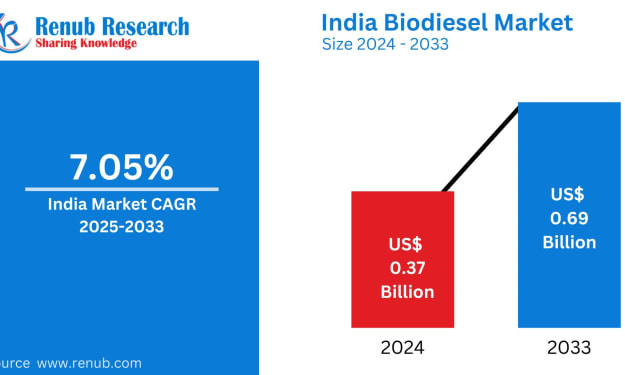
The India biodiesel market stands at a pivotal moment, driven by the nation’s urgent need to cut carbon emissions, strengthen its energy independence, and adopt cleaner fuel alternatives. According to Renub Research, the India biodiesel market is set to reach US$ 0.69 billion by 2033, up from US$ 0.37 billion in 2024, growing at a CAGR of 7.05% from 2025 to 2033. This strong outlook reflects India’s broad-based shift toward renewable energy and sustainable industrial practices.
By Renub Researchabout a month ago in The Swamp
“We hope they will give us heat”: Bitter winter cold bites for Kyiv’s residents as Russia steps up attacks
Winter in Kyiv has never been kind, but this season carries a sharper edge. As icy winds sweep through the streets and snow settles on damaged rooftops, the cold is no longer just a feature of the weather—it is a constant reminder of a war that shows no sign of easing. With Russia stepping up attacks on critical infrastructure, Kyiv’s residents are enduring long power outages, unreliable heating, and an exhausting routine of adaptation and survival.
By Aqib Hussain2 days ago in The Swamp



Comments
There are no comments for this story
Be the first to respond and start the conversation.