
EU-UK Summit, 19 May 2025: A Reset Moment in a Post-Brexit World
Why the 2025 EU-UK Summit Matters

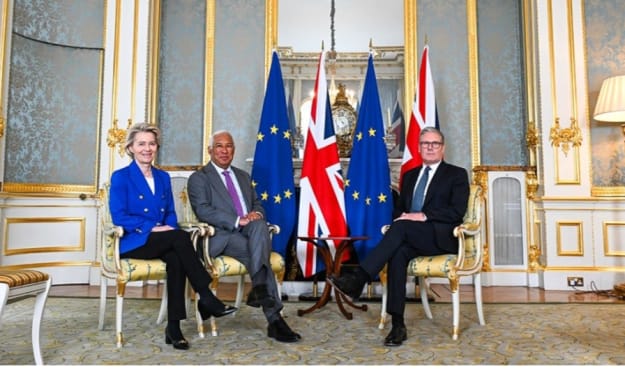
The EU-UK summit held on 19 May 2025 marked one of the most significant diplomatic encounters between Brussels and London since Brexit officially reshaped their relationship. Nearly a decade after the referendum, both sides arrived at the table with a shared understanding: cooperation, not confrontation, is now essential in an increasingly unstable global environment.
While the summit did not reverse Brexit, it symbolized a clear effort to reset relations, focusing on practical collaboration rather than ideological division. From trade and security to climate policy and mobility, the meeting reflected how deeply intertwined the EU and the UK remain—despite political separation.
A Changing Political and Global Context
The summit took place against a backdrop of global uncertainty. Ongoing conflicts, economic volatility, energy insecurity, and shifting alliances have forced European leaders to rethink strategic priorities. For the UK, operating outside the EU has brought both autonomy and new challenges. For the EU, maintaining stability on its borders has become a central concern.
By 2025, the tone surrounding Brexit had noticeably softened. The emphasis had moved away from blame and toward damage control, cooperation, and future-proofing. The summit reflected a mutual recognition that continued friction benefits neither side.
Trade Relations: From Friction to Fine-Tuning
Trade was a central topic at the EU-UK summit. Since Brexit, businesses on both sides have faced increased bureaucracy, border delays, and regulatory divergence. While the Trade and Cooperation Agreement (TCA) provided a foundation, gaps and inefficiencies have persisted.
At the summit, leaders discussed streamlining customs processes, improving regulatory cooperation, and addressing sector-specific challenges—particularly in agriculture, pharmaceuticals, and financial services. Though no sweeping trade overhaul was announced, incremental improvements were framed as realistic and necessary.
The message was clear: smoother trade is not about political symbolism, but about protecting jobs, supply chains, and economic resilience.
Security and Defense Cooperation
One of the most notable outcomes of the EU-UK summit was renewed emphasis on security and defense cooperation. With geopolitical tensions rising globally, both sides acknowledged that shared intelligence, coordinated sanctions, and joint defense initiatives are more important than ever.
The UK, despite leaving the EU, remains a major military and intelligence power in Europe. Discussions focused on strengthening collaboration through NATO, enhancing cyber security cooperation, and improving crisis response mechanisms.
This area revealed how Brexit has not erased shared threats—or shared responsibilities.
Migration and Mobility: A Sensitive Balance
Migration remained a sensitive but unavoidable topic. The UK’s post-Brexit immigration policies have tightened controls, while the EU continues to manage internal movement and external borders. At the summit, leaders explored limited mobility frameworks aimed at students, researchers, and young professionals.
While full freedom of movement is politically off the table, both sides acknowledged the value of people-to-people connections. Expanding academic exchanges, cultural programs, and short-term work opportunities were discussed as ways to rebuild trust without reopening old political wounds.
Climate and Energy Cooperation
Climate policy emerged as one of the most constructive areas of agreement. Both the EU and the UK have committed to ambitious net-zero targets and recognize that climate change does not respect borders.
The summit highlighted cooperation on renewable energy, emissions trading alignment, and energy security—particularly in response to global supply shocks. Joint investment in offshore wind, green hydrogen, and cross-border energy infrastructure was presented as mutually beneficial.
Here, the EU-UK relationship looked less like rivals and more like partners facing a shared existential challenge.
Northern Ireland and Regulatory Stability
Northern Ireland remained a quiet but critical element of the discussions. While previous years were dominated by disputes over the Northern Ireland Protocol and later frameworks, the 2025 summit reflected cautious optimism.
Leaders emphasized maintaining stability, protecting the Good Friday Agreement, and ensuring predictable regulatory arrangements. Though not headline-grabbing, this steady tone suggested that both sides are invested in preventing Northern Ireland from becoming a recurring flashpoint.
Political Signals and Public Perception
Beyond policy outcomes, the summit carried symbolic weight. The choice to hold a high-level EU-UK meeting signaled political maturity and a willingness to move forward. For many citizens, Brexit fatigue has replaced Brexit fervor.
Public opinion across Europe increasingly favors practical cooperation over ideological rigidity. The summit tapped into this sentiment, presenting collaboration as a necessity rather than a concession.
What the Summit Did Not Do
Importantly, the EU-UK summit did not promise dramatic breakthroughs. There was no return to the single market, no customs union, and no attempt to rewrite Brexit history. Instead, the focus was pragmatic: improve what exists, reduce friction, and keep dialogue open.
This realism may be its greatest strength.
Conclusion: A Relationship Redefined, Not Reversed
The EU-UK summit of 19 May 2025 did not undo Brexit—but it did redefine how both sides choose to live with it. The meeting marked a shift from confrontation to coordination, acknowledging that separation does not eliminate interdependence.
In a world shaped by uncertainty, cooperation has become a strategic necessity. The summit demonstrated that while the EU and the UK now walk separate political paths, they remain bound by geography, history, and shared challenges.
If sustained, this renewed engagement could turn a painful rupture into a functional partnership—one focused less on the past, and more on navigating the future together.
About the Creator
Keep reading
More stories from Aarif Lashari and writers in The Swamp and other communities.
EU-UK Summit, 19 May 2025: A Reset Moment in a Post-Brexit World
The EU-UK summit held on 19 May 2025 marked one of the most significant diplomatic encounters between Brussels and London since Brexit officially reshaped their relationship. Nearly a decade after the referendum, both sides arrived at the table with a shared understanding: cooperation, not confrontation, is now essential in an increasingly unstable global environment.
By Aarif Lashari2 months ago in The Swamp
The Forsyth House Fire
Since 1851, Forsyth House has stood on the corner of Union Street and Gordon Street in the heart of Glasgow. Its iconic, or was... because on Sunday 8th of March, 2026, a fire broke out in a small, seemingly un-named shop in the building and tore all that history down. As I write, the rubble is still unsettled and the street is still blocked off. Central Station is quiet on the upper level, and around 30 small businesses have quite literally gone up in smoke.
By S. A. Crawford3 days ago in The Swamp


Comments
There are no comments for this story
Be the first to respond and start the conversation.