
Donald Trump’s 3 Most Dangerous International Deals — And Why They Still Matter in 2025
These deals didn’t just shake global politics—they’re still echoing today.
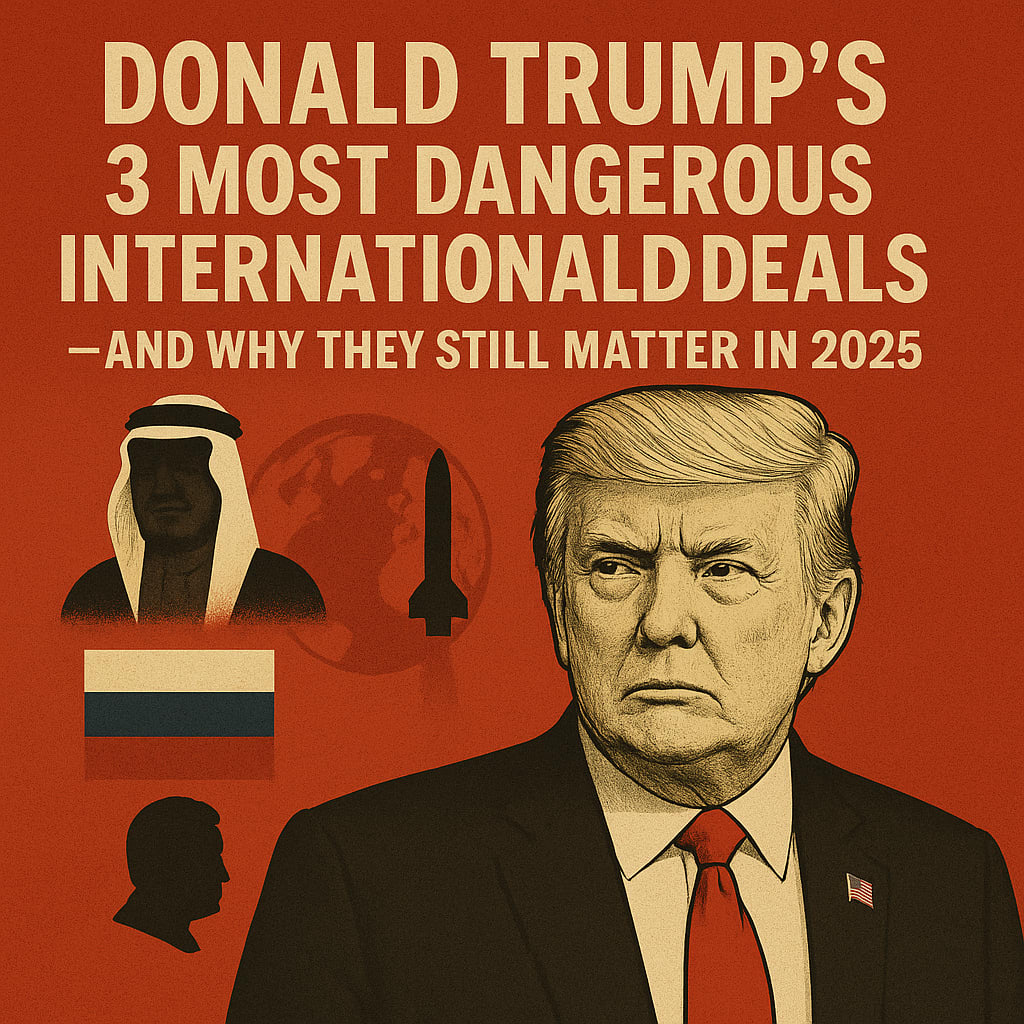
Love him or hate him, one thing is certain: Donald Trump changed the rules of international diplomacy. As the 45th President of the United States, Trump didn’t just tear up old agreements—he forged new ones that stunned allies, emboldened adversaries, and rewrote America’s role on the global stage.
Now, in 2025, with Trump dominating headlines yet again, it's worth revisiting three of the most controversial—and arguably dangerous—international deals he made. These weren’t just bold moves. They were seismic shifts with ripple effects still being felt in today's geopolitics.
Let’s break down the top three.
1. 🇸🇦 The Saudi Arms Deal: Billions for Bombs — and Silence
The Deal:
In 2017, Trump announced a jaw-dropping $110 billion arms deal with Saudi Arabia, calling it the “largest arms deal in history.” Over the following years, U.S. arms shipments to the kingdom surged, including precision-guided munitions, tanks, and fighter jets.
Why It Was Dangerous:
This deal came at a time when Saudi Arabia was intensifying its military campaign in Yemen—a conflict the United Nations described as the world’s worst humanitarian crisis. American weapons were being used in airstrikes that killed civilians, bombed hospitals, and displaced millions.
Trump, however, defended the deal by citing economic benefits and job creation. “They’re spending $400 billion in our country. I don’t want to lose all of that investment,” he said, shrugging off concerns over Saudi Arabia's human rights abuses.
Why It Still Matters in 2025:
The U.S.-Saudi relationship remains a geopolitical tightrope. While the Biden and subsequent administrations have scaled back support, many of those weapons deals are still active. More importantly, the Trump-era normalization of “business-first” diplomacy gave authoritarian regimes a green light:
If the price is right, ethics don’t matter.
The echoes of that mindset are visible today as new arms contracts—with countries like Egypt, India, and Turkey—are being scrutinized under public pressure. Trump’s Saudi deal set a dangerous precedent that profit trumps peace.
2. 🇰🇵 The North Korea “Love Letters” Diplomacy: Symbolism Over Substance
The Deal:
In a move that shocked the world, Donald Trump became the first sitting U.S. president to meet with North Korea’s Kim Jong-un. Over several summits between 2018 and 2019, the two exchanged praise, flattery, and even “love letters,” as Trump himself described them.
Trump agreed to suspend joint military exercises with South Korea in exchange for vague promises of denuclearization. No verifiable steps were taken by North Korea to dismantle its arsenal.
Why It Was Dangerous:
Trump's personal diplomacy with a brutal dictator was unprecedented. Critics warned that legitimizing Kim without securing enforceable concessions was a gift to the regime.
And they were right.
In the years following the summits, North Korea expanded its missile capabilities, tested new weapons, and walked away from negotiations without consequence. Trump’s embrace gave Kim global stature—without making the world any safer.
Why It Still Matters in 2025:
North Korea remains a nuclear-armed powder keg. Satellite intelligence in early 2025 shows that Pyongyang is close to developing submarine-launched ballistic missiles—an escalation that could threaten U.S. territories and allies across the Pacific.
Meanwhile, the Trump-Kim era remains a case study in how charismatic diplomacy without enforcement mechanisms can backfire. Today’s world leaders are more cautious, but the precedent stands:
A photo op can overshadow policy.
3. 🇷🇺 The Helsinki Summit: Trusting Putin Over U.S. Intelligence
The Deal (Or Lack Thereof):
In July 2018, Trump stood beside Russian President Vladimir Putin at a press conference in Helsinki and publicly sided with Putin over his own intelligence agencies regarding Russian interference in the 2016 U.S. election.
“I don’t see any reason why it would be [Russia],” Trump said, despite overwhelming evidence from the CIA, FBI, and NSA.
Why It Was Dangerous:
Trump’s comments shocked lawmakers across the political spectrum. Former CIA Director John Brennan called it “nothing short of treasonous.” It sent a chilling message: America’s national security apparatus could be publicly undermined—by its own president.
Trump’s cozy relationship with Putin didn’t result in formal treaties, but his rhetoric weakened alliances and emboldened autocrats. The lack of pushback on cyberattacks, human rights abuses, and election interference signaled weakness, not strength.
Why It Still Matters in 2025:
Cyberwarfare is now the frontline of modern conflict. In the 2024 U.S. election, intelligence agencies detected coordinated disinformation campaigns tied to Russian bots, echoing the 2016 playbook. Some watchdogs argue that Trump’s normalization of Russian influence left democratic systems more vulnerable.
Additionally, former U.S. allies—particularly in Europe—remain skeptical of American loyalty. NATO cohesion is still recovering from the Trump years, where he threatened to withdraw support entirely unless member states “paid their fair share.”
Today’s world leaders must now constantly reassure global partners that American foreign policy is stable—a trust Trump helped fracture.
The Trump Doctrine: Transactional and Tactical
Trump's international “deals” weren’t always formal treaties. Instead, they reflected a broader philosophy—foreign policy as a business transaction. Loyalty was tied to money. Morality was optional. Long-term strategy was often sacrificed for media optics and political wins.
He negotiated with autocrats like Kim Jong-un and Vladimir Putin while alienating long-time allies in Canada, Germany, and France. He imposed tariffs on friends and embraced foes. And while some saw it as bold, others saw it as dangerous chaos in a world already on edge.
Why It All Still Matters Today
Even though Trump left office in 2021, and a new political chapter is unfolding in 2025, his international decisions continue to shape the playing field. Here's how:
New Leaders Must Manage His Fallout: From weapons deals still in motion to alliances that need rebuilding, global diplomats are still cleaning up.
Precedents Are Hard to Undo: Trump's deals normalized behaviors that future leaders—both in the U.S. and abroad—might mimic.
He Might Return: With Trump signaling another presidential run or continued political influence, many are bracing for a second wave of “America First” diplomacy.
Final Thought: Dangerous or Just Different?
To his supporters, Trump was the first president in decades to challenge the status quo, confront allies on trade, and “keep enemies guessing.”
To critics, he was reckless, transactional, and dangerously indifferent to human rights, global security, and democratic norms.
But love him or loathe him, one fact is unavoidable:
Donald Trump's international deals didn’t stay in the past—they’re shaping our future.
And as the world inches deeper into an era of digital warfare, authoritarian resurgence, and economic uncertainty, the legacy of those deals may be more relevant—and more dangerous—than ever before.
About the Creator
White House Weighs Executive Action to Cap Credit Card Rates
The White House is reportedly considering executive action to impose a cap on credit card interest rates, a move that could significantly impact millions of Americans grappling with rising debt. With household credit card balances climbing and interest rates at multi-decade highs, the potential policy has sparked debate among economists, consumer advocates, and the financial industry. The decision, if implemented, would be one of the most direct interventions by the federal government into consumer credit markets in decades. Rising Credit Card Debt in America Credit card debt has surged in the United States, fueled by post-pandemic spending, inflation, and rising interest rates. According to recent reports, U.S. consumers carry over $1 trillion in outstanding credit card balances, with average interest rates hovering around 20% or higher. For many households, high-interest debt has become a cycle that is increasingly difficult to escape. The White House’s contemplation of a federal cap on these rates reflects growing concern about consumer financial stress. Advocates argue that without intervention, millions of Americans may face long-term financial instability, risking defaults and broader economic consequences. What the Executive Action Might Entail While details are still emerging, an executive action could allow the federal government to directly limit the interest rates charged on credit cards without requiring new legislation from Congress. Historically, credit card interest rates have been regulated at the state level, with federal law largely leaving them to market forces. Potential provisions of such an executive action could include: Maximum APR (Annual Percentage Rate) Limits: A fixed ceiling on the interest rate credit card companies can charge. Protection for Vulnerable Consumers: Specific safeguards for households carrying high balances or at risk of default. Transparency Requirements: Ensuring credit card terms and fees are clearly disclosed to consumers. The action may be temporary or structured to last until Congress enacts more permanent legislation addressing consumer credit. Supporters’ Perspective Consumer advocacy groups and some Democratic lawmakers have welcomed the idea of a rate cap. They argue that excessive interest rates exacerbate inequality and disproportionately affect lower- and middle-income households. “Credit cards should not be traps that keep hardworking Americans in debt,” says Angela Martinez, director of a consumer rights nonprofit. “A rate cap can provide immediate relief, giving families breathing room to pay down balances and regain financial stability.” Supporters also contend that such an intervention could prevent predatory practices by certain lenders and protect the broader economy from potential debt crises caused by widespread defaults. Critics’ Concerns Financial institutions and some economists warn that capping rates could have unintended consequences. Banks may respond by: Reducing Credit Access: Higher-risk consumers might find it harder to obtain credit if lenders can’t price risk appropriately. Increasing Fees: Banks could compensate for lost interest income through higher fees or other charges. Impacting Lending Behavior: Credit card issuers may tighten credit limits, change terms, or reduce incentives like rewards programs. Economist Kevin Anderson notes, “While a rate cap helps existing cardholders, it could reduce access to credit for consumers who need it most. The challenge is finding a balance between affordability and maintaining a healthy credit market.” Historical Context Interest rate caps are not a new concept in the United States. During the 1980s and 1990s, several states imposed limits on credit card interest rates, but federal law eventually allowed national banks to preempt state caps, creating today’s largely market-driven system. Previous efforts at limiting rates at the federal level have been controversial, with debates centered on consumer protection versus market efficiency. The current economic environment—high inflation and rising consumer debt—has reignited discussions about the need for intervention. Potential Economic Impact Implementing a federal rate cap could have wide-ranging effects: Immediate Consumer Relief: For households carrying high-interest debt, even a small reduction in rates could free up monthly cash flow for other expenses or debt repayment. Market Adjustments: Banks may revise lending practices, potentially affecting the broader credit market and interest rates on other loan products. Behavioral Changes: Consumers may adjust borrowing habits, potentially reducing reliance on credit cards and seeking alternative financing. Financial analysts caution that the effectiveness of such a policy depends on the specific structure of the cap and accompanying measures to ensure continued access to credit. Political Implications The move to cap credit card rates reflects a broader political focus on economic fairness and consumer protection. For the administration, it signals a commitment to addressing everyday financial challenges faced by Americans, particularly in the context of rising inflation and living costs. However, any executive action is likely to face legal challenges from financial institutions and industry groups arguing that such a cap exceeds presidential authority or conflicts with federal banking laws. The outcome could shape debates on executive power and the limits of regulatory intervention in financial markets. What Consumers Should Know For consumers, the news of a potential rate cap offers hope but also underscores the importance of personal financial management. Experts advise: Pay Down High-Interest Debt: Reducing balances remains the most effective way to limit interest costs. Shop for Lower-Rate Cards: Comparing credit card offers can help minimize interest payments. Budget Carefully: Managing monthly expenses and avoiding new high-interest debt remains critical, regardless of policy changes. Even with a federal cap, personal financial decisions will continue to determine long-term stability. Conclusion The White House’s consideration of an executive action to cap credit card interest rates highlights the ongoing struggle between consumer protection and market dynamics. For millions of Americans carrying high-interest debt, the proposal could offer much-needed relief. At the same time, the move introduces uncertainty for banks, lenders, and the broader credit market. Legal, economic, and political factors will all play a role in shaping the final outcome. Ultimately, whether the policy is enacted or challenged, the discussion underscores a central issue: ensuring that credit is both accessible and affordable for all Americans. As the administration weighs its options, households, financial institutions, and lawmakers will watch closely, knowing that the decisions made today could have lasting effects on consumer finances for years to come.
By Muhammad Hassan3 days ago in The Swamp



Comments
There are no comments for this story
Be the first to respond and start the conversation.