
Cuban Protesters Ransack Communist Office as Energy Crisis Deepens
Public anger erupts as prolonged blackouts and fuel shortages push Cuban communities to the brink. Mounting power outages and economic hardship spark rare unrest against the ruling government. Frustration over electricity shortages and rising living costs fuels protests across the island. Energy shortages trigger demonstrations as residents demand solutions to daily blackouts. Growing economic strain and failing power infrastructure ignite tensions in Cuba.

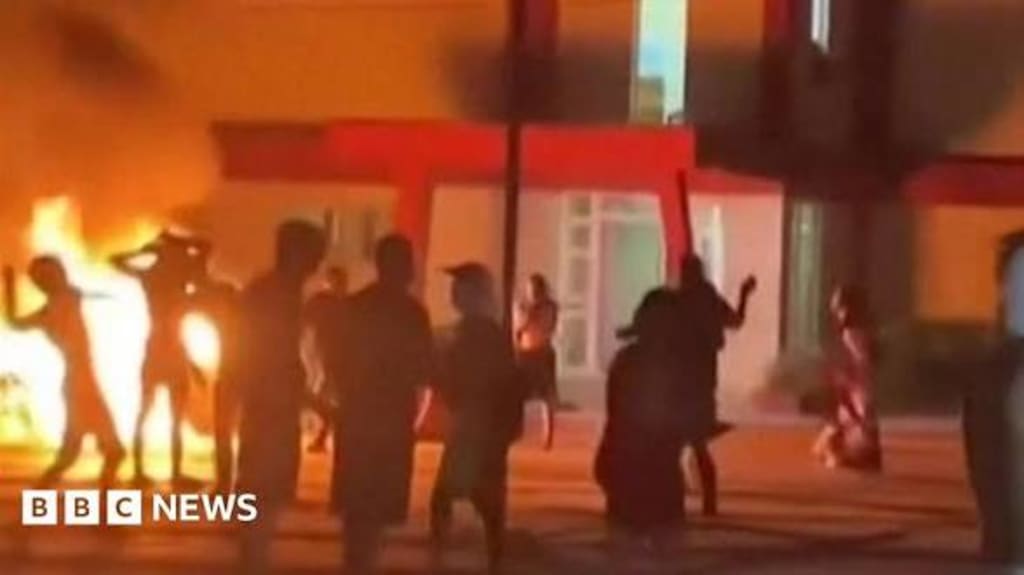
Frustration over worsening power shortages erupted into violence in parts of Cuba this week after demonstrators stormed and ransacked a local office belonging to the ruling Communist Party of Cuba. The incident reflects rising anger among ordinary Cubans struggling with long electricity outages, dwindling fuel supplies, and an economy under intense strain.
According to witnesses and local reports, a group of protesters gathered outside the party building in a provincial town late in the evening after yet another day of prolonged blackouts. What began as a demonstration demanding reliable electricity and government accountability quickly escalated as some participants forced their way into the building, overturning furniture, smashing windows, and damaging official equipment.
Authorities later deployed police to restore order and secure the building. While officials did not immediately release details about arrests or injuries, government sources confirmed that an investigation into the incident was underway.
The unrest comes amid one of the most severe energy shortages the island has faced in years. Cuba’s fragile power grid has been struggling with aging infrastructure, limited fuel imports, and mounting economic pressure. In recent months, blackouts lasting several hours at a time have become a daily reality for many communities.
Residents say the outages are disrupting every aspect of life. Food spoils quickly in homes without refrigeration, businesses are forced to close early, and hospitals and essential services must rely on backup generators. For families already coping with shortages of food and medicine, the lack of electricity has become another source of anxiety.
“The lights go out for half the day,” said one resident who witnessed the protest. “We can’t cook properly, we can’t store food, and it’s extremely hot at night. People are exhausted and angry.”
The government of Cuba has acknowledged the severity of the energy crisis, attributing it to multiple factors including mechanical failures at several major power plants and difficulties importing fuel. Officials have also pointed to the long-standing economic embargo imposed by the United States, which they say complicates efforts to purchase equipment and energy supplies.
However, critics argue that years of underinvestment and poor management have left the country’s energy infrastructure vulnerable. Several power stations date back decades and require extensive maintenance or replacement, but financial constraints have slowed modernization efforts.
The ransacking of the Communist Party of Cuba office represents a rare public challenge to the island’s one-party political system. Although small demonstrations have occurred periodically, direct attacks on government facilities remain unusual and are often quickly suppressed by security forces.
Observers say the incident illustrates how economic hardship is fueling deeper dissatisfaction with the government. Since the economic downturn that intensified during the global pandemic, Cuba has experienced rising inflation, shortages of basic goods, and increasing migration as citizens seek opportunities abroad.
In response to the growing unrest, officials urged calm and promised that measures are being taken to stabilize the power supply. Government representatives said repair crews are working around the clock to restore several malfunctioning power plants and that emergency fuel shipments are expected in the coming weeks.
Authorities also warned against vandalism and disorder, stressing that damaging public property would only complicate recovery efforts. State media described the ransacking incident as an isolated act carried out by a small group of individuals exploiting public frustration.
Despite those assurances, many residents remain skeptical about how quickly the situation will improve. The energy crisis has persisted for months, and previous government promises to reduce blackouts have brought only temporary relief.
Energy experts say Cuba’s electricity sector faces structural challenges that cannot be solved quickly. The island relies heavily on aging thermal power plants and imported fuel, leaving it vulnerable to supply disruptions and price fluctuations. Renewable energy projects, including solar and wind facilities, have been proposed as part of long-term solutions but remain limited in scale.
Meanwhile, the daily realities of the crisis continue to weigh heavily on ordinary citizens. During extended outages, neighborhoods often fall into darkness with little warning, forcing residents to rely on candles or battery-powered lamps. In densely populated areas, the lack of air conditioning and ventilation during hot evenings has become particularly difficult.
Community leaders and local activists say people are not necessarily looking for confrontation but for practical improvements that would make daily life more manageable. Reliable electricity, stable food supplies, and economic opportunities remain among the most urgent demands voiced by residents.
Whether the latest unrest signals a broader wave of protests remains unclear. In the past, demonstrations over economic conditions in Cuba have sometimes spread rapidly through social media and word of mouth before being contained by authorities.
For now, the ransacked party office stands as a visible symbol of the growing frustration simmering across the island. As the energy crisis continues and blackouts persist, the government faces increasing pressure to deliver solutions that restore stability and confidence among a population grappling with daily hardship.
About the Creator
Fiaz Ahmed
I am Fiaz Ahmed. I am a passionate writer. I love covering trending topics and breaking news. With a sharp eye for what’s happening around the world, and crafts timely and engaging stories that keep readers informed and updated.
Keep reading
More stories from Fiaz Ahmed and writers in The Swamp and other communities.
A tiny Mid East nation at the center of decades-old war finds itself caught in another
The small Mediterranean nation of Lebanon has spent decades navigating the aftermath of wars, political divisions, and economic turmoil. Now, as tensions escalate across the Middle East once again, the country finds itself trapped in the shadow of another potential conflict, raising fears among citizens and regional observers that Lebanon could be drawn into a crisis beyond its control. For many Lebanese, the situation feels painfully familiar. The country’s history has been shaped by conflict, from the devastating Lebanese Civil War that lasted from 1975 to 1990 to the destructive 2006 Lebanon War between Israel and Hezbollah. Each episode left deep scars on the country’s infrastructure, economy, and national psyche. Today, Lebanon again stands on uncertain ground. Rising hostilities between regional powers have intensified security concerns along its southern border, where sporadic exchanges of fire have become increasingly common. Although the clashes remain limited in scope, analysts warn that even a minor escalation could quickly spiral into a wider confrontation. Residents in southern villages near the border say they have grown accustomed to living under the threat of sudden violence. Many families maintain emergency plans in case fighting intensifies, while others have already moved to safer areas in the capital Beirut or further north. “We have lived through this before,” said a shopkeeper in a border town who asked not to be identified. “When tensions rise, people start preparing quietly. We hope nothing happens, but we know how quickly things can change.” The renewed instability comes at a particularly fragile moment for Lebanon, which is still struggling with one of the worst economic crises in its modern history. Since 2019, the Lebanese currency has collapsed, inflation has soared, and many banks have restricted withdrawals, leaving ordinary citizens unable to access their savings. Public services have also deteriorated dramatically. Electricity shortages have forced many households to rely on private generators, while hospitals and schools continue to face funding shortages. Against this backdrop, the prospect of another military confrontation is deeply alarming for a population already grappling with daily hardship. Political divisions within the country further complicate the situation. Lebanon’s complex sectarian political system often struggles to produce unified responses to national challenges. Rival factions hold sharply different views on foreign policy and the role of armed groups operating within the country. The presence of Hezbollah, a powerful political and military organization backed by Iran, remains one of the most sensitive issues. Supporters see the group as a crucial force defending Lebanon from external threats, while critics argue that its military activities risk dragging the entire country into regional conflicts. Across the border, officials in Israel have repeatedly warned that any large-scale attacks originating from Lebanese territory would trigger a significant military response. Israeli leaders say they are closely monitoring developments and remain prepared for a range of scenarios. International observers are urging restraint on all sides. The United Nations, which maintains peacekeeping forces in southern Lebanon through the United Nations Interim Force in Lebanon, has called for diplomatic efforts to prevent escalation and preserve stability along the border. Peacekeeping troops continue to patrol the region, working with the Lebanese Armed Forces to monitor ceasefire lines and reduce the risk of accidental clashes. However, officials acknowledge that peacekeepers can only do so much if hostilities intensify. Regional analysts say Lebanon’s geographic position makes it especially vulnerable during periods of wider conflict. Located between competing regional powers and home to various political and military factions with international ties, the country often becomes a stage where broader geopolitical rivalries play out. At the same time, many Lebanese citizens say they are weary of being caught in struggles beyond their control. Community leaders and civil society groups have repeatedly called for policies that prioritize national stability and economic recovery rather than confrontation. “People here want normal lives,” said a university lecturer in Beirut. “We want jobs, functioning institutions, and a future for our children. Another war would only deepen the suffering.” Despite the tension, diplomats continue to work behind the scenes to prevent a broader conflict. International mediators are reportedly engaged in quiet discussions aimed at reducing military activity along the border and encouraging dialogue among regional actors. Whether those efforts will succeed remains uncertain. For now, Lebanon once again finds itself walking a precarious line—caught between history and geography, and between the ambitions of powerful forces surrounding it. As the Middle East enters another volatile chapter, the fate of this small nation may once again depend on events unfolding far beyond its borders. For millions of Lebanese citizens already facing profound economic and political challenges, the hope remains that diplomacy will prevail before another devastating conflict takes hold.
By Fiaz Ahmed about 13 hours ago in The Swamp
The Forsyth House Fire
Since 1851, Forsyth House has stood on the corner of Union Street and Gordon Street in the heart of Glasgow. Its iconic, or was... because on Sunday 8th of March, 2026, a fire broke out in a small, seemingly un-named shop in the building and tore all that history down. As I write, the rubble is still unsettled and the street is still blocked off. Central Station is quiet on the upper level, and around 30 small businesses have quite literally gone up in smoke.
By S. A. Crawford2 days ago in The Swamp
Trump Calls on UK to Send Warships to Keep Strait of Hormuz Open Subtitle: Rising tensions in the Persian Gulf reignite debate over international responsibility to protect one of the world's most critical shipping routes.
The Strait of Hormuz has always been a focal point of global geopolitical tension. As one of the most vital maritime chokepoints in the world, it carries a massive portion of the planet’s oil supply every single day. Recently, former United States President Donald Trump reignited international discussion by urging the United Kingdom to send warships to help keep the Strait of Hormuz open amid increasing security concerns in the region.
By Jameel Jamaliabout 18 hours ago in The Swamp


Comments
There are no comments for this story
Be the first to respond and start the conversation.