
China Luxury Car Market Size and Forecast 2025–2033
How Wealth Creation, Smart Mobility, and Electrification Are Redefining Premium Automobiles in the World’s Largest Auto Market


Introduction
The luxury car market in China is bound to grow at a highly incremental rate from US$ 193.67 billion in 2024 to US$ 355.46 billion by 2033, witnessing a CAGR of 6.98% from 2025 to 2033. This sustained expansion is driven by rising disposable income, an expanding affluent middle class, and increasing consumer interest in high-end vehicles that combine prestige, performance, and technology. China, already the world’s largest automobile market by volume, is rapidly becoming the epicenter of luxury automotive innovation.
Luxury vehicles in China are no longer just symbols of wealth; they increasingly represent technological sophistication, environmental responsibility, and personalized mobility. With government policies favoring electric vehicles, the growth of digital ecosystems, and intensifying competition among global and domestic brands, the country’s luxury automotive sector is undergoing a fundamental transformation.
China Luxury Car Market Outlook
Typically, a luxury car is a high-end vehicle offering premium quality, advanced technology, superior materials, and elevated comfort compared to standard automobiles. Brands such as Mercedes-Benz, BMW, Audi, Bentley, and Porsche have traditionally defined this segment through craftsmanship and performance.
In China, luxury cars have gained enormous popularity over the past decade, supported by rapid economic development and rising disposable incomes. The fast-growing middle and upper-income groups increasingly view premium vehicles as expressions of professional success and lifestyle aspirations. Urban professionals, entrepreneurs, and technology leaders prioritize vehicles that reflect both status and innovation.
Government support for electric vehicles (EVs) has further reshaped the segment. Luxury electric sedans and SUVs now appeal to environmentally conscious buyers who want both prestige and sustainability. International brands and domestic manufacturers alike are tailoring their offerings to Chinese preferences—longer wheelbases, advanced infotainment systems, localized voice control, and smart connectivity—making China one of the most strategically important luxury car markets globally.
Growth Drivers in the China Luxury Car Market
1. Rising Disposable Income and an Expanding Affluent Class
China’s rapidly growing high-income and upper-middle-class population remains the strongest pillar of luxury vehicle demand. Increased disposable incomes have encouraged consumers to upgrade from mass-market cars to premium brands that symbolize achievement and comfort. Urbanization and diversification of economic activity have produced a new generation of professionals and entrepreneurs who prioritize brand image, advanced features, and driving experience.
Luxury cars are no longer confined to elite consumers alone. Financing programs, leasing options, and subscription-based ownership models have made premium vehicles accessible to younger buyers. In major metropolitan centers, luxury cars are increasingly regarded as long-term investments that deliver both performance and lifestyle value.
At a national level, per-capita disposable income reached RMB 41,314 (US$ 5,734) in 2024, with real income growth across all income groups. Rising household ownership of durable goods—including automobiles—reflects improving consumption capacity and living standards, further supporting luxury car sales.
2. Integration of Advanced Technology and Smart Connectivity
China’s luxury car buyers are among the world’s most tech-savvy consumers. Demand for vehicles equipped with artificial intelligence, advanced driver-assistance systems (ADAS), autonomous features, and smart infotainment is accelerating. Automakers are responding by embedding 5G connectivity, augmented-reality dashboards, and voice-controlled digital ecosystems in their latest models.
This technological shift aligns with China’s national strategy for digital innovation. Luxury vehicles now function as connected mobility platforms, seamlessly integrated with smartphones, smart homes, and cloud services. Electric and hybrid luxury vehicles with advanced software systems are gaining exceptional traction.
In June 2025, the Maextro S800, branded as the “Rolls-Royce of China,” was launched under Huawei’s Harmony Intelligent Mobility Alliance (HIMA) in partnership with JAC. The model illustrates how domestic manufacturers are blending technology leadership with luxury positioning to challenge established global brands.
3. Growing Demand for New Energy and Sustainable Luxury Vehicles
Sustainability has become a core growth engine for China’s luxury car market. Government incentives, carbon-neutrality targets, and rising environmental awareness are driving consumers away from traditional internal-combustion engines (ICE) toward electric and hybrid alternatives.
Global luxury brands such as Tesla, BMW, and Porsche are strengthening their electric portfolios with flagship models like the Model S, BMW i7, and Porsche Taycan. Meanwhile, domestic players including NIO, BYD, and Zeekr are redefining premium EVs through cutting-edge design and competitive pricing.
In October 2025, Hyundai Motor Company, together with Beijing Hyundai, unveiled its new energy strategy for China and introduced the ELEXIO electric SUV, highlighting the market’s accelerating shift toward sustainable luxury mobility. With expanding charging infrastructure and improved battery technology, electric luxury vehicles are becoming both aspirational and practical.
Challenges in the China Luxury Car Market
1. Intense Competition and Market Saturation
China’s luxury automotive market is highly competitive. While global leaders such as Mercedes-Benz, BMW, and Audi retain strong brand equity, emerging domestic EV manufacturers are reshaping the competitive landscape. Price competition, technological innovation, and frequent product launches are compressing profit margins.
Consumers have become more discerning, prioritizing digital features, sustainability, and personalization over traditional brand prestige alone. As growth in Tier-1 cities begins to mature, competition is shifting toward Tier-2 and Tier-3 cities, where price sensitivity remains higher. Automakers must balance affordability with premium positioning while maintaining product differentiation.
2. Economic Uncertainty and Shifting Consumer Sentiment
Macroeconomic fluctuations, real estate market volatility, and rising living costs can influence discretionary spending on high-value goods such as luxury cars. Younger buyers are also redefining luxury, emphasizing experiences, technology, and sustainability over traditional ownership.
Additionally, regulatory policies regarding emissions, vehicle registration quotas, and import tariffs in major cities present operational challenges. To sustain demand, manufacturers are increasingly adopting flexible pricing strategies, subscription services, and localized marketing approaches tailored to evolving consumer expectations.
Segment Analysis
China Hatchbacks Luxury Car Market
Luxury hatchbacks appeal to urban consumers seeking compact design, efficiency, and premium features. Models such as the Audi A3 Sportback and BMW 1 Series attract young professionals navigating congested metropolitan environments. With advanced infotainment systems, premium interiors, and hybrid variants, hatchbacks balance practicality and prestige. As urbanization continues, this segment is expected to play a strategic role in China’s luxury vehicle ecosystem.
China Sedans Luxury Car Market
Luxury sedans remain the backbone of China’s premium automotive sector. Flagship models like the Mercedes-Benz E-Class, BMW 5 Series, and Audi A6 are synonymous with executive status, comfort, and performance. Chauffeur-driven demand in major cities reinforces their dominance. Although SUVs are gaining popularity, sedans continue to symbolize refinement and business success, particularly with the introduction of hybrid and fully electric variants.
China Luxury ICE Car Market
Despite accelerating electrification, internal-combustion luxury vehicles still maintain a loyal customer base. Brands such as Lexus, Maserati, and Mercedes-Benz retain appeal among consumers who value engine performance, driving dynamics, and traditional craftsmanship. Hybrid technologies and improved fuel efficiency have prolonged the relevance of this segment, particularly in regions where charging infrastructure remains limited.
China Foreign Brands Luxury Car Market
Foreign brands continue to dominate China’s luxury car market, with BMW, Mercedes-Benz, Audi, and Lexus holding significant market share. Their global reputation, engineering excellence, and brand heritage resonate strongly with affluent consumers. Strategic localization—including extended wheelbase models and tailored interiors—has enhanced competitiveness. However, the rise of domestic premium EV manufacturers is intensifying competition, pushing foreign brands to accelerate digital transformation and electrification.
China Luxury Car Company-Owned Stores Market
Direct-to-consumer retail models are gaining momentum. Company-owned flagship stores allow manufacturers to control branding, pricing transparency, and customer experience. Brands such as Tesla, BMW, and Mercedes-Benz are leading this transformation with experiential showrooms, personalized services, and integrated online-to-offline platforms. This model strengthens brand loyalty and sets new benchmarks in luxury automotive retail.
Regional Market Insights
Beijing Luxury Car Market
As China’s political and cultural center, Beijing remains a leading luxury car hub. Affluent consumers, corporate executives, and government officials drive strong demand for premium sedans and EVs. Strict emission policies have accelerated adoption of electric and hybrid luxury vehicles, positioning Beijing as a trendsetter for sustainable mobility.
Shanghai Luxury Car Market
Shanghai’s cosmopolitan culture and financial prominence make it a critical market for premium automotive innovation. High-income professionals favor technologically advanced, environmentally friendly luxury vehicles. With advanced EV infrastructure and global exposure, Shanghai serves as a testing ground for new designs and digital mobility solutions.
Zhejiang Luxury Car Market
Zhejiang’s entrepreneurial economy fuels rapid growth in luxury car demand. Cities such as Hangzhou and Ningbo host a large base of affluent business owners seeking vehicles that reflect success and modernity. The region’s emphasis on innovation and sustainability has also driven adoption of premium EVs.
Tianjin Luxury Car Market
Tianjin’s industrial base, proximity to Beijing, and growing urban affluence are strengthening its position in the luxury automotive market. Demand for imported brands and electric luxury models is increasing, supported by expanding retail networks and financing solutions aimed at younger professionals.
Market Segmentation
By Vehicle Type
Hatchbacks
Sedans
Sport-Utility Vehicles (SUVs)
Multi-Purpose Vehicles (MPVs)
By Powertrain
Internal-Combustion Engine (ICE)
Electric Vehicles (BEV, PHEV, HEV, FCEV)
By Brand Origin
Domestic Chinese Brands
Foreign Brands
By Sales Channel
Authorized Dealerships
Company-Owned Stores
Online Direct-to-Consumer
By City
Beijing
Shanghai
Jiangsu
Fujian
Zhejiang
Tianjin
Guangdong
Inner Mongolia
Hubei
Chongqing
Rest of China
Company Analysis (5 Viewpoints)
Overviews | Key Person | Recent Developments | SWOT Analysis | Revenue Analysis
BMW Group
Mercedes-Benz Group AG
Volkswagen Group (Audi AG)
Tesla Inc.
Lexus (Toyota Motor Corp.)
Zhejiang Geely Holding (Zeekr)
Dongfeng Motor Company
China FAW Group (Hongqi)
NIO Inc.
These companies are shaping the future of luxury mobility in China through electrification, software-driven innovation, strategic partnerships, and localized product development.
Final Thoughts
The China luxury car market is entering a defining decade. With projected growth from US$ 193.67 billion in 2024 to US$ 355.46 billion by 2033, the industry reflects the broader evolution of Chinese consumer culture—where wealth creation, digital innovation, and environmental responsibility intersect.
Luxury vehicles in China are no longer mere symbols of status. They are becoming intelligent mobility platforms that embody technology, sustainability, and personalized experiences. While competition, regulatory pressures, and economic uncertainty pose challenges, the market’s transformation toward electric, connected, and customer-centric mobility presents enormous opportunities.
For global automakers and domestic innovators alike, China is not just a growth market—it is the blueprint for the future of luxury automobiles worldwide.
About the Creator
Renub Research
Renub Research is a Market Research and Consulting Company. We have more than 15 years of experience especially in international Business-to-Business Researches, Surveys and Consulting. Call Us : +1-478-202-3244
Keep reading
More stories from Renub Research and writers in The Swamp and other communities.
Global Diaper Market Size and Forecast 2025–2033
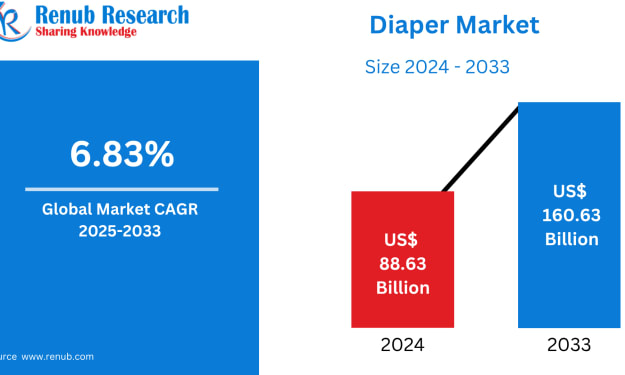
Global Diaper Market The global diaper market is on a strong growth trajectory, reflecting deep shifts in demographics, lifestyles, healthcare awareness, and sustainability. According to the figures you provided from Renub Research, the diaper market is expected to reach US$ 160.63 billion by 2033, rising from US$ 88.63 billion in 2024, at a CAGR of 6.83% between 2025 and 2033. Expansion across both baby and adult segments is being fueled by higher birth rates in emerging economies, the rapid growth of geriatric and incontinence-care populations, and consumers’ rising preference for high-quality, absorbent, and easy-to-use diaper solutions.
By Renub Research6 days ago in The Swamp
Huawei Mate X Foldable Design: What Living With a Book-Style Phone Is Really Like
Foldable phones always look impressive in photos, but living with one is a completely different experience. The Huawei Mate X foldable design takes a unique approach compared to other foldable phones, and that difference becomes clear the moment you start using it every day, not just when you unfold it.
By abualyaanart7 days ago in The Swamp



Comments
There are no comments for this story
Be the first to respond and start the conversation.