
Bridge Owner Lobbied Trump Administration Before President’s Blast at U.S.–Canada Crossing
New Reports Raise Questions About Influence, Infrastructure and Trade Policy as Detroit‑Windsor Bridge Dispute Escalates
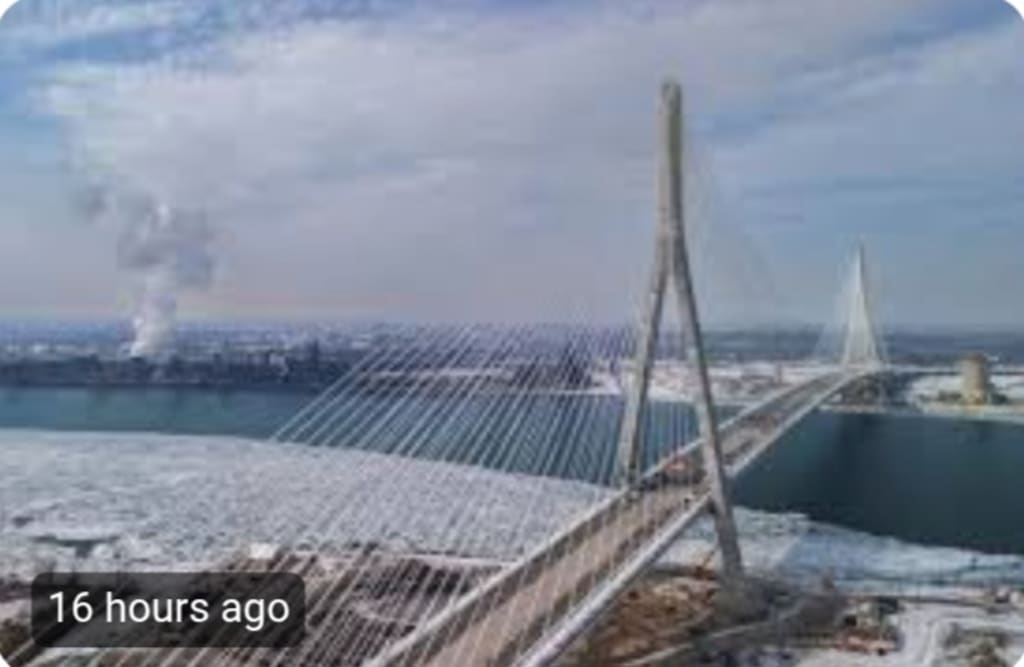
In early February 2026, a high-profile controversy emerged over the Detroit–Windsor border crossing, drawing attention to both political influence and international trade policy. Reports indicate that the owner of the privately held Ambassador Bridge met with senior Trump administration officials just hours before President Donald Trump publicly criticized and threatened to block the opening of the new Gordie Howe International Bridge, a project jointly managed by the United States and Canada.
The Players and the Project
The Gordie Howe International Bridge is a multibillion-dollar infrastructure project designed to improve trade efficiency and ease congestion at the older Ambassador Bridge. Funded largely by Canada, the bridge represents a collaboration between Canadian authorities and Michigan, with toll revenues allocated to reimburse the construction cost over time.
The Ambassador Bridge, owned by the Moroun family, has long been a profitable privately held crossing. Matthew Moroun, who inherited control from his father Manuel Moroun, has historically opposed the Gordie Howe Bridge, arguing it would siphon traffic and toll revenue from the family’s bridge.
Lobbying Before the President’s Statement
On February 9, 2026, Matthew Moroun reportedly met with Howard Lutnick, U.S. Secretary of Commerce, or other senior officials, hours before President Trump issued a public threat against the Gordie Howe Bridge.
Trump posted on social media, claiming that the U.S. might block the bridge’s opening unless Canada agreed to certain demands related to ownership or revenue sharing. The timing of the Moroun meeting has raised questions about whether private lobbying influenced presidential rhetoric.
A Sudden Shift in Trump’s Position
During his first term, Trump had publicly supported the Gordie Howe Bridge, calling for its “expeditious completion” as a symbol of U.S.–Canada cooperation. His recent threats, however, signaled a sharp reversal.
Observers note that this shift coincided with broader trade tensions, including disputes over Canada’s agreements with other nations. Critics suggest that the timing of the Moroun meeting may have contributed to Trump’s sudden criticism of a project he previously endorsed.
Economic Stakes of the Gordie Howe Bridge
The Gordie Howe Bridge is more than a local infrastructure project. It plays a key role in U.S.–Canada trade, handling a significant volume of commercial traffic. Michigan Governor Gretchen Whitmer has emphasized the bridge’s economic importance, including job creation and improved logistics.
Canada financed the construction, but Trump’s public comments suggested that the U.S. should claim a greater share of ownership or revenue — a position widely rejected by Canadian officials. Despite the controversy, Michigan authorities have indicated that the bridge’s opening will proceed as planned.
Private Influence and Public Policy
This incident highlights concerns about how private interests can affect federal decision-making. Wealthy donors and business owners often have access to senior officials, creating perceptions — and sometimes realities — of influence over policy.
The Moroun family has historically donated to political campaigns, including Republican causes. While no direct link has been publicly confirmed between donations and Trump’s statements, the proximity of the lobbying meeting to the president’s threat has drawn scrutiny from lawmakers and political analysts alike.
Political and Diplomatic Implications
Canadian officials have stressed that the bridge project is a mutually beneficial collaboration and called for diplomatic resolution. U.S. lawmakers, from both parties, have expressed concern about private influence on presidential decisions.
The controversy underscores the delicate balance between infrastructure development, trade policy, and political influence. As cross-border commerce remains critical to both nations, any disruption could have wide-reaching economic consequences.
Looking Forward
As the Gordie Howe Bridge nears completion, all eyes will be on whether political disputes delay its opening. Observers also see this as a broader lesson in governance: how private lobbying, political priorities, and international relationships intersect.
The Moroun meeting and Trump’s subsequent social media threat highlight the complexity of infrastructure decision-making in the U.S., especially when private profits, public interest, and international diplomacy collide.
Conclusion
The Ambassador Bridge controversy demonstrates the tension between private influence and public policy. As Michigan and Canadian officials move forward with the Gordie Howe Bridge, the episode serves as a reminder that major infrastructure projects often involve more than engineering — they also involve politics, lobbying, and strategic interests.
Whether the bridge opens smoothly or faces further political hurdles, this case underscores the importance of transparency and oversight in decisions that affect trade, the economy, and international relations.
About the Creator
Keep reading
More stories from Ayesha Lashari and writers in The Swamp and other communities.
Telegram Is Reportedly Being Slowed and Restricted in Russia
In recent days, Telegram — one of the world’s most widely used messaging platforms — has reportedly been slowed and restricted in Russia, prompting concern among millions of users. The Russian communications regulator, Roskomnadzor, has been throttling Telegram’s network traffic, affecting media uploads, downloads, and the smooth operation of voice and video messages. While text messaging continues to work, the degraded performance has left many users frustrated. This is part of a broader effort by Russian authorities to tighten control over foreign technology platforms and push citizens toward government-backed alternatives. For Telegram users in Russia, this has significant implications for daily communication, business operations, and access to news. What Exactly Is Happening? Reports indicate that Telegram’s functionality has slowed significantly across Russia. Media-heavy features such as voice messages, videos, and large file transfers are experiencing delays, while connections often drop intermittently. Users have noted that group chats and channels that rely on fast updates have become less reliable. The slowdown appears to be a deliberate measure by Roskomnadzor, citing Telegram’s alleged non-compliance with Russian laws, including content regulation and data localization requirements. However, no official security threat has been publicly disclosed. This partial throttling means that Telegram is still accessible but its performance is noticeably hindered. Why Russia Is Targeting Telegram Russia’s authorities claim that Telegram has failed to comply with multiple legal requirements: Removing content flagged by authorities Hosting user data on Russian servers Preventing misuse of the platform for criminal or extremist activity The Kremlin has also been promoting “digital sovereignty,” encouraging the use of state-backed messaging platforms. Telegram’s refusal to fully comply with local laws makes it a prime target for regulation, as the government seeks greater control over online communication. Telegram’s founder, Pavel Durov, has criticized these measures, arguing that they violate privacy and freedom of expression while attempting to force users into government-supervised alternatives. Historical Context: Telegram and Russia Telegram has faced Russian restrictions before. In 2018, the platform was temporarily banned for failing to provide encryption keys to authorities, only for the ban to be lifted later due to widespread public disruption. In 2025, Russia also imposed partial restrictions on voice and video messaging. These recurring measures highlight a broader pattern: Russian regulators increasingly control foreign platforms through fines, throttling, or outright bans, often citing security, compliance, or national legislation. Telegram’s current slowdown is the latest example in a decade-long tension between the platform and Russian authorities. Impact on Users The restrictions have multiple consequences for Russian Telegram users: 1. Disrupted Communication Slower media uploads and downloads affect how users share photos, videos, and voice messages. Large group chats and public channels face delays, reducing their reliability for real-time communication. 2. Reduced Access to Information Telegram channels are widely used as news sources. Throttling media-rich content hampers the app’s role as a source of updates and public information, particularly in regions with restricted press freedom. 3. Adoption of VPNs Many users are turning to VPNs or proxy services to bypass the throttling, illustrating both the demand for unrestricted access and the limitations of government-imposed restrictions. 4. Shift Toward State-Backed Apps Russia is encouraging the adoption of its government-backed messaging platform, Max, raising concerns over privacy, surveillance, and state control. International Reactions Human rights organizations, including Amnesty International, have criticized the throttling as a restriction on freedom of expression. Limiting Telegram’s performance undermines digital rights and the ability of citizens to communicate privately and securely. Globally, the situation in Russia raises questions about the future of encrypted messaging and the balance between government oversight and personal privacy. Telegram’s challenges could set a precedent affecting other countries’ regulatory approaches to tech platforms. What Comes Next for Telegram? Telegram continues to function in Russia, but the future remains uncertain. Possible scenarios include: Further throttling or partial blocking of the platform New fines or legal actions against the company Full bans if compliance is not achieved Increased use of VPNs by users to bypass restrictions The platform’s commitment to privacy and free communication will continue to be tested as Russian authorities tighten regulatory controls. Users, both inside and outside Russia, will likely monitor the situation closely to see how it evolves. Conclusion Russia’s throttling of Telegram highlights a growing global tension between government control and digital freedom. While users in Russia still have access to the platform, its performance degradation affects daily communication, business activities, and access to news. For the international community, the Telegram situation serves as a reminder of the challenges facing encrypted communication in countries with strict online regulations. It also underscores the ongoing struggle between user privacy, freedom of expression, and government oversight in the digital age. As Telegram navigates these challenges, the resilience of both the platform and its users will be critical. For now, Russian users are adapting with workarounds, while the world watches closely to see if more severe restrictions are coming next.
By Ayesha Lashari4 days ago in The Swamp
Why Black History Matters in America?
The United States of America is celebrating their 250th anniversary in 2026. I'm proud to be an American and as someone who was born here, I wouldn't imagine myself living anywhere else. This is a country where opportunities are possible. Where anyone can be successful in anything they desire to do. Equality, community, and togetherness are the backbones of what America is and should be about. However, we have an administration who wants to erase and disregard those who have made positive, meaningful impacts in our country, specifically Black figures, such as Martin Luther King, Jr., Rosa Parks, and Maya Angelou. President Trump and his administration have been constantly complaining and fighting against what they call the "Woke agenda". They use this excuse as a distraction from other issues they refuse to address, such as the high cost of living, climate change, and inflation. That equality is dividing America, when in reality, it's bringing us together. Being woke is not tied to a specific political party. No matter where you stand on the political spectrum, you can still care about other people and their plights. Compassion and empathy for others isn't tied to a political party, either. We were taught as children to treat others the way we want to be treated and not judge others because they're different from us. Caring about others isn't a personal attack on your beliefs. It doesn't make you any less of a person. People who are easily offended over African American figures, past or present, or anything related to it, are grasping at straws. Current and future generations need to know who people like Harriet Tubman and Shirley Chisholm were, especially in the classroom. Black History is part of American History. It should be recognized, not hidden or forgotten. Besides, you can't shield children from everything, just because your feelings are easily hurt.
By Mark Wesley Pritchard 14 days ago in The Swamp
Rubio Warns Europe of New Era in Geopolitics Ahead of Major Munich Speech
U.S. Senator Marco Rubio has warned European leaders that the world is entering a new and more dangerous era of geopolitics, marked by shifting alliances, intensifying great-power competition, and growing instability. His remarks come ahead of a highly anticipated speech at the Munich Security Conference, one of the world’s most influential gatherings of political and security leaders. In comments released before his address, Rubio said that Europe and the United States must prepare for a future defined less by cooperation and more by rivalry among major powers, particularly involving China, Russia, and regional actors seeking to challenge the Western-led international order. “We are no longer living in the post–Cold War moment,” Rubio said. “We are entering a period where power politics is returning, and democracies must be prepared to defend not only their interests but their values.” A Changing Global Landscape Rubio’s warning reflects growing concern in Washington that global politics is undergoing a fundamental transformation. Conflicts in Ukraine and the Middle East, rising tensions in the Indo-Pacific, and the spread of advanced military technologies have reshaped strategic thinking across NATO and the European Union. According to Rubio, Europe can no longer assume that peace and stability will be guaranteed through diplomacy alone. He argued that defense spending, military readiness, and technological innovation must become central priorities for Western nations. “The idea that economic interdependence alone would prevent conflict has proven wrong,” he said. “Authoritarian states are using trade, energy, and technology as tools of coercion.” His message is expected to resonate strongly in Munich, where leaders from more than 40 countries will discuss security threats ranging from cyber warfare and artificial intelligence to energy security and climate-related risks. Focus on Russia and China A central theme of Rubio’s upcoming speech is expected to be the twin challenges posed by Russia and China. He has consistently described Russia’s war in Ukraine as a defining conflict for Europe’s future and warned that failure to deter Moscow could embolden other powers. Rubio is also expected to urge European governments to reduce their economic dependence on China, particularly in strategic sectors such as telecommunications, rare earth minerals, and advanced manufacturing. “Europe must decide whether it wants strategic autonomy or strategic vulnerability,” Rubio said. “You cannot rely on authoritarian regimes for the foundations of your economy and security.” His comments come as several European countries reassess their trade and investment policies with Beijing, amid fears of supply chain disruption and political pressure. Pressure on NATO Unity Rubio’s remarks also highlight concerns over unity within NATO. While the alliance has expanded and strengthened its eastern defenses since the Ukraine war, divisions remain over burden-sharing and long-term strategy. He warned that internal disagreements could weaken Europe’s ability to respond to future crises. “Adversaries are watching for cracks in our unity,” Rubio said. “They believe democracies are too divided and too slow to act. We must prove them wrong.” The senator is expected to call for closer U.S.–European cooperation on defense production, intelligence sharing, and joint military exercises, arguing that fragmented responses would only benefit rival powers. Europe’s Role in a New Era European officials attending the Munich conference are likely to view Rubio’s speech as both a challenge and a reassurance. On one hand, his message underscores the seriousness of the threats facing Europe. On the other, it signals continued American engagement in European security at a time when questions persist about the future direction of U.S. foreign policy. Several European diplomats have privately acknowledged that the geopolitical environment has changed more rapidly than anticipated. One senior EU official said that Rubio’s warning reflects “a broader recognition that the old assumptions about stability no longer apply.” The conference is expected to include discussions on strengthening Europe’s defense industry, protecting critical infrastructure, and coordinating responses to hybrid threats such as disinformation campaigns and cyberattacks. A Broader Political Signal Rubio’s appearance in Munich also carries political significance at home. As a prominent voice on foreign policy in the U.S. Senate, he has positioned himself as a leading advocate for a tougher stance on authoritarian powers and for renewed leadership among democratic allies. His speech is likely to be seen as part of a broader effort to shape Western strategy for the coming decade, emphasizing deterrence, resilience, and unity. Analysts say his warning should not be interpreted as pessimism but as a call to action. “This is about preparing Europe and the United States for a world where competition is the norm,” said one transatlantic security expert. “Rubio is urging leaders to face reality and adapt.” Looking Ahead As Rubio takes the stage in Munich, his message will test how ready European governments are to confront a harsher geopolitical climate. Whether his call leads to concrete policy shifts remains to be seen, but his warning underscores a growing consensus that the global order is entering a period of profound change. For Europe, the challenge will be to translate rhetoric into long-term strategy — ensuring that security, economic independence, and democratic values remain at the center of its response to a rapidly evolving world.
By Fiaz Ahmed 2 days ago in The Swamp
When True Love Never Questions Your Soul
“And she’s going to learn that this life will hit you, hard, in the face, wait for you to get back up, just so it can kick you in the stomach but getting the wind knocked out of you is the only way to remind your lungs how much they like the taste of air.” — Sarah Kay’s Poem — If I Should Have a Daughter
By Chantal Christie Weiss8 days ago in Humans



Comments
There are no comments for this story
Be the first to respond and start the conversation.