
Bread, Circuses, and the South Lawn
When leaders trade solutions for spectacle, the crowd always roars.

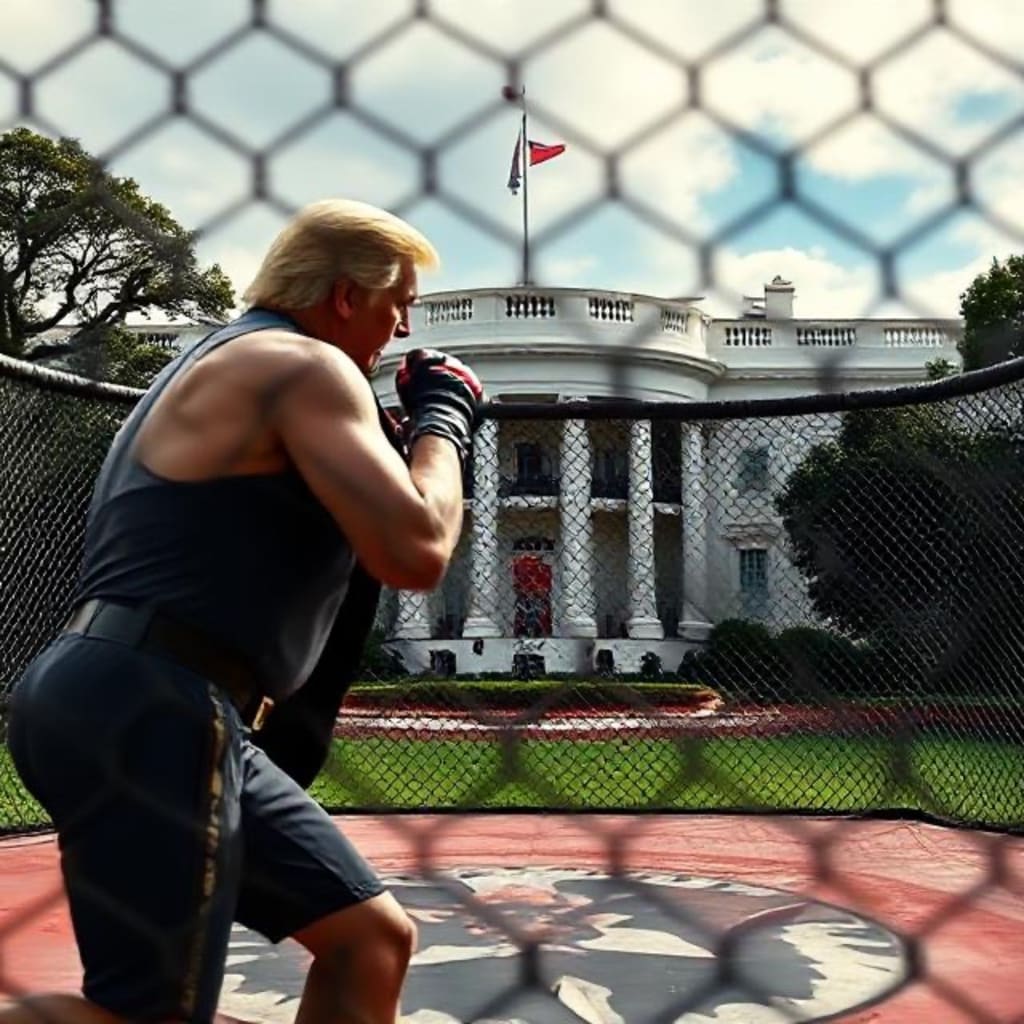
When Dana White and Donald Trump announced that UFC cage fights would be staged on the South Lawn of the White House during America’s 250th birthday in 2026, it sounded like parody. But it wasn’t satire. It was spectacle — and spectacle has a long history.
The Roman poet Juvenal once warned that emperors pacified the public with panem et circenses — bread and circuses. Feed the masses, entertain them, and they won’t ask questions about corruption, collapse, or lost freedoms. The crowd roared while the empire cracked.
Two thousand years later, the octagon is being rolled onto the lawn of the White House. And the echoes are deafening.
Rome’s Lesson: Spectacle as Power
The Roman Empire understood that power wasn’t only about laws and armies. It was also about distraction. Gladiatorial games, chariot races, and festivals were more than entertainment — they were pressure valves. Citizens focused on blood and showmanship instead of famine, corruption, and political rot.
The arena became a tool of statecraft. Keep the citizens fed and dazzled, and they will forgive incompetence, or at least look away from it.
But history is clear: the more Rome relied on spectacle, the weaker its institutions became. The more the people were entertained, the less they were governed.
America’s Founders Feared the Same Thing
The architects of the American republic knew their Roman history. They studied Cicero and Polybius, and they understood how spectacle could destroy liberty.
In Federalist No. 10, James Madison warned against factions that could inflame passions and distract citizens from rational governance. Alexander Hamilton cautioned against demagogues who would “pay an obsequious court to the people” through shallow appeals. George Washington himself, in his farewell address, warned against the dangers of leaders who put popularity over principle.
Their solution was a system of checks and balances, deliberation, and restraint. The presidency was never meant to be a stage for blood sport.
UFC on the South Lawn: A Modern Circus
Now, on the eve of America’s semiquincentennial, the White House is literally being turned into an arena. Dana White has promised a UFC card in front of the president’s residence — a spectacle for thousands in person, and millions on television.
The political symbolism is unavoidable. What was once the people’s house becomes the emperor’s colosseum. The office meant to embody law, debate, and the Constitution is remade as a backdrop for cage fighting.
Is it sport? Yes. Is it entertainment? Of course. But is it also a deliberate distraction? The timing suggests so. America is facing economic turmoil, gridlocked government, rising extremism, and crises of trust in its institutions. What better way to redirect anger than to give the public something visceral, violent, and immediate?
Like Rome before it, America risks swapping civic engagement for blood and spectacle.
The Crowd Always Roars
The danger is not that people will boo — it’s that they will cheer. Rome’s citizens demanded games as much as emperors offered them. Likewise, millions of Americans love UFC and will tune in, not caring about the deeper symbolism.
And that’s the point. The louder the crowd, the easier it is to ignore the cracks in the republic. The more attention on the octagon, the less attention on the Constitution.
This is what Juvenal meant: if people are entertained enough, they’ll trade their role as citizens for the role of spectators.
Founding Fathers in the Bleachers
Imagine Madison, Jefferson, or Adams walking onto the South Lawn in July 2026. Would they celebrate the republic’s survival, or recoil at its transformation into a cage match?
The men who designed a system of deliberation, debate, and law would see this for what it is: not just entertainment, but erosion.
When Benjamin Franklin was asked what the Constitutional Convention had produced, he famously replied: “A republic, if you can keep it.”
Hosting gladiator matches at the White House is a sign we may not be keeping it.
More Than a Fight Card
The UFC spectacle isn’t just about sports. It’s about image. It’s about power. And it’s about the dangerous slide from governance into performance.
Rome’s emperors gave the people gladiators when they could no longer give them stability. America’s leaders now promise cage fights on the White House lawn when they cannot promise solutions.
Bread and circuses, then. Bread and circuses, now.
Closing Thought
History doesn’t repeat itself exactly, but it does echo. Rome echoed with the sound of lions and steel in the arena. America may soon echo with the clang of the octagon on the White House lawn.
The crowd will roar. The cameras will roll. And the republic, like Rome before it, will risk trading its substance for its show.
The question is simple: are we still citizens, or just spectators?
About the Creator
ambiguous karma
I'm a historian and religious studies scholar with 2 B.A.'s in History and Religious Studies (Salem College) I write with grit, insight, and satire: exploring power, belief, and resistance across time. Scholar by training, rebel by nature.
Keep reading
More stories from ambiguous karma and writers in The Swamp and other communities.
Democracy in the Cage: Uncle Sam on the Ropes
The White House lawn has seen its share of ceremonies, protests, and presidential addresses. But never before has it looked like this: a steel cage, floodlights, and two unlikely fighters locked in a brawl for the nation’s attention. On one side, Uncle Sam — the lanky, bearded symbol of America’s ideals, dressed in his star-spangled best. On the other, a red-capped bruiser who treats politics as a pay-per-view event rather than a solemn responsibility.
By ambiguous karma5 months ago in The Swamp
A Gathering of Evil Bosses
“I’m the queen of chin jutting while I smooth my hair, attacking, insulting, and deflecting to protect my appointer.” “Oh, please, Blondi, my hair is curled, highlighted, and longer than yours. I feature television commercials telling immigrants that we will give them a free plane ride home, and if they voluntarily turn themselves in, they will be allowed to legally apply for re-entry. It runs everywhere, and I look good in it! You can’t compete because of your blond hair. Mine is nicer, and my lips are prettier than yours.”
By Andrea Corwin 13 days ago in The Swamp
Flower Bloom 369
FLOWER Bloom 2/25/26 Wednesday By Mariann Carroll Karen had been with Tony for 7 years. Tony started acting strangely after her surgery. He would mow the lawn in the rain and be on his cellphone. He started pushing Karen away. Tony came clean about seeing someone. Karen moved out two months later. Karen moved in with a friend. She felt betrayed.
By Mariann Carroll5 days ago in Fiction



Comments
There are no comments for this story
Be the first to respond and start the conversation.