
Behind the Barbed Wire:
How a New ICE Facility in Nebraska Rekindles America’s Immigration Debate


The Nebraska sky was painted in gold as the sun dipped behind the endless plains. Reporters gathered at a freshly built gate, cameras flashing against the steel fences crowned with barbed wire.
What stood behind wasn’t just concrete and metal. It was a new ICE detention facility—a place meant to hold migrants, but symbolically holding something far bigger: America’s identity and its promise as the land of opportunity.
In mid-August 2025, Homeland Security Secretary Kristi Noem announced the construction of a brand-new immigration detention center in Nebraska. The administration presented it as a step toward “protecting the nation” and “restoring order at the border.”
Yet to many, it felt like another step toward an America increasingly defined by walls rather than bridges.
The facility is designed to house thousands of migrants apprehended at the southern border. For officials, it’s a tool of enforcement; for critics, it’s a stark reminder of a nation that once welcomed dreamers but now confines them behind steel doors.
A Glimpse Inside: Picture a young man from Guatemala, barely twenty. He leaves behind a struggling village in search of the American dream. Instead of freedom, he finds himself under fluorescent lights in a cold cell, his journey reduced to a case file number.
The clang of steel doors echoes louder than any whisper of opportunity. For him, this isn’t a beginning—it’s an ending he never imagined.
Between Security and Humanity: Supporters argue that America needs tougher border control to safeguard communities, insisting that the detention center is a necessary shield.
Opponents counter that these facilities strip people of their humanity and transform the United States into a fortress of fear rather than a beacon of hope. This clash is no longer just about policy. It’s about the soul of a nation that has always wrestled with the balance between security and freedom.
Conclusion: The debate over immigration in the United States has never been just about numbers or laws. It is, at its heart, about identity. Every generation of Americans has wrestled with the question: Who belongs here, and who doesn’t?
The Nebraska facility is simply the latest symbol of this struggle. Supporters see it as proof that the government is finally taking border security seriously, responding to fears of crime, job competition, and national sovereignty. For them, the fences and locked gates are not symbols of cruelty, but shields against uncertainty in a rapidly changing world.
Opponents, however, see something much darker. They argue that by confining migrants—many of whom are fleeing violence, poverty, or climate disasters—the U.S. risks betraying its founding promise as a refuge for the oppressed. They remind us that the words etched on the Statue of Liberty, “Give me your tired, your poor, your huddled masses yearning to breathe free”, are not just poetry. They are supposed to be a guiding principle.
But the reality is that America has always lived in tension between these two visions. The same nation that welcomed millions of immigrants through Ellis Island also passed restrictive quotas. The same country that celebrates stories of families “making it” from nothing has, at times, turned away boats of refugees. The story is not new—it’s simply being rewritten in Nebraska, behind steel bars and razor wire.
What makes this moment unique is the visibility. Social media, advocacy groups, and independent journalists are already amplifying the voices of detainees and families torn apart by these policies. In an age where images and stories travel instantly across the world, the human cost of immigration enforcement cannot be hidden behind walls.
So, what does the Nebraska detention facility really represent? Perhaps it is not just a building, but a mirror—reflecting back the contradictions of a nation still undecided about what kind of future it wants. Will America choose security at the expense of compassion? Or will it find a way to balance the need for order with the moral imperative of dignity?
The answer won’t be written in the cement of a prison floor or the steel of a barred gate. It will be written in how Americans respond—whether they accept this facility as normal, or whether they see it as a turning point to demand something different.
In the end, the story of immigration in America has never been about walls or borders. It has always been about people—about those who risk everything to cross deserts, rivers, and oceans for a chance at a better life. Whether this new facility becomes a footnote in history or a defining chapter will depend on the choices America makes today.
Because behind every policy, behind every debate, there is a beating heart waiting for an answer: Does the American dream still exist—and if so, who gets to dream it?
About the Creator
Youssef Khabchi
Political & Human Rights Writer | Exploring global and North African issues with an analytical lens | Advocating for freedom, justice, and equality through powerful storytelling.
Keep reading
More stories from Youssef Khabchi and writers in The Swamp and other communities.
The war in Ukraine and Global Diplomacy:
Introduction: The conflict in Ukraine isn’t just a regional war — it’s a geopolitical earthquake shaking the foundations of international relations. Every move made in Kyiv or Moscow sends ripples across capitals from Washington to Brussels and Beijing. As the world watches, the question is no longer just who will win on the battlefield, but how this war will reshape diplomacy, alliances, and the very rules that govern global order. Join me as we dive into the heart of this complex and pivotal moment in history.
By Youssef Khabchi7 months ago in The Swamp
Parallel Protests
I haven't written for quite some time, but I have A LOT of thoughts about yesterday's protest rally against our government's involvement and complicity in America's war on Iran, on the harbourside of my home city Bristol, and I need to put them somewhere. My gorgeous girlfriend is always a loving and listening ear and sharing it all with her will always be a healthy and happy way of processing the mental and emotional weight, but getting it straight in my brain to share means writing it all down in straight lines, so, here we are and thanks for being here.
By Steph Cole8 days ago in The Swamp
Turkey Considering Deployment of F-16s to Cyprus, Ministry Source Says
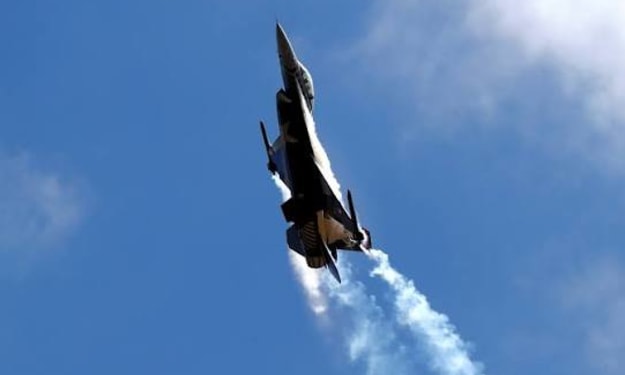
Ankara signals potential military escalation as tensions rise in the Eastern Mediterranean. Turkey is reportedly considering the deployment of F-16 fighter jets to Cyprus, according to a source within the Turkish Ministry of Defence. The potential move comes amid heightened regional tensions and ongoing disputes over airspace and territorial waters in the Eastern Mediterranean. The source, who requested anonymity due to the sensitivity of the issue, stated that Ankara is evaluating options to strengthen its military presence on the island in response to what it perceives as growing threats and provocative actions by neighboring states. While no final decision has been made, Turkish defence officials are reportedly assessing the logistics, operational readiness, and strategic implications of such a deployment. Strategic Context in the Eastern Mediterranean Cyprus has long been at the center of geopolitical disputes, particularly involving Turkey, Greece, and other regional powers. Turkey maintains a military presence in the northern part of the island, which it recognizes as the self-declared Turkish Republic of Northern Cyprus. Greece and the internationally recognized Republic of Cyprus consider such actions a violation of sovereignty. The consideration of deploying F-16s reflects Ankara’s intent to assert air superiority in contested areas and strengthen deterrence against perceived encroachments by neighboring forces. Turkish military analysts suggest that stationing fighter jets on the island could provide rapid response capabilities and enhanced surveillance of maritime zones in the Eastern Mediterranean, where energy exploration and military activity have created ongoing disputes. Potential Regional Reactions The announcement has already sparked concern among Greece, Cyprus, and other European states with interests in regional stability. Analysts warn that any increase in Turkish military assets on the island could exacerbate tensions and risk accidental clashes in congested airspace. Greek officials have historically expressed strong opposition to military expansions by Turkey in Cyprus, emphasizing that such deployments could violate international agreements and heighten the risk of confrontation. Similarly, the Republic of Cyprus has warned that any escalation could undermine ongoing diplomatic efforts to manage territorial disputes. European Union diplomats have also noted the importance of de-escalating military posturing in the region. In recent months, Brussels has called on all parties to exercise restraint, warning that heightened tensions in the Eastern Mediterranean could disrupt regional trade, energy exploration, and broader security cooperation. F-16 Capabilities and Operational Impact The Turkish Air Force operates a fleet of F-16 fighter jets capable of air defense, ground attack, and surveillance operations. Deploying these jets to Cyprus would enhance Turkey’s ability to respond rapidly to regional incidents, including aerial incursions, maritime disputes, or potential conflicts over energy exploration zones. Military analysts highlight that F-16s, when combined with advanced radar and command systems, provide significant operational reach and flexibility. They can conduct patrols, intercept aircraft, and support naval operations in contested areas. Such capabilities would reinforce Turkey’s position and demonstrate its readiness to protect strategic interests. Diplomatic Considerations While Turkey’s defence ministry has not officially confirmed the deployment, international observers are closely monitoring the situation. Analysts emphasize that a unilateral military build-up could provoke a response from neighboring states, potentially triggering a cycle of escalation. Diplomats from Greece, Cyprus, and the EU have reportedly begun consultations to coordinate messaging and assess contingency plans. Regional security experts note that ongoing military exercises, coupled with potential deployments, require careful management to avoid accidental clashes or miscalculations. Broader Implications The Eastern Mediterranean has emerged as a flashpoint for regional power competition, with multiple countries asserting claims over territorial waters and airspace. Energy exploration, maritime boundaries, and longstanding historical disputes contribute to the complexity of the situation. Turkey’s consideration of deploying F-16s to Cyprus underscores the delicate balance between deterrence and provocation. While Ankara frames the move as defensive, neighboring states view it as a potential escalation that could destabilize the region further. The international community is urging all parties to pursue diplomatic channels and confidence-building measures to prevent unintended incidents. Observers warn that missteps in the coming weeks could have far-reaching consequences, not only for Cyprus and Turkey but for broader regional security in the Eastern Mediterranean.
By Fiaz Ahmed 4 days ago in The Swamp


Comments
There are no comments for this story
Be the first to respond and start the conversation.