

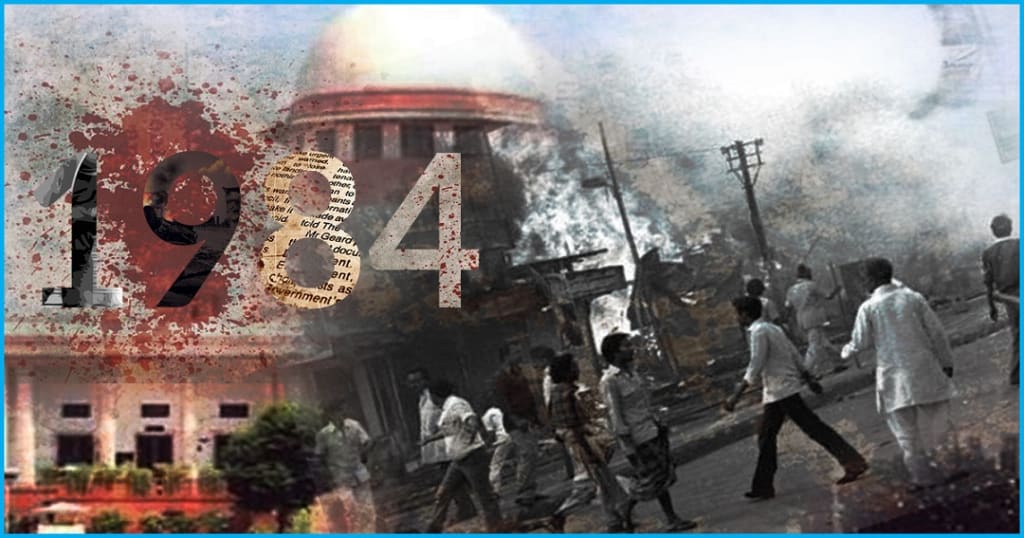
All through the period from October 31 to November 5, 1984, large mobs largely formed by hooligans loyal to the ruling Indian Congress Party from many part of the country attacked Sikh community. The mobsters swarmed into Sikh neighborhoods, arbitrarily killing any Sikh men they could find. these events should not be called riots, but be described as one sided pogrom or a crime against humanity. This was a black spot on India history .
After the assassination of Indira Gandhi on 31 October 1984 by two of her Sikh bodyguards, anti-Sikh riots erupted the following day. They continued in some areas for several days, killing more than 50,000 Sikhs in 40 cities across India. Delhi were the worst affected. Perpetrators carried iron rods, knives, clubs, and combustible material (including kerosene and petrol).
They entered Sikh neighbourhoods, killing Sikhs indiscriminately and destroying shops and houses. Armed mobs stopped buses and trains in and near Delhi, pulling off Sikh passengers for lynching; some were burnt alive. Others were dragged from their homes and hacked to death, and Sikh women were reportedly gang-raped and Sikhs also had acid thrown on them.
09.20 AM: Indira Gandhi was shot by two of her security guards at her residence No. 1, Safdarjung Road, and rushed to All India Institute of Medical Sciences.
11 AM: Announcement on All India Radio specifying that the guards who shot Indira Gandhi were Sikhs. A big crowd was collecting near AIIMS.
02.00 PM: Though her death was yet to be confirmed officially, it became common knowledge because of BBC bulletins and special afternoon editions of newspapers.
04.00 PM: Rajiv Gandhi returned from West Bengal and reached AIIMS. Stray incidents of attacks on Sikhs in and around that area. .
Late evening and night: Mobs fanned out in different directions from AIIMS. The violence against Sikhs spread, starting in the neighbouring constituency of Congress councillor Arjun Dass. The violence included the burning of vehicles and other properties of Sikhs. That happened even in VIP areas like the crossroads near Prithviraj Road where cars and scooters belonging to Sikhs were burnt.
This commission was appointed in November 1984. Ved Marwah, Additional Commissioner of Police, was assigned the job of enquiring into the role of the police during the carnage of November 1984. Many of the accused officers of Delhi Police went to Delhi High Court. As Ved Marwah completed his inquiry towards the middle of 1985, he was abruptly directed by the Home Ministry not to proceed further. Complete records of the Marwah Commission were taken over by the government & were later transferred to the Misra Commission. However, the most important part of the record, namely the handwritten notes of Mr Marwah, which contained important information, were not transferred to the Misra Commission.
Kapur Mittal Committee was appointed in February 1987 on the recommendation of the Misra Commission to inquire into the role of the police, which the Marwah Commission had almost completed in 1985 itself, when the government asked that committee to wind up and not proceed further. After almost two years, this committee was appointed for the same purpose. This committee consisted of Justice Dalip Kapur and Mrs Kusum Mittal, retired Secretary of Uttar Pradesh. It submitted its report in 1990. Seventy-two police officers were identified for their connivance or gross negligence. The committee recommended forthwith dismissal of 30 police officers out of 72. However, till date, not a single police officer has been awarded any kind of punishment.
This committee was recommended by the Misra Commission for recommending registration of cases. It consisted of Justice M.L. Jain, former Judge of the Delhi High Court and Mr A.K. Banerjee, retired Inspector General of Police. The Misra Commission held in its report that a large number of cases had not been registered and wherever the victims named political leaders or police officers, cases were not registered against them. This committee recommended registration of cases against Mr Sajjan Kumar in August 1987, but no case was registered. In November 1987 many press reports appeared for not registering cases in spite of the recommendation of the committee. In December 1987, one of the co-accused along with Sajjan Kumar, namely Mr Brahmanand Gupta filed a writ petition in the Delhi High Court and obtained a stay against this committee. The government did not oppose the stay. The Citizens Justice Committee filed an application for vacating the stay. Ultimately, the writ petition was decided in August 1989 and the high court quashed the appointment of this committee. An appeal was filed by the Citizens Justice Committee in the Supreme Court of India.
http://www.antisikhriots1984.50webs.com
About the Creator
Keep reading
More stories from baljeet singh and writers in The Swamp and other communities.
Best 20 quotes for life
Top 20 Best Quotes Throughout the long-term people have created and discovered ways by which to put themselves out there, and pass on a message to other people. Without overemphasizing a point just as giving a far-reaching history exercise on humanities, we can simply say that the strategies that we have done this have changed. Notwithstanding, one articulation that has held all through time is rehashing a couple of words that have been expressed in season. I for one allude to these as statements. At the point when somebody who is regarded or known by numerous individuals during a specific period expresses an expression that is spoken in season, many discover these maxims as being helpful. At that point, these colloquialisms in the long run are viewed as the best moving statements ever. I trust this point of view bodes well and you have had the option to follow how I have come to comprehend the advancement of statements. I should concede that submitting a portion of my #1 persuasive statements has been something I end up doing. Additionally, cutting edge pioneers like to add them to significant addresses that they convey.
By baljeet singh5 years ago in Humans
The Forsyth House Fire
Since 1851, Forsyth House has stood on the corner of Union Street and Gordon Street in the heart of Glasgow. Its iconic, or was... because on Sunday 8th of March, 2026, a fire broke out in a small, seemingly un-named shop in the building and tore all that history down. As I write, the rubble is still unsettled and the street is still blocked off. Central Station is quiet on the upper level, and around 30 small businesses have quite literally gone up in smoke.
By S. A. Crawforda day ago in The Swamp
China Inflation Takes Off After Holiday Boost as Oil Shock Looms
Inflation in China has accelerated following a surge in consumer spending during the recent holiday period, prompting renewed concern among economists about the trajectory of prices in the world’s second-largest economy. The rebound in demand, combined with rising global oil prices, is beginning to place upward pressure on household costs and industrial production across the country. Official data released by China’s statistics authorities showed that consumer prices rose more quickly than expected in the weeks following the holiday season. The annual increase in the Consumer Price Index (CPI) marked one of the strongest readings in months, reflecting higher spending on food, travel, entertainment, and retail goods as millions of people returned to restaurants, tourist sites, and shopping centers. Economists say seasonal spending often causes temporary price increases, particularly around major holidays. However, analysts warn that this year’s inflation uptick may not be purely seasonal. The combination of recovering domestic demand and rising energy costs is creating a broader inflationary trend that could affect both consumers and manufacturers. One key factor driving the surge is the spike in global oil prices. Energy markets have become increasingly volatile amid geopolitical tensions and supply concerns, raising the cost of crude oil shipments to major importers. As the world’s largest crude importer, China is particularly sensitive to fluctuations in energy prices. Higher oil costs quickly ripple through the economy. Transportation, manufacturing, and agricultural production all depend heavily on fuel, meaning that rising crude prices can push up the cost of goods and services throughout the supply chain. Analysts say this “cost-push” inflation is already becoming visible in factory output data. Chinese manufacturers have reported higher input costs, especially for chemicals, plastics, and transportation. Many companies are now deciding whether to absorb these expenses or pass them on to consumers through higher retail prices. If producers begin raising prices more aggressively, inflation could accelerate further in the coming months. Food prices also contributed to the increase in inflation. Fresh vegetables, pork, and cooking oils saw noticeable price rises after the holiday season, partly because of increased demand and temporary supply disruptions. Food prices remain a particularly sensitive issue in China because they account for a large portion of household spending. While the inflation surge may signal stronger economic activity, it also presents a challenge for policymakers. The People's Bank of China has spent much of the past two years attempting to stimulate economic growth through supportive monetary policies. However, if inflation continues to rise rapidly, authorities may face pressure to tighten financial conditions. Central banks typically raise interest rates or reduce liquidity in order to control inflation. Such measures can slow price increases but may also reduce investment and consumer spending. Balancing economic growth with price stability is therefore becoming a delicate task for policymakers in Beijing. Another concern for economists is the potential global impact of China’s inflation trends. As a major manufacturing hub and trading partner for countries around the world, price changes in China often influence global supply chains. Higher production costs in Chinese factories could lead to more expensive exports, affecting consumer prices in markets across Asia, Europe, and North America. Financial markets are closely watching how Chinese authorities respond. Investors worry that rising energy prices combined with inflation could slow economic growth if households cut spending or businesses reduce expansion plans. At the same time, stronger domestic demand could help support global trade at a time when many economies are experiencing uncertainty. The situation is further complicated by the possibility of an energy shock if geopolitical tensions continue to push oil prices upward. Analysts warn that a sudden surge in crude prices could intensify inflationary pressure in China, forcing policymakers to intervene more aggressively. Despite these challenges, some economists remain cautiously optimistic. They argue that moderate inflation may signal a healthy rebound in consumer confidence after a period of slower growth. If price increases remain manageable, stronger spending could support employment and business activity throughout the year. Still, much will depend on the trajectory of global energy markets and the resilience of domestic demand. Should oil prices spike sharply or supply disruptions persist, inflation could rise faster than policymakers anticipate. For now, China’s latest inflation data serves as an early signal that economic conditions are shifting. After a period of subdued price growth, the country is entering a new phase where stronger consumption and rising energy costs may reshape the outlook for both domestic markets and the global economy.
By Fiaz Ahmed 5 days ago in The Swamp




Comments
There are no comments for this story
Be the first to respond and start the conversation.