
American CEOs Push Back on Trump … Mildly
Why Corporate Leaders Are Speaking Up — But With Caution

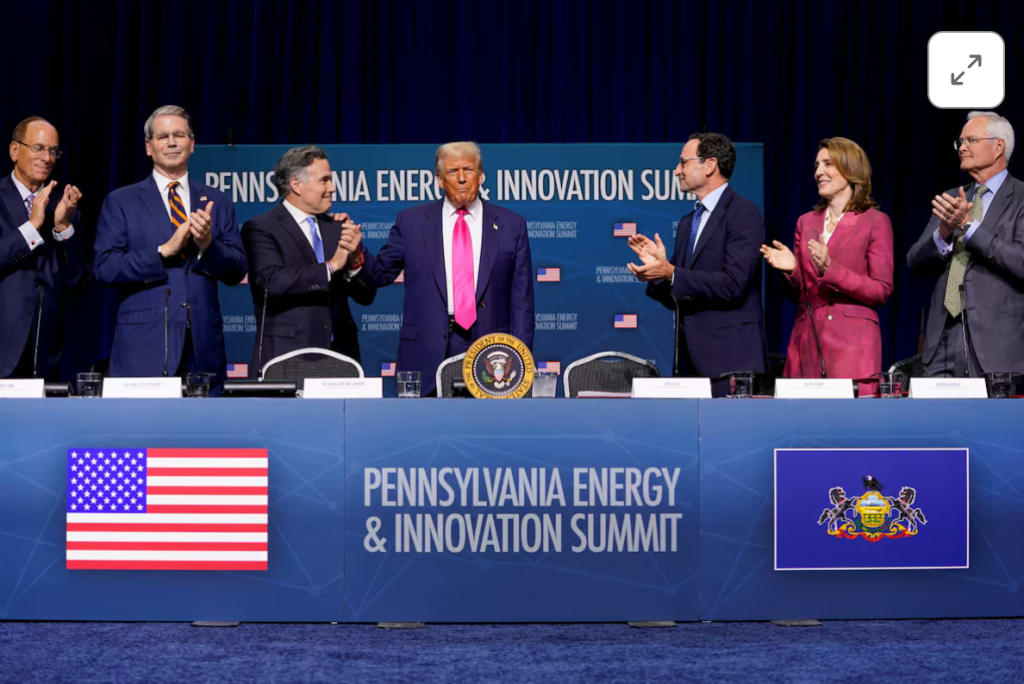
In recent weeks, a number of high-profile American CEOs have quietly pushed back against statements and policies associated with former President Donald Trump. But the pushback has been, in many cases, mild, measured, and careful, reflecting a delicate balancing act that corporate leaders must navigate in today’s hyper-polarized political climate.
This development offers a window into how American business elites respond to political pressure, and how the intersection of commerce, politics, and public opinion continues to shape corporate America.
A Subtle Shift in Tone
Unlike past periods when CEOs either enthusiastically endorsed or outright criticized political figures, the current trend is characterized by subtlety. Statements often take the form of:
General appeals to unity or civility
Calls for rule-of-law and fair processes
Emphasis on values like transparency, diversity, or democracy
Few corporate leaders directly name Trump in their statements. Instead, they employ carefully crafted language that signals disagreement without alienating large segments of customers, shareholders, or employees.
This approach illustrates a broader trend in corporate communications: speak cautiously, act selectively, but maintain moral credibility.
The Context Behind the Pushback
Several factors are driving this mild pushback:
Political Risk: CEOs operate in a climate where political positions can trigger boycotts or backlash. Open confrontation with Trump could alienate millions of voters, particularly in key markets.
Investor Sensitivity: Shareholders are increasingly attentive to reputational risk. While some investors value moral leadership, many prioritize stability and profitability over political statements.
Employee Expectations: Younger workers, especially in tech and finance, are vocal about corporate ethics and social responsibility. CEOs must demonstrate awareness without appearing overtly partisan.
As a result, corporate leaders are caught between economic pragmatism and social accountability — a tension that shapes how they respond to Trump’s actions and statements.
Notable Examples
Several corporate figures have made headlines for their subtle pushback:
Tech Leaders: Executives in Silicon Valley have emphasized democratic principles, free speech, and transparency, often in statements about social media regulation and misinformation. While Trump is not named, the message is clear to the public and insiders alike.
Financial Executives: CEOs in banking and finance have highlighted stability, market integrity, and lawful governance in their speeches and op-eds. Again, the tone is mild but signals concern about political interference.
Consumer Goods CEOs: Leaders in major retail and manufacturing have released statements supporting diversity, inclusion, and corporate responsibility, implicitly challenging rhetoric associated with Trump without directly engaging in partisan debate.
This approach allows companies to signal values, protect brands, and avoid direct confrontation simultaneously.
Why the Pushback Is Mild
There are several reasons why CEOs are not more forceful:
Market Exposure: Trump retains significant influence among a portion of the American electorate. Companies fear alienating consumers who continue to support him.
Reputation Management: Aggressive criticism could provoke political attacks, regulatory scrutiny, or calls for boycotts.
Stakeholder Diversity: Modern corporations serve stakeholders across political, cultural, and geographic lines. A strong stance risks dividing key audiences.
The result is a form of corporate diplomacy: leaders are pushing back without making waves.
The Role of Corporate America in Political Discourse
The mild pushback raises questions about the role of business in politics:
Should CEOs act as moral leaders or remain neutral to protect profits?
How much influence should corporate America have on political processes and public opinion?
Can subtle statements effectively shape policy, or do they merely preserve brand reputation?
These questions are not new, but the Trump era has amplified their significance. Companies are more aware than ever that their public communications are scrutinized in real time, especially on social media platforms.
Implications for the Business-Politics Relationship
The subtle pushback demonstrates that corporate America is evolving its political strategy:
Measured messaging allows CEOs to maintain influence without full confrontation.
Indirect engagement signals values to employees and the public while avoiding overt partisanship.
Stakeholder balancing ensures companies remain resilient in polarized environments.
This approach could set a precedent for how businesses navigate future political controversies, particularly when dealing with leaders who remain polarizing figures.
Critics and Observers Weigh In
Not everyone views mild pushback as sufficient. Critics argue that caution can become complicity, especially when corporate leaders avoid confronting actions that may undermine democratic norms.
Some analysts suggest that stronger stances could shift public perception, encouraging other CEOs to speak out and creating pressure for more substantial reforms.
On the other hand, defenders of mild pushback argue that subtle influence is often more sustainable than headline-grabbing confrontations. By avoiding overt partisanship, CEOs preserve their capacity to act on issues like policy advocacy, philanthropy, and social initiatives.
Looking Ahead: What This Means for Corporate America
The current trend is unlikely to change overnight. Trump remains a polarizing figure, and corporate America is navigating uncharted political territory.
Future developments may depend on:
Shifts in public opinion or electoral outcomes
Economic pressures, including market volatility or labor unrest
Social movements demanding greater corporate accountability
For now, the era of mild pushback appears to be the default strategy — signaling awareness without risking the bottom line. How long this approach remains viable will shape the relationship between business, politics, and society in the coming years.
Conclusion
American CEOs are walking a fine line. They want to signal concern about political developments and uphold corporate values — but they also face real risks to profit, reputation, and influence.
Their mild pushback against Trump illustrates a broader truth about modern corporate leadership: in today’s polarized environment, diplomacy is as important as moral clarity. While critics may wish for bolder action, the subtle approach reflects a calculated strategy, one that balances ethics, economics, and optics.
Ultimately, this cautious stance may be a sign of how business will continue to engage politics in a hyper-connected, scrutinized world — shaping policy and public opinion quietly, from behind the curtain.Start writing...
About the Creator
Muhammad Hassan
Muhammad Hassan | Content writer with 2 years of experience crafting engaging articles on world news, current affairs, and trending topics. I simplify complex stories to keep readers informed and connected.
Keep reading
More stories from Muhammad Hassan and writers in The Swamp and other communities.
Behind the Curtain: The AI Future Is Here
For years, artificial intelligence lived behind a curtain. It was something we associated with science fiction, distant futures, or experimental labs filled with glowing screens and genius engineers. But that curtain has been pulled back — and what’s behind it is no longer theoretical. The AI future isn’t coming. It’s already here. From the phones in our pockets to the systems guiding global markets, artificial intelligence has slipped into daily life with astonishing speed. Often invisible, sometimes misunderstood, and frequently underestimated, AI is reshaping how we work, learn, create, and even think. The transformation is happening quietly — but its impact is anything but small. AI Didn’t Arrive Overnight — It Slipped In One of the most surprising things about AI’s rise is how subtle it has been. There was no single moment when the world “switched on” artificial intelligence. Instead, it crept in through convenience: Recommendation algorithms deciding what we watch Navigation apps predicting traffic before it forms Smart assistants responding to our voices Software filtering spam, editing photos, and translating languages instantly Each improvement felt minor. Together, they rewired modern life. Behind the curtain, AI systems were learning — absorbing massive amounts of data, improving through patterns, and becoming more capable without demanding much attention from the public. By the time people realized how advanced these tools had become, AI was already deeply embedded. The Workplace Is Being Rewritten Few areas reveal AI’s impact more clearly than work. Automation once threatened mostly factory jobs. Today, AI reaches into offices, studios, classrooms, and hospitals. Writing assistants draft emails and reports. AI tools analyze legal documents, generate marketing copy, design graphics, and even help write computer code. For businesses, the appeal is obvious: AI is fast, scalable, and available 24/7. For workers, the picture is more complicated. Some roles are being enhanced — productivity boosted rather than replaced. Others are quietly disappearing, absorbed into algorithms that can do the same work in seconds. The future of work is no longer about humans versus machines. It’s about humans working alongside systems that never sleep — and never stop learning. Creativity Meets Code Perhaps the most controversial development in AI is its move into creative spaces. Music, art, writing, and film were once considered uniquely human. Now, AI can compose songs, generate paintings, and write stories that are surprisingly convincing. This has sparked both excitement and fear. Supporters argue that AI is a tool — one that expands creativity rather than replacing it. Critics worry that originality is being diluted, and that human creators are being overshadowed by machines trained on their own work. Behind the curtain, the question isn’t whether AI can create — it clearly can. The real question is how society defines creativity when machines participate in it. Power, Control, and Invisible Decisions One of AI’s most profound impacts is also its least visible: decision-making. AI systems now influence: Loan approvals Job recruitment screening Medical risk assessments Policing and surveillance patterns Social media visibility These systems don’t just process data — they shape outcomes. And yet, many operate as “black boxes,” making decisions that even their creators struggle to fully explain. This raises urgent concerns about bias, accountability, and transparency. When algorithms influence who gets hired, who gets watched, or who gets denied opportunities, who is responsible for mistakes? Behind the curtain, AI isn’t neutral. It reflects the data it’s trained on — including society’s inequalities. Governments Are Playing Catch-Up While tech companies race ahead, governments are struggling to keep pace. Regulation moves slowly. Innovation does not. Policymakers around the world are now scrambling to define rules for AI — from data protection and privacy to deepfake detection and job displacement. The challenge is enormous: regulate too harshly, and innovation stalls; regulate too loosely, and power concentrates in the hands of a few corporations. The AI future is forcing governments to confront questions they’ve never had to answer before: Who owns data? Who is liable for AI-driven harm? How do you protect democracy in an age of synthetic media? Behind the curtain, AI development has already outpaced traditional political structures. Education in an AI World Classrooms are changing too. AI tutors can personalize learning, adapt to student pace, and provide instant feedback. At the same time, concerns about cheating, dependency, and critical thinking are growing. If AI can instantly generate answers, essays, and solutions, what should education focus on next? Many educators argue the answer lies in creativity, reasoning, ethics, and problem-solving — skills that AI can support, but not fully replace. The goal is no longer memorization, but understanding. The curtain is lifting on a future where learning is continuous — and deeply intertwined with intelligent tools. Fear, Hope, and the Human Question Public reactions to AI swing between extremes: utopian dreams and apocalyptic fears. Some see AI as humanity’s greatest ally — curing diseases, solving climate problems, and unlocking productivity. Others fear mass unemployment, loss of control, and erosion of human identity. The truth likely lies somewhere in between. AI is not an unstoppable force of destiny. It is a human-made system, shaped by choices, incentives, and values. What happens next depends less on the technology itself and more on how society chooses to use it. The Curtain Is Open — Now What? The most important realization is this: we are no longer watching the AI future from a distance. We are living inside it. The curtain has been pulled back. The systems are active. The decisions are being made — sometimes with us, sometimes without us. The challenge ahead is not stopping AI, but guiding it. Demanding transparency. Protecting human dignity. Ensuring that progress benefits many, not just a few. Because the AI future is here — and what happens next is still being written.
By Muhammad Hassan2 months ago in The Swamp
The Forsyth House Fire
Since 1851, Forsyth House has stood on the corner of Union Street and Gordon Street in the heart of Glasgow. Its iconic, or was... because on Sunday 8th of March, 2026, a fire broke out in a small, seemingly un-named shop in the building and tore all that history down. As I write, the rubble is still unsettled and the street is still blocked off. Central Station is quiet on the upper level, and around 30 small businesses have quite literally gone up in smoke.
By S. A. Crawforda day ago in The Swamp
New England Patriots’ Plane Brought Americans Back From the Middle East
An aircraft belonging to the New England Patriots was used in an unexpected humanitarian mission after helping transport American citizens out of the Middle East during a period of escalating regional tensions. The unusual operation highlighted how private organizations and sports franchises sometimes step in to assist during international crises when traditional travel routes are disrupted.
By Fiaz Ahmed 8 days ago in The Swamp




Comments
There are no comments for this story
Be the first to respond and start the conversation.