
What Is a Margin Trading Exchange? Everything You Need to Know
Discover what a margin trading exchange is, how it works, and the risks and benefits involved. Learn everything you need to know before trading with leverage in 2025.

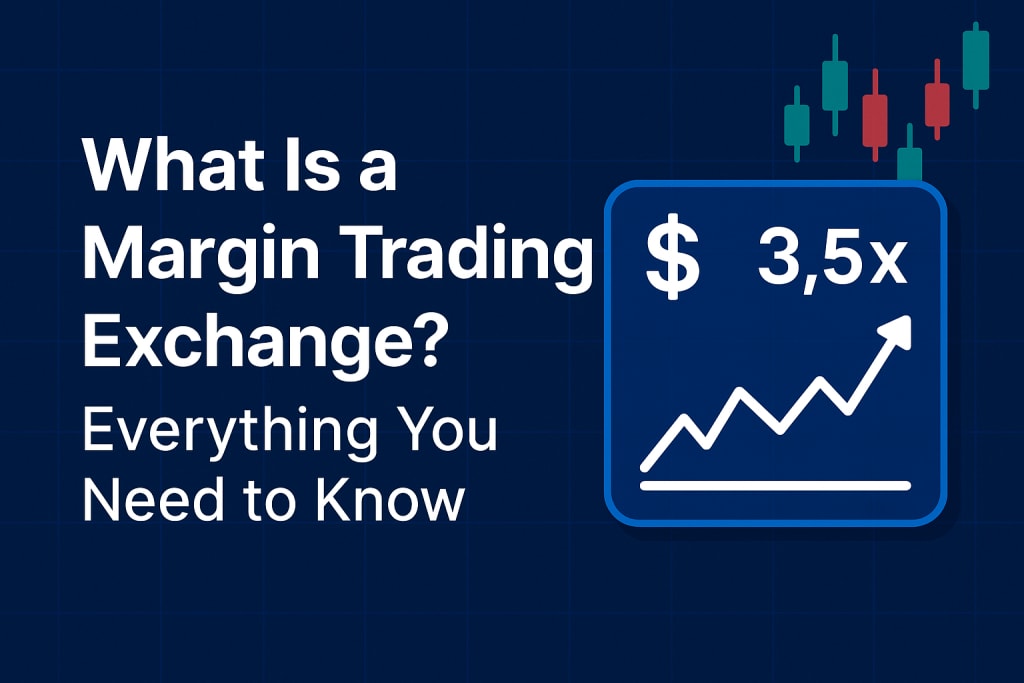
In the world of cryptocurrency and financial trading, the term margin trading is becoming increasingly popular. But what exactly is a margin trading exchange, and how does it work? Whether you're new to the trading scene or just exploring advanced strategies, this blog will give you a clear understanding of margin trading exchanges and what makes them different from standard trading platforms.
What Is Margin Trading?
Before diving into margin trading exchanges, let’s break down the concept of margin trading itself.
Margin trading is a method of trading assets using funds provided by a third party — typically the exchange. It allows traders to access more capital than they currently own, enabling them to open larger positions and potentially increase profits.
Here’s a simple example:
Suppose you have $100. On a 5x margin, you can trade with $500. If the market moves in your favor, your gains are based on the $500, not just your $100. However, the risk also increases, meaning losses are amplified in the same way.
What Is a Margin Trading Exchange?
A margin trading exchange is a platform that enables users to trade cryptocurrencies (or other financial assets) using borrowed funds. These exchanges offer various levels of leverage, typically ranging from 2x up to 100x, depending on the platform and the asset being traded.
Unlike regular spot exchanges — where you can only trade the amount of crypto you actually hold — margin exchanges let you borrow money to increase your trading power.
Key Features of Margin Trading Exchanges
Leverage Options
Traders can choose how much leverage they want to use. For example, 10x leverage means every $1 you put in gives you $10 to trade with.
Margin Account
To start margin trading, you’ll need to open a margin account separate from your regular trading account.
Collateral Requirement
You’ll have to deposit a certain amount as collateral. If your trade goes against you, the exchange might liquidate your position to cover the loss.
Risk Management Tools
Exchanges usually offer tools like stop-loss and take-profit orders to help manage risk.
Interest on Borrowed Funds
Borrowed funds come with an interest rate, which varies from platform to platform.
How Does It Work?
Here’s a simple step-by-step process of how margin trading works on an exchange:
- Deposit Funds: You deposit an initial amount (called margin) into your account.
- Choose Leverage: Decide how much leverage you want to apply.
- Open a Position: Based on market trends, you go long (expecting prices to rise) or short (expecting prices to fall).
- Monitor & Manage: Watch the market and manage your trades using risk management tools.
- Close or Liquidate: You can close the trade when you're satisfied, or the platform may liquidate it automatically if the market moves against you too much.
In the world of crypto exchange margin trading, this process happens fast — and often in highly volatile conditions. That’s why understanding the tools and terms is essential before diving in.
Pros of Margin Trading Exchanges
- Higher Profit Potential: Small price movements can result in significant gains due to leverage.
- Diversified Strategies: Traders can use long and short positions to profit in both rising and falling markets.
- Efficient Capital Use: You can trade larger volumes without tying up all your capital.
Risks Involved
- Amplified Losses: Just as gains are multiplied, so are losses.
- Liquidation Risk: If the market goes against your position, the exchange might close your trade to prevent further losses.
- Interest Costs: Borrowing funds means paying interest, which can eat into profits.
- Volatility Sensitivity: Crypto markets are highly volatile, increasing the risk factor in margin trading.
Popular Margin Trading Exchanges
Some of the top crypto margin trading exchanges include:
- Binance
- Bybit
- Kraken
- BitMEX
- KuCoin
Each platform has its own leverage limits, trading pairs, and fee structures, so it’s important to do your research before choosing one.
Final Thoughts
Margin trading exchanges offer an exciting opportunity for experienced traders to boost their profits, but they come with significant risks. If you’re just getting started, take time to learn the mechanics, use demo accounts if available, and never invest more than you can afford to lose.
Remember, trading on margin isn’t just about higher rewards — it’s also about smarter risk management.
About the Creator
Andrew Thomas
Hi, I'm Andrew Thomas, working at Debut Infotech, a leading blockchain development company. With a highly skilled team, we’ve built over 150+ platforms for startups and enterprises.
Keep reading
More stories from Andrew Thomas and writers in The Chain and other communities.
Why Decentralized Exchange Development is the Future of Cryptocurrency
The cryptocurrency world is evolving rapidly, and decentralized exchanges (DEXs) are emerging as game-changers in the market. Unlike centralized exchanges, which rely on intermediaries to manage transactions, decentralized exchanges operate on blockchain technology, enabling peer-to-peer trading without a central authority. But why is DEX development gaining so much traction? Let’s explore why decentralized exchange development is shaping the future of cryptocurrency.
By Andrew Thomas11 months ago in The Chain
Token Launch Strategies That Align With 2026 Market Expectations
The token launch landscape entering 2026 looks fundamentally different from the speculative cycles that defined earlier crypto eras. Market participants are no longer chasing short-term hype alone. Capital allocators, exchanges, regulators, and even retail users increasingly demand demonstrable product traction, governance clarity, compliance readiness, and sustainable economics. The collapse of several high-profile token launches during the 2022–2024 downturn exposed weaknesses in poorly structured tokenomics, inflated valuations, and superficial community building. In response, the market has matured.
By Jennifer Atkinson4 days ago in The Chain
Silence, Patterns, and Power: How Tom Bower Changed the Royal Conversation
For months, the royal conversation rippled with speculation. Claims multiplied, narratives twisted, and every whisper seemed to point back to the same names. But one man whose voice normally thundered across royal reporting said nothing—Tom Bower. Known for investigative aggression and fearless conclusions, Bower’s silence didn’t just feel unusual. It felt intentional. Observers noticed. Commentators asked where he’d gone. Why wasn’t he weighing in? And then came the realization: Tom Bower doesn’t react to noise. He studies the echo. While tabloids flung accusations and social media threads tied Meghan Markle to every flare-up inside the monarchy, Bower remained quiet. That wasn’t restraint—it was strategy. Bower had no interest in arguing rumor versus fact. His method relies on something far more revealing than gossip: institutional behavior. Silence as Data Where others saw unanswered questions, Bower saw an unfolding pattern. Inside Buckingham Palace, silence isn’t absence. It is a coded response. A pause. A calculation. A decision about what is worth engaging—and what is safer to ignore. Bower wasn’t analyzing the scandal itself; he was analyzing how the palace reacted to the scandal. Which stories were swatted away within hours? Which claims lingered unchallenged for months? Which headlines forced quiet restructuring behind closed doors? To Bower, these reactions told the real story—one about stress fractures and shifting roles inside the monarchy. The Meghan Variable What emerged from his study wasn’t accusation, but recurrence. Meghan Markle wasn’t presented as the source of crises—but as the constant in the room each time turbulence hit. Not triggering explosions, but always standing close enough for the shockwaves to force recalibration. This interpretation damaged no reputations legally—but it reshaped perception. Institutions don’t need villains. They react to pressure, not personalities. And by simply existing at the center of modern royal controversy—interviews, lawsuits, streaming projects, fractured family ties—Meghan represented unpredictability. In royal systems built on predictability, unpredictability reshapes behavior. The Palace Logic Palace advisers work from a simple, centuries-old rulebook: Threats to the Crown’s function are addressed Threats to the Crown’s image are absorbed You don’t fight every rumor—especially when fighting validates the rumor. Sometimes silence is not weakness but defense. To the public, silence feels mysterious. To the institution, silence is strategy. Harry’s Blind Spot Prince Harry’s story complicates this further. For him, silence meant abandonment. Lack of response confirmed neglect rather than restraint. Harry believed discussion was the solution, that acknowledgment could heal wounds. But the monarchy is not designed for emotional transparency. It is designed to outlast individuals, moods, and moments. And so, what looked like indifference to Harry was—according to Bower—calculated caution. When Bower Finally Spoke By the time Tom Bower broke silence, the ground had already shifted. Public trust in royal messaging had cracked. Media fatigue had set in. Sympathy moved from one side to another, then back again. Bower offered no new allegations. He offered explanation. He spoke about patterns—how silence itself becomes a reaction, how institutions prioritize stability over fairness, and how recurring storms force systems to distance rather than confront. His words reframed everything. Suddenly, the debate wasn’t: “Is this rumor true?” The question became: “Why does the palace treat this rumor differently?” That reframing turned speculation into a study of power. The Impact of Insight From the palace’s viewpoint, Bower’s words required no response—and they gave none. Engagement would elevate. Silence would deflate. For Meghan and Harry, the shift was subtle but significant. It challenged the narrative that ignoring them meant irrelevance or denial. Instead, it suggested strategic containment. The media world, weary of royal upheaval, reacted differently. Producers didn’t panic—they paused. Not because Bower exposed wrongdoing, but because he illuminated the operating system behind the monarchy’s reactions. And once a system is visible, it is harder to ignore. The Conversation Evolves Tom Bower didn’t break silence to drop bombs. He broke silence to show how bombs are diffused—even when no explosion is heard. His intervention changed nothing on paper: No policies, no statements, no public apologies. Yet it changed everything in perception. He taught audiences to stop listening only to what is said—and start studying what is left unsaid. And in the end, that insight may be more disruptive than any accusation. Because once silence stops looking accidental and starts looking deliberate, distance becomes clarity— and the story begins to write itself.
By Behind the Curtain6 days ago in The Chain



Comments
There are no comments for this story
Be the first to respond and start the conversation.